Showing posts with label Operation - - Annihilate. Show all posts

Thursday, June 5, 2014

Turnabout Intruder

JANICE: The year we were together at Starfleet is the only time in my life I was alive.
KIRK: I never stopped you from going on with your space work.
JANICE: Your world of starship captains doesn't admit women. It isn't fair.
KIRK: No, it isn't. And you punished and tortured me because of it.


How should that line from Janice Lester be read? Does the word your refer directly to Kirk or to Starfleet in general? If Lester is talking about Starfleet as a whole then it can only be taken literally. Women cannot become starship captains. Alternatively, if Lester is only talking about Kirk then maybe she blames Kirk for allowing their relationship to wither because he's so obsessed with being a starship captain that he can't allow anything else to matter, not even a relationship which clearly meant a huge amount to Lester.

Star Trek fans have spent a lot of time debating exactly what Janice Lester means. Ultimately everybody brings their own interpretation to the table. Personally I think Lester is speaking literally. Starfleet does not allow women to become starship captains. There's no evidence to contradict this in the previous 78 episodes (and consider the wider culture, it wasn't until 1998 that Lieutenant Commander Darlene Iskra became the first woman appointed to command a US Navy ship). It's possible to argue that Kirk is just humouring Lester. He knows she's wrong but he's mindful of her condition and doesn't want their first meeting in years, and potentially their last meeting if she really is dying, to end in another argument. However even if Kirk is just trying to be polite there are other hints that Starfleet's policy is to exclude women from the captain's chair. During the court martial Lester in Kirk's body has the line "....she would not be allowed to serve as the captain," implying that even if Starfleet agreed that the mind of Kirk was trapped in Lester's body they still wouldn't allow Kirk-as-Lester to resume command of the Enterprise. Muddying the waters further are Kirk's ,"no it isn't," response to Lester's claim that "it isn't fair," and his unfinished final line of the episode. "Her life could have been as rich as any woman's, if only. If only..." If only... what? If only she'd not been utterly insane, or if only she'd known her place?

It's interesting that 45 years after this episode was made it is still possible to debate exactly what Lester means. Could this ambiguity be deliberate? it would have been the easiest thing in the world to tidy up the language and clarify whether Starfleet has a problem with Lester or her gender. The script for Turnabout Intruder was finalised in December 1968. The fuss over the Kirk/Uhura kiss in Plato's Stepchildren would still have been fresh in everyone's memory. Is it possible that someone on the writing staff didn't want to rule out the idea of women commanding starships, but was also concerned that the contemporary audience would find the idea a step too far into crazy science fiction? Whatever the case the later series and films would be happy to clarify this point; in 1973 Star Trek: The Animated Series showed Uhura taking command in the episode The Lorelei Signal.

It is of course possible that the confusion caused by Lester's line is the result of bad writing. There are other examples on display elsewhere. It's never made clear what is wrong with Lester. Everyone just assumes that she's going to die of radiation poisoning before the subject is quietly dropped about halfway through the episode when everyone gets distracted by Kirk's behaviour. The portrayal of security on the Enterprise is also odd. At times the ship feels more like ISS Enterprise from Mirror, Mirror, with the Captain allowed to get away with any excessive behaviour as long as he keeps security onside. The biggest offender is the end of the episode when the story just stops. Suddenly the transfer is unstable and Kirk and Lester pop back into their proper bodies; the end. Janice Lester and doctor Arthur Coleman, who murdered their way through the staff of the Camus II expedition and were prepared to murder their way through the senior staff of a starship, are simply allowed to wander off after Coleman promises to look after Lester.

All that said there are a lot of points where the writing is really pleasing and subtle. Kirk in Lester's body quickly realises that trying to explain the truth just makes people think Lester is paranoid. There's a great moment when he plays off Nurse Chapel's emotions by asking her, "is a visit by that very kind Mister Spock to be allowed?" It's also good to see that it's Kirk's impulsiveness, and his preference for action, that gets him deeper into trouble. His escape from sickbay just gets him recaptured and confined in isolation, and is also what gets Spock into trouble when he disobeys Lester-as-Kirk's order that no one should talk to Kirk-as-Lester. The loyalty Spock feels for Kirk is made clear by his immediate acceptance of what has happened to Kirk, once it becomes impossible for there to be any other explanation. There is also a good demonstration of Spock's pragmatism when he points out that although he believes Kirk belief is not enough. They must have evidence. There's also a couple of nice lines which show Kirk and Lester have radically different ideas about why their relationship failed. Lester-as-Kirk tells McCoy, "I walked out on her when it became serious," while Kirk-as-Lester later tells the court martial, "her intense hatred of her own womanhood made life with her impossible."

William Shatner is all over the place. At times he works really hard to convince the audience that someone different is driving Kirk's body. When Lester-as-Kirk first calls the Enterprise Shatner puts in a tiny hesitation on his, "Captain Kirk to the Enterprise," line and then fractionally jerks his head in surprise when Scott replies. He stands differently and is visibly tense when he first walks on to the bridge for the first time before beginning to relax. He nervously brushes a hand across his hair on the, "I walked out on her when it became serious," line as if to imply that on an unconscious level Lester knows this isn't the exact truth. The problem is William Shatner can't resist going for the obvious laugh, and he enjoys himself just a bit too much; as was the case in A Piece Of The Action. The scene where Lester-as-Kirk talks to Doctor McCoy while filing his nails stands out as an obvious example. It probably got a big laugh on set but it undermines Lester because it's been established that she hates her own femininity so this prissy little action makes no sense.

Behind the camera Donald R. Rode does his usual fine work as film editor. He edits together a couple of very short flashback scenes to the mind swap which work as neat pieces of visual story telling. The editing during the mind meld scene is also effective. After Spock breaks the link the pacing is deliberately slow with two wordless close-ups of Kirk and Spock before the tension is broken with Spock's line, "I believe you." Donald R. Rode also works in some genuine humour when the mind transfer begins to fail. He cuts between a close-up of William Shatner gurning on the bridge and a four shot of Kirk-as-Lester, Spock, McCoy, and Scotty in their cell. This is followed by a shot of Lester-as-Kirk on the bridge, and the camera slowly pulls back to reveal Chekov and Sulu staring at Kirk as if he was the crazy person on the bus. A moment which manages to be funny and also underlines how Kirk-as-Lester has lost command of the crew. At the end of the episode there's also a lovely moment when the acting and editing combine to create a wordless demonstration of why Kirk is able to lead and Lester is reduced to bluster and shouting.

KIRK: Can you do anything for her?
COLEMAN: I'd like to take care of her.
MCCOY: Of course. Come with me.

Harry Landers makes brief eye contact with DeForest Kelley before delivering Coleman's line. This is followed by a reaction shot of William Shatner raising his head, as if Kirk is also looking at McCoy. Finally DeForest Kelley looks back at Harry Landers before delivering McCoy's line. The effect is of wordless communication between Kirk and McCoy. It's not necessary for Kirk to ask whether Coleman can care for Lester. Kirk knows a look is enough to convey his opinion because he instinctively understands how to build a consensus with his officers. Regardless of the story logic of allowing Coleman to take charge of his partner in murder it's a nice contrast to the earlier scene where Lester-as-Kirk fails to convince McCoy that Coleman should take responsibility for Kirk-as-Lester and is reduced to barking out an order.

It's easy to see why a lot of fans regret this being the last episode of Star Trek's run on NBC. At the most basic level this feels like an unsatisfactory goodbye because Uhura is missing. Nichelle Nichols had another engagement. In a script which otherwise features all of the regular cast, it's a shame she should couldn't be present. The suggestion that women cannot be starship captains also means that the series leaves on a sour note. It's a reminder for the modern audience that for all Star Trek's progressive ideals it was a sixties television series created by sixties men with sixties attitudes. For a series which did such good work challenging social attitudes it's disappointing to see it had such a blind spot when it came to its own treatment of women.

Turnabout Intruder is a disappointment compared to how seasons one and two ended. Season one ended with Operation - - Annihilate! a more confident episode than the first broadcast episode The Man Trap which shows clear growth and progress for the series. Season two ended with Assignment: Earth an ambitious, if flawed, attempted to launch a Star Trek spin-off series. Turnabout Intruder is virtually a bottle show. Seven minutes into the episode we're back on the Enterprise for the duration of the story. The story isn't even uniquely Star Trek. It's an attempt to fit a standard body swap story into the Star Trek format. The Prisoner episode Do Not Forsake Me Oh My Darling was broadcast on CBS on 3rd August 1968, and The Avengers episode Who's Who?? before that on ABC, 19th May 1967. Going back further to 11th November 1963 there is also an episode of The Outer Limits called The Human Factor. Still for all its faults it's good that Star Trek ends on a story which underlines the loyalty the Enterprise crew have for each other.

Enterprise crew deaths: None.
Running total: 56

Friday, March 8, 2013

The Immunity Syndrome

The Changeling, The Doomsday Machine, Obsession, and The Immunity Syndrome are four second season episodes which all share a similar plot. In each the Enterprise is both the first and last line of defence against a powerful single entity which will destroy billions if left unchecked.

In two of the stories the entity is a bizarre form of life. In the other two it is a machine. In two of the stories the entity is destroyed by anti-matter. Two of the stories begin with the discovery that entire solar systems have been wiped clean of life. In two of the stories the entity is a space vampire which can suck the life right out of you. Two of the stories use Herman Melville's Moby Dick as a character template. In two of the stories the entities are huge, rendering the Enterprise insignificant in comparison. In two of the stories the creature is about to reproduce. In two of the stories the menace has come from beyond the edge of the galaxy. In two of the stories the action takes place entirely on the Enterprise (and a third uses redressed Enterprise sets as a different location).

Any series will hit on themes and repeat them because they easily lend themselves to scripts. In the case of the four stories listed above it's a basic part of the Star Trek format that the Enterprise is out there on the front line by itself. A certain level of repetition is going to be an inevitable part of the set up of an episode. It's down to the skill of the writers and the production team to make sure individual episodes are distinctive, and don't just become an endless stream of clichés along the lines of David Gerrold's spoof storyline Green Priestesses Of The Cosmic Computer from his book The World Of Star Trek.
What matters is the difference between stories, not the similarities. How many times has the Enterprise run into a being with superior god-like powers? About ten, depending on how you define a being with superior god-like powers, but nobody would describe the Metrons in Arena as being the same as Charlie X. What is important about The Changeling, The Doomsday Machine, Obsession, and The Immunity Syndrome is how each episode differs from the others. So where The Changeling begins by sharing plot elements with The Doomsday Machine (after investigating a distress call Kirk must face off against an overwhelmingly powerful machine foe) the story surprisingly turns into a mechanical version of Charlie X where Kirk must act as a father figure to a massively powerful being and keep it happy until he can work out a way to neutralise the threat.

Purely in script terms The Immunity Syndrome is the weakest of these four episodes. What makes makes The Immunity Syndrome different is what its script lacks compared to the others. The Immunity Syndrome has no character like The Doomsday Machine's Commodore Decker. There is no attempt to develop a character by adding new back story, as with Kirk in Obsession. Unlike Nomad in The Changeling the space amoeba cannot talk. If the monster cannot be reasoned with, or bluffed, then the threat cannot be personified. It's a simple space monster waiting to be destroyed. The Immunity Syndrome is the story which comes closest to matching the basic plot outline given earlier; the Enterprise is both the first and last line of defence against a powerful single entity which will destroy billions if left unchecked.

However, sometimes less is more. The Immunity Syndrome is more narratively pared back than the other three stories and so there is actually less to go wrong. It's great that Nomad can talk, and come on board the Enterprise. Kirk can confront the menace rather than just staring at a view screen in awe. Unfortunately Kirk then goes on to defeat Nomad by confusing it with logic. Likewise with Obsession it's great that Kirk is given more back story and written as a man out for revenge, but midway through a weekly television series is not the best place to suddenly reformat your lead character as a watered down Captain Ahab in space. The Doomsday Machine remains practically perfect in every way.

So the script of The Immunity Syndrome is simple, and a little familiar, but fun. The Enterprise goes toe-to-toe with a giant space amoeba which can suck the life out of entire planetary systems , and is about to reproduce by binary fission. The remorselessness of mathematics means one amoeba will become two, and then four, and then eight, until the entire galaxy is as dead as the Gamma 7A system. A nice concept, and one which is well used.

Like The Changeling there is a mismatch between the being at the centre of the script, and the effect it has. The Changeling wanted the audience to be surprised at the power of Nomad being contained in such a small shell. In The Immunity Syndrome there is a mismatch between the simplicity of the amoeba and its ability to potentially wipe out all life in the galaxy. The script is able to carry this difference in size through to a nice metaphor comparing the amoeba invading our galaxy to a virus invading a body, with the Enterprise as the antibody.

Also, like The Doomsday Machine, small story telling tricks add to the believability although they are really there to make the script work. In The Doomsday Machine it is not practical for the planet killer to keep following the Enterprise. The script needs breaks in the action to move the story forwards and to give the characters a rest from being constantly chased. To get round this the planet killer is described as being programmed to ignore anything as small as a ship beyond a certain radius. This behaviour is there for solid plot reasons, but makes the planet killer seem more like a real object. It has a logic to its actions and its behaviour is predictable, like a real machine. In The Immunity Syndrome the amoeba is surrounded by a zone of darkness. The zone is really there for logistical reasons, to cut down the number of expensive and time consuming amoeba effects shots, but it also makes sense for an energy eating being to be surrounded by a zone of darkness. The thing even eats light! Although evidently it doesn't find light as nutritious as whatever energy it drains from lifeforms.

The zone of darkness also allows the slight plot to be stretched out, without making the episode seem padded. Acts one and two are about the mystery of the zone. What is it? What is the cause? Why do the laws of motion seem to be reversed? What is slowly killing the crew? The first two acts emphasise the exploration of the unknown, and the willingness of the Enterprise crew to put their lives on the line when required. Unfortunately it also makes for an episode which is less rewarding on repeat viewing. Once all the answers to the questions are known there's not much to concentrate on beyond some quality Spock/McCoy bickering, and Kirk having to decide which of his friends will be sent to their death in the shuttle.

Joseph Pevney directs and, rather like Ralph Senensky in Obsession, the Enterprise standing sets seem to mess up his ability to compose interesting shots. Generally speaking I've preferred Joseph Pevney and Ralph Senensky's direction to that of the other regular director Marc Daniels, but there's no doubt The Doomsday Machine is the better directed story when compared to Obsession or The Immunity Syndrome. The more generic approach Pevney uses here could be a result of the stricter time restrictions Senesky complained about when making Obsession; the insistence on completing shows in five and a half days. This isn't to say Pevney's direction here is completely flat. There's some nice naturalistic direction as Spock senses the destruction of the Intrepid (an odd name for a ship crewed by 400 Vulcans, does Vulcan not have its own starships?). McCoy and Kirk look as if they are about to start riffing on what it would be like to be on a ship full of Vulcans when Spock suddenly reacts with pain. McCoy is positioned to face Spock, but Kirk is looking forwards. As Spock groans Kirk's head snaps round, and he and McCoy stare at Spock as if unable to believe what they are seeing. For a fraction of a second the pair stand frozen, and then McCoy touches Kirk's arm and the two race across the bridge to Spock. Moments like this are few and far between. Film editor Donald R. Rode, who did excellent work on The Doomsday Machine, can't make much of the footage. It's a shame this was the last episode Pevney directed.

It's not possible to talk about The Immunity Syndrome without talking about the effects work on the space amoeba. It's brilliant. A high point for effects work on the series. No wonder Van Der Veer Photo effects shared an Emmy nomination for Star Trek special effects in 1969; although the series did not win. Interestingly outside of the space amoeba much of the effects work is cut to the bare minimum. This is possibly the only episode in which no one transports anywhere, and no phasers are fired. The limited resources of the show are virtually all concentrated on the amoeba. Of course the remastered versions have been able to expand the scope of the effects shots considerably, but it's very pleasing to note they largely settle for recreating what was seen in 1968.
Original
Remastered version
Original
Remastered version
The Immunity Syndrome also adds to the idea that outside of our galaxy is some sort of nightmare howling waste populated by hideous creatures and killer robots which are constantly seeking a point of entry. So far Star Trek has shown us the space parasites from Operation - - Annihilate!, the planet killer from The Doomsday Machine, and now a giant single celled life form capable of draining the life force from entire solar systems. No wonder Q thought mankind wasn't prepared for the unknown in the Star Trek: The Next Generation episode Q Who. Based on what Kirk has encountered so far Q was right.

Enterprise crew deaths: None again.
Running total: 43

Misc:

Robert Justman is messing around with the closing titles again. This week he uses a test shot of William Blackburn as one of Sargon's androids from Return To Tomorrow. In the photo Billy Blackburn is rolling his eyes up into his head which accounts for the android's slightly grotesque appearance. Also in the closing titles is a shot of a smiling Spock, also from Return To Tomorrow which I don't think was used in the episode.


Sunday, January 20, 2013

Obsession

Obsession and The Doomsday Machine both tell the story of a man consumed by the need for revenge at all costs. Both are apparently based on Moby-Dick (or so the internet tells me, it's a book I haven't read) but both are very different. In Obsession the focus is on Captain Kirk and his determination to destroy the cloud vampire which 11 years ago attacked the USS Farragut killing 200 of Kirk's then shipmates including Captain Garrovick who Kirk describes as, “one of the finest men I ever knew”. In The Doomsday Machine the focus of the script is on Kirk and the Enterprise crew trying to deal with Commodore Decker and his determination to destroy the planet killer which, etc, etc.

Shifting the focus of a story from one character to another completely changes the way it plays out. Swap them over and
Obsession is about the Enterprise meeting Commodore Decker whose entire crew has been wiped out by the cloud vampire and The Doomsday Machine is about Kirk's horror as he encounters the planet killer which 11 years before destroyed the USS Farragut. It works on other stories as well. Imagine a version of The Alternative Factor in which the focus of the story is on Kirk so that it is he, rather than Lazarus, who has an insane alternate universe duplicate. Or a version of The Deadly Years where Kirk is immune to the ageing effects and must watch as his friends get older and older.

Playing around like this is fun but it shows how narrow the line can be between a great story and an average one. Some stories might be improved by shifting the focus to Kirk (the version of The Alternative Factor with Kirk A and an insane alternate universe Kirk B at least sounds like it has potential) but personalising a story for the lead character doesn't guarantee success. Operation - - Annihilate! isn't any better for including the death of Kirk's brother, that's a story point which gets lost in the episode, and a version of The Doomsday Machine with Kirk out for revenge on the planet killer immediately suffers from the loss of Commodore Decker; both as the scripted character and William Windom's performance. 

There's another example bubbling away in the background of Obsession. The Enterprise needs to collect urgently needed perishable vaccines from the USS Yorktown and take them to the colony on Theta VII. This is a just a reprise of the plot from The Galileo Seven, where the Enterprise must make a rendezvous to get vaccines to the New Paris colonies where a plague is out of control. Both sub-plots are there to put an arbitrary time limit on the main story, and explain why Kirk cannot simply hang around until the cloud vampire is killed/the missing shuttle is found. Obsession is the more successful version because it distributes this plot strand among the Enterprise crew, rather than giving it to a stroppy Federation official, High Commissioner Ferris. The deadline feels more real and urgent when the reminders are coming from Spock, McCoy, Scotty, and Uhura rather than the Federation Bureaucrat Of The Week. Even though Kirk's deadline is equally artificial in both episodes the one in Obsession is more effective.

Elsewhere in the script, making Kirk the Captain Ahab of Obsession weakens the story. Effectively Obsession asks the audience to answer the question, “will Kirk sacrifice everything for vengeance?” Of course he won't. At the most basic level the audience knows there is another episode of Star Trek next week. By contrast The Doomsday Machine is asking the question, “will Commodore Decker sacrifice everything for vengeance?” and the answer is yes, because he's a guest character and he's not shackled by the need for everything to be back to normal next week. The Doomsday Machine gets a lot of excitement out of sequences where the planet killer threatens the Enterprise but those scenes are not asking, “will the Enterprise be destroyed” (audience: “no”) but “how will Spock and McCoy deal with Commodore Decker.” A good script avoids asking the audience questions with an obvious answer. So while The Alternative Factor asks “will the universe be destroyed?” (Magic 8-Ball: “Very doubtful” ) Charlie X doesn't ask “will Charlie destroy the Enterprise?” it asks “how will Captain Kirk deal with Charlie?” (Of course a great story will ask a question as a red herring, so The Devil In The Dark starts out by asking the audience, “can Captain Kirk defeat the horrible space monster?” and then completely subverts our expectations.)

So, although Obsession sells itself as being about Captain Kirk's desire for revenge no matter the cost, the audience goes into the story knowing that Kirk will not sacrifice his career or life. This can't help but lessen the dramatic tension. The script hits this problem during a scene when the Enterprise is chasing the cloud vampire at warp eight.

SCOTT: Captain, we can't do it. If we keep this speed, we'll blow up any minute now.
[Scott looks frantic, everyone else is worried. Kirk looks as if he might burst into tears of frustration.]
KIRK; Go to warp six.

Kirk decides to slow the Enterprise even though that will let the cloud vampire escape (he doesn't know it's going to turn and attack). He decides not to be Captain Ahab, and puts the safety of the ship before anything else. In the process Kirk demonstrates why he's a better commander than Matt Decker, and why Kirk, unlike Decker, never loses his ship. It's a lovely character moment but this story is about Kirk's obsessive need to kill the cloud vampire. A scene where the captain puts safety first doesn't fit. And Kirk is soon back to being determined to kill the cloud vampire once it turns and engages the Enterprise, before fleeing again. 

Enjoyable as Obsession is this sort of confusion over details is a problem. Kirk's plan to kill the cloud vampire involves detonating an ounce of anti-matter but the episode is unclear about the power of this explosion. Spock states, “a matter-antimatter blast will rip away half the planet's atmosphere,” but once on the surface Kirk delays detonating the anti-matter until the creature is right on top of the blast, as if the explosion is suddenly much more localised. When the vampire is feasting on the haemoplasm bought as bait it is all of 40 feet away but Kirk and Garrovick react as if the plan is wrecked unless they find new bait to lure the vampire right on to the anti-matter. The anti-matter is primed and ready to blow. Why can't they just detonate and get the hell out of Dodge? Likewise when beaming Kirk and Garrovick back to the ship the episode does its best to get tension of out that old Star Trek standby a last second beam out. However what we see on screen is Kirk and Garrovick start to appear on the pad before fading, and the transporter hum sound effect also fading out. Spock raises an eyebrow and tells Scotty, “reset, energise.” Where have Kirk and Garrovick gone? The editing, and sound effects, and character reactions suggest the transporter failed to grab the pair who are still on the planet until the second attempt, after the shockwave has rocked the Enterprise, when the transporter locks on and brings them back. Somehow the episode seems to be treating the anti-matter explosion as simultaneously planet devastating, and amazingly short lived and localised.

On the positive side Nurse Chapel gets a very good scene where she brings food to Garrovick's cabin and bluffs him over Doctor McCoy's order to eat. These scenes of her being competent and professional establish her character far more effectively than ones where she has nothing to do but moon over Spock. Also, at the end of the episode is a special effects shot which must have been technically complicated at the time but unfortunately now looks unremarkable. As the cloud vampire moves to feed on Kirk and Garrovick the pair beam out, and the anti-matter detonates. In a single shot the camera must pan to allow the cloud vampire to appear to move, and then stop for the transporter effect. On top of this there are three layers, for want of a better word, of animation; the transporter effect; the cloud vampire; and the explosion. 

Ralph Senesky directed Obsession, and his work seems less inspired compared to his earlier stories This Side Of Paradise and Metamorphosis. The Enterprise work is not terrible, in Garrovick's debriefing he sits in front of a solid green background which makes for a good contrast with his red shirt, but possibly the corridors and rooms of the Enterprise offered less opportunity for shot composition than the location filming and extensive planet set of his other stories.

On his website Ralph says,

“
I can definitely say there was a drop in quality from THIS SIDE OF PARADISE and METAMORPHOSIS to the other episodes I directed the second season. And I ascribe the reason for this drop to the impossible expectation that episodes of STAR TREK could be filmed in five and a half days and maintain the standard of production excellence that had been established. “ 


The planet work is excellent. There's a striking overhead shot of the three dead security guards in the teaser, and after Garrovick's squad are attacked there is a hand-held camera shot to suggest a first person view as Kirk and Garrovick approach the bodies. On the cloud vampire's home world Senesky repeats a trick from Metamorphosis and has clouds, little puffs of smoke, added to the sky which brings the set to life, and also makes it look like the cloud vampire could be anywhere.

Actually Senesky repeats two tricks from
Metamorphosis. The cloud vampire is realised as an animated overlay placed on top of the picture which allows the creature to stay stationary in the frame and move with the camera. This is how the Companion was realised in Metamorphosis and Senesky's familiarity with the technique may be one of the reasons he was asked to direct this story. 


Enterprise crew deaths: 5. Two of the initial survey team are killed outright while Ensign Rizzo survives for a while before dying. Then two of Garrovick's team are attacked and one dies outright while the other is reported as being in a critical condition. When the creature gets into the air conditioning vents on the Enterprise it attacks another two crewmen, again killing one and leaving the other barely alive.The fate of the injured crew is never revealed so let's assume they made a full recovery.
Running total: 42

Thursday, December 20, 2012

Journey To Babel

Star Trek tends to avoid family attachments, which makes Spock unique because we get to meet his parents. Apart from Sarek and Amanda the only direct family seen on screen is Kirk's brother who was already dead when he appeared in Operation - - Annihilate! It's a reflection of how television storytelling changed that by the time Star Trek: The Next Generation was broadcast it was more unusual for family not to appear. Picard's brother turned up, as did Riker's Dad, Worf's brother, Troi's mother, Data's father and brother (not bad for an android), La Forge's father, and Beverly Crusher and Wesley were of course mother and son. Tasha Yar and Doctor Pulaski are the only regular characters whose relatives don't pop in for a visit.

The downside of having family come to stay is that it's a plotline which is often used very badly to add a little emotional jeopardy to a story. The death of Kirk's brother in Operation - - Annihilate! should be the lynch pin of the script but it barely seems to register and Kirk displays more concern about Spock's blindness. Likewise the appearance of Riker's father in The Icarus Factor is the cue for a painfully generic story about grumpy Mr Riker and his son's daddy issues caused by never hearing the old man say he loved him. In the end the pair fight, and bond, and the emotional scars are healed just in time for the end of the episode when old Mr Riker leaves and is never heard from again. Of course the alternative doesn't always work either. Babylon 5's commander John Sheridan had a healthy relationship with his father but this just resulted in scenes of Sheridan going on about the wonderfulness of his dad.

D. C. Fontana's script for Journey To Babel gives Spock and Sarek a familiar father/son television relationship; Sarek disapproves of Spock's life choices and Spock wants to please his dad. The unique strength of the story is it focuses on the two characters who can never hug and admit their true feelings for each other. For an idea of how painfully this plot could have been handled just give Spock and Sarek some of the more turgid dialogue from The Icarus Factor. 

SAREK: I should have explained this to you a long time ago, but it hurt too much. Then the wall grew up between us. ... You know, it's funny. I can talk to a whole roomful of admirals about anything in the galaxy, but I can't talk to you about how I feel.
SPOCK: How do you feel?
SAREK: How do you think? I love you, son. I've got to get back to the Starbase.
SPOCK: I know. I'm glad you came.
[They embrace]
SAREK: Be careful now, okay?

Instead the pair's relationship is played out by proxy, through the reactions of the characters who can admit to feeling emotion. So we see Kirk's embarrassment at Sarek's dismissive treatment of his son, and Amanda's fury as Spock tries to hide behind logic to justify risking his father's life by delaying taking part in a medical procedure. However, just because Spock will not admit to feeling emotion doesn't mean he has no emotional needs. One of the pleasing aspects of the story is the way Spock seems to be making decisions based on what he imagines will gain Sarek's approval rather than choosing his own path; the cause of the original split between the pair. In the agreement scene with Amanda, Spock has a line which starts, “can you imagine what my father would say...” Even at a crisis point he's trying to second guess his father's reaction. Some interesting light is shone on Spock's character because while he is attempting to be more Vulcan than other Vulcans he makes a couple of silly mistakes.

Most obvious is the one Spock admits to, not recognising the Orion ship and realising it is on a suicide mission. As Kirk says to Spock, “you might have had something else on your mind.” Secondly, Spock obviously believes not informing Kirk that Ambassador Sarek is his father will demonstrate he is above such petty family ties and emotional concerns. Actually by not passing all relevant information on to his commanding officer Spock leaves Kirk looking badly prepared in front of the ambassador from Vulcan. The jury is out on whether Spock makes a third mistake in refusing to take part in McCoy's operation once Kirk is injured. “We're carrying over one hundred valuable Federation passengers. We're being pursued by an alien ship. We're subject to possible attack. There has been murder and attempted murder on board. I cannot dismiss my duties,” is Spock's summary of the situation. He's right but he fails to add that Sarek will definitely die if the operation does not begin soon. Sarek is arguably the most important of all the Federation passengers; as Gav says, “in council, his vote carries others.” Sarek's death could derail or seriously delay admission of the Coridan planets. Essentially Spock is balancing a known risk against an unknown risk. The Enterprise might not be attacked by the mystery ship. There might not be another murder among the passengers. Sarek will die.

Journey To Babel is a character piece and the relationships and interplay of the characters are skilfully handled as you would expect from the writer of This Side Of Paradise. Unfortunately the plot itself is less assured. It is fussy and overcomplicated, like the Orion plan to destabilise the negotiations by killing an ambassador and making Sarek look like a suspect and also by killing Captain Kirk, and also by destroying the Enterprise.

Journey To Babel seems to be trying to pull off the same trick as The City On The Edge Of Forever a story that packs a lot of material into its four acts. The key difference is that The City On The Edge Of Forever moves forwards in a clear, linear fashion from medical accident to alien artefact to time travel to love story and wherever the story goes it is always being driven by the search for Doctor McCoy. By contrast Journey To Babel begins by focusing on diplomatic tensions among the ambassadors, then becomes a murder mystery when Sarek becomes an obvious suspect in the death of Gav the Tellarite ambassador. Spock's 'hey my Dad could totally have murdered this dude' moment is yet another attempt to impress Sarek with his logic and dispassionate assessment, Spock must have been secretly delighted when Sarek says, “I quite agree.” However, Gav's body is barely cold before Sarek collapses and the story becomes a medical drama, and finally an Enterprise in peril story as the mystery ship which has been shadowing the Enterprise moves in to attack. By the end of the story the ambassadors have been more or less forgotten and Gav's murder is never solved; the audience is left to assume he was killed by Thelev the Orion agent but no one ever accuses him and he never confesses. What's missing is something to gell these different plots together, as the hunt for McCoy does in The City On The Edge Of Forever, the obvious candidate is the poor relationship between Spock and his father but that storyline parallels the action on board the Enterprise rather than affecting it directly.

Joseph Pevney directs and while he can't add much visual excitement to the grey corridors of the Enterprise he does create some striking images. Most obviously there's the reception with the assorted alien ambassadors rendered in a variety of different colours and styles. The scene begins with a single take following a pair of gold-painted dwarves, each wearing robes and what appears to be a knitted fez. As Kirk's captain's log fills us in on the situation the two ambassadors push their way between another pair of delegates having an animated conversation and then pass along a buffet laid with brightly coloured space food and drink, before the moving camera comes to rest on Kirk's group. Expensive prosthetics are restricted to the major alien delegates, the blue Andorians, pig-like Tellarites, and the Vulcans, and fun can be had taking a look at the extras at the back of the scene. Two men lurk behind Sarek, one with what looks a like a grey, granny bun style wig, on his head and the other bearded with his dark hair done in Pippi Longstocking braids. The scene looks like pure distilled Star Trek, and yet this is the first time we've seen a group of different aliens together like this.

The dead Tellarite hanging upside down in the Jefferies tube is another striking image; and even 45 years later congratulations are due to whichever extra, or stuntman, endured the discomfort to allow the shot to be captured. It's also a striking piece of editing by James D. Ballas, we cut straight from Gav storming out of the reception, to a stock shot of the Enterprise, to Gav hanging dead in front of the camera. Less effective is the later editing of the attack on Kirk. Cutting straight into the middle of the fight between Kirk and the Orion agent may save precious screen time but it jars very badly. and is one of the few times when Star Trek's editing becomes momentarily disorientating and draws the viewer out of the episode.

Deforest Kelly gets a good joke at the start of the episode when he asks Spock, “how does that Vulcan salute go?” After an unsuccessful attempt to duplicate Spock's hand position (“that hurts worse than the uniform”) he nods when introduced to Sarek, and then raises his hand slightly before glancing down and lowering it again.

The episode ends with Spock and Sarek's relationship apparently patched up. The earlier more frosty state of affairs presumably answers a question from
Amok Time, one that goes unnoticed among all the Vulcan weirdness on display in that episode. Why didn't Spock's parents attend his wedding

Enterprise crew deaths: None, despite the damage done by the attacking ship.
Running total: 35

Wednesday, November 7, 2012

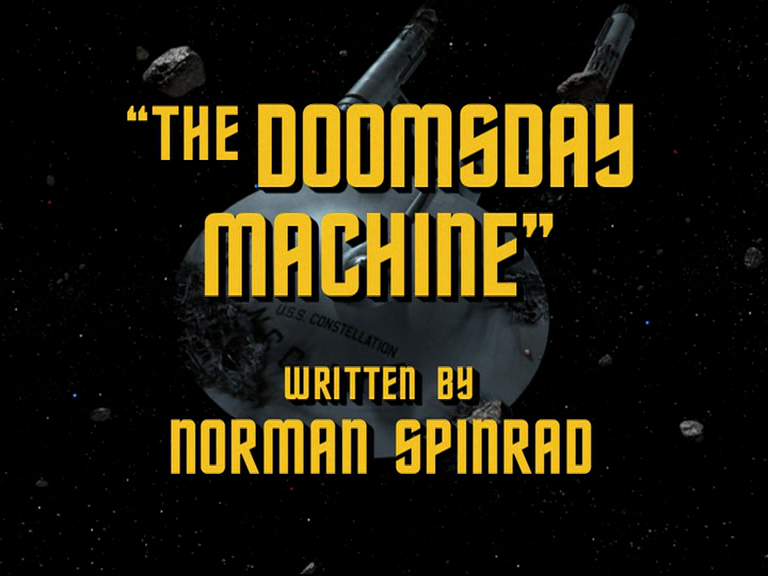
The Doomsday Machine

William Windom is brilliant as Commodore Matt Decker. It's probably the best performance by a guest star on a series not always notable for allowing guest stars to shine. Unless an actor is extremely good, or very lucky, they stand little chance of making an impression against Star Trek's regular cast and attendant science-fiction gubbins (winking lights, strange makeup, weird noises, bizarre creatures, etc). Pity poor Alfred Ryder credited as the guest star of The Man Trap when all the audience remembers is the salt vampire, or Robert Brown dropped at the last minute into a thankless role (technically two thankless roles) in The Alternative Factor and unable to make an impression against the special effects of that episode. There are actors who make Star Trek work for them. William Campbell, as Trelane in The Squire Of Gothos, and Ricardo Montalban, as Khan in Space Seed both take big central characters and make them their own. More impressively Mark Lenard, as the Romulan Commander with no name in Balance Of Terror, and Celia Lovsky as T'Pau in Amok Time both make very good impressions in considerably smaller roles than those given to Ricardo Montalban or William Campbell. Generally speaking though Star Trek tends to be a series which treats the guest star role as disposable. A slot which can be filled by simply giving the star something different to do (evil Kirk in The Enemy Within), or by a prop (Nomad in The Changeling), or a costume (the Gorn, Arena), or by not bothering with a guest star at all (Operation – Annihilate!).

William Windom is so good it comes as something of a disappointment to discover he thought the role, “seemed kind of silly, with the planet eater and spaceships. It's like doing a cartoon, so I acted accordingly!” As a fan, his blunt comment disappoints for two reasons. First because as a non-actor it's easy to assume an actor has to like the material to turn in a good performance (an assumption most actors would probably consider an insult to their professionalism). Secondly because The Doomsday Machine is great. It would be nice to think some of that greatness rubbed off on Windom and made him remember this job as different from the more run of the mill material. Still, it's a reasonable assessment from an actor with an amazingly long career, who seemed to regard television as the disposable portion of his work. The Doomsday Machine was one of ten jobs Windom had in 1967 (the others being parts in Run for Your Life, The Fugitive, Bob Hope Presents the Chrysler Theatre, Hour of the Gun, The Invaders, Custer, Gentle Ben, Dundee and the Culhane, and Judd for the Defense). Imagine how the job must have appeared from his perspective. Five days schlepping across Los Angeles to a soundstage at Desilu (a company past its prime), surrounded by the aforementioned blinking lights and actors in strange makeup, and being told to look scared at something the production team will add later.

There's a surprising similarity between Commodore Decker and Finney from Court Martial. Most obviously in both cases the production team dress the character in a gold coloured top, and give them stubble; apparently the ultimate sign in the 1960s of someone losing their mind. Both actors use the same performance style for their character; letting their voice crack, bulging their eyes, and making quick transitions between emotional states. The key difference is Windom's performance works while Richard Webb's seems melodramatic and over the top. Party this is down to the way each character is introduced to the audience. Court Martial spends a great deal of its running time telling us how everyone loves Finney; he's popular in Starfleet (certainly much more popular than Kirk judging by the welcome he gets at Starbase 11), and generally together enough to assemble (and fake evidence for) an elaborate revenge plot against Captain Kirk. When Finney is finally revealed as a ranting, barely in control madman there's a mismatch between what the audience has been told, and what they are shown, and Webb's performance seems wrong. By contrast The Doomsday Machine sets up two destroyed planetary systems, and a wrecked starship. After Matt Decker is introduced in a virtually catatonic state Windom's performance seems appropriate because his character has obviously gone through hell. Also, Windom is a better actor than Webb. That's not to run down Webb's performance too much because he's fine in Court Martial, but Windom is just astonishing.

KIRK: Matt, where's your crew?
DECKER: On the third planet.
KIRK: There is no third planet.
DECKER: Don't you think I know that? There was, but not anymore. They called me. They begged me for help, four hundred of them. I couldn't. I couldn't.

Windom brings those lines to life. His red-eyed, crumpled face delivery of “don't you think I know that,” is pure melodrama but it works perfectly and sets a doom-laden tone for the rest of the episode. It's no surprise to learn he used to self-deprecatingly refer to himself as Willie the Weeper.

It's the addition of Matt Decker to The Doomsday Machine which makes Norman Spinrad's script sing. His character defines the threat to the Enterprise, acting as a warning from the future of what Kirk could become if his luck ever runs out. Decker also doubles the threat to the Enterprise crew. There's the external threat from the planet killer, and the internal one from Decker who is obsessed with taking revenge against the machine which killed his crew. Decker's presence also makes Kirk more heroic. It's not accidental that Decker as a Commodore outranks both Spock and Kirk. If Decker was a mere Captain he would still be able to take charge of the Enterprise but there would be no drama in the scene where Kirk orders Spock to relieve Decker. It would simply be one Captain taking action against another, the scene only works because Kirk has to undercut the chain of command. The script also shows why Spock is a natural second in command. He knows Decker is wrong but he plays things by the book and follows regulations. He lacks Kirk's ability to make an intuitive leap and find another solution. Essentially Spock's plan is to keep confronting Decker with the facts until he listens to reason. “You tried to destroy it once before, Commodore. The result was a wrecked ship and a dead crew.” Spock doesn't understand emotion enough to realise that saying astonishingly brutal things like that don't help; especially not to someone still grieving over the deaths of 430 crew. The scenes where Decker assumes command of the Enterprise show what an asset Leonard Nimoy is to Star Trek. When Deforest Kelly yells, “do something,” Nimoy's stone-faced stare manages to project the impression that Spock's mind is going at a million miles an hour trying to find a way to relieve Decker of command; really Nimoy was probably wondering what to have for lunch.

The presence of Commodore Decker is also what separates the threat in The Doomsday Machine from the similar one posed by Nomad three episodes ago in The Changeling. Both are apparently unstoppable machines capable of wiping out planetary systems, and both pose a massive threat to the Enterprise. Apart from the difference in size, it's only Nomad's ability to talk which separates the two. The dividing line between good and average stories is very fine and it's easy to imagine transplanting elements from The Changeling into The Doomsday Machine. Nomad could easily have sterilized the Constellation crew, leaving Decker out for revenge and shocked by the threat posed by something so small. Or, Kirk could have beamed inside the planet killer and talked the controlling computer to death with illogic. Kirk is also dealing with a considerable ramping up of threat. Over the last year and a bit he's gone from dealing with a single salt vampire on the Enterprise, to planetary outbreaks of insanity, to machines capable of destroying entire planetary systems.

Marc Daniels, a solid workmanlike director, injects some flourishes into the bridge scenes. Most notably in a lovely tracking shot which starts on Sulu, follows a yellow shirted ensign round to Kirk who then walks in front of the bridge screen and around to Spock. Daniels must have been, understandably, proud of this shot as he repeats it with Kirk and Spock at the end of the episode. Film editor Donald R. Rode also does good work intercutting Kirk and McCoy searching the Constellation with Scotty and the damage control team examining engineering. He also manages to extend the final 30 second countdown to 90 seconds. Something which he makes tense, rather than silly, by cutting frantically between the Enterprise bridge, Scotty attempting to fix the transporter, the transporter room, exterior shots, and Kirk on the Constellation, “Gentlemen, I suggest you beam me aboard.”

Helping Donald R. Rode's cutting in the 30 second countdown is Sol Kaplan's astonishing score. As the planet killer closes on the Constellation, Kaplan gives us a pulsing rhythm which speeds up and increases the tension as the Constellation and the planet killer close on each other, and ends on cornets blaring as the planet killer is destroyed. Kaplan's music is what makes The Doomsday Machine such an outstanding Star Trek episode. It perfectly underscores big moments like Decker flying the shuttle into the planet killer's maw and small ones like the first sighting of the crippled Constellation. Just as important, Kaplan understands the value of silence. When the Enterprise is caught in the planet killer's tractor beam, and Spock threatens to relieve Decker on the grounds that his actions would amount to suicide, the whole scene plays out with no music, and instead the score is brought back on Sulu's line, “we're being pulled inside” to make the ending of act two more dramatic.

Kaplan also composes a theme for people using the transporter which leads to a great musical double-bluff as Kirk sets the timer running on Scotty's lashed up self-destruct system for the Constellation. In the build up to Kirk pressing the red button the music is playing the pulsing planet killer pursuit theme. As he presses the button a trumpet plays a little flurry which extends out into a single held note. The same note as the one which starts the already established transporter theme. As the film cuts to a shot of the transporter the music sounds as if it is making a transition between the theme for the planet killer and the one for the transporter and it tricks the audience into expecting to see Kirk beamed safely aboard. Instead the transporter gives out a puff of smoke, and the held note breaks up into a musical sting. Amusingly, Kaplan is the name of one of the unfortunate guards killed in The Apple (the 9th episode filmed, after The Doomsday Machine but shown the week before), he's the one zapped by lightning, maybe someone on the writing team was having a joke.

Enterprise crew deaths: None.
Running total: 34

Sunday, September 9, 2012

Operation - - Annihilate!

Writer Steven W. Carabatsos is something of a mystery man. He is credited as Star Trek's story editor from The Conscience Of The King to A Taste Of Armageddon, and yet unlike the story editor who followed him, D. C. Fontana, he never seems to have given any substantial interviews* and searching the internet reveals very little information. The third Star Trek story editor Arthur H. Singer is equally elusive so perhaps this just reflects the relative anonymity of a job which focuses on scripts, compared to D. C. Fontana's more significant role across Star Trek, and seems to share blurred boundaries with John D. F. Black and Robert Justman's more senior position of associate producer. Still, considering how the production side of Star Trek has been mined for anecdotes, his absence from the series history seems odd.

With Operation - - Annihilate! the first season finishes as it started, with a monster show, and provides an opportunity to compare and contrast. Star Trek is now a visibly more confident programme. At the most basic level the scale of the stories has increased. The Man Trap, the first story broadcast, was about a single monster loose on the Enterprise. Operation - - Annihilate! is about a planetary invasion. And the show is more confident about the audience's ability to fill in gaps for themselves. Operation - - Annihilate! has a handful of extras standing in for a planetary population, and location filming and a few sets representing a capital city. This might not sound like a big deal but look at the first few stories made, they either take place on the Enterprise or on planets where we see the entire population; an automated lithium cracking station, a lithium mining planet with three miners, an archaeological dig of two people, and so on. The first planet with a potentially substantial off-screen population is Dagger Of The Mind, the tenth episode filmed, where presumably there are guards and inmates in addition to the ones we see. The next episode after that is Miri where backlot location footage is justified with a line about Miri's world looking exactly like Earth, Spock even dates the city to the 1960s, and although there must be other cities and more children none are ever mentioned. Planet Q, from The Conscience Of The King, is the first world Star Trek shows us which definitely has an off-screen population, the view from the Leighton's window shows a city in the distance.

On other levels the series hasn't moved forwards at all. We're never given any explanation for what the space parasites want, in the same way we're never told why the salt vampire is unable to resist munching four Enterprise crew in the space of a few hours. Five episodes after The Devil In The Dark and we're back to monsters being bad because they are monsters. It's frustrating because the space parasites are not just spreading randomly from world to world, they are travelling in one direction, which implies a destination. And if not then it's sure nice of the things to move through three dimensional space in a straight line, an idea Futurama, joked about in The Day The Earth Stood Stupid.

HERMES: This is mighty strange. First, the civilisation Space Rome collapsed, then Don Martin 3 went caflooie and now Tweenis 12.
FRY: Looks like this planet is next in line.
LEELA: That's Earth. The planet we live on.
FRY: I'd hate to be those guys.

Something else which hasn't changed is the need to give the Enterprise crew personal involvement. In The Man Trap the salt vampire impersonated McCoy's ex Nancy Crater. Here, Kirk's brother Sam is already dead, a victim of the space parasites, Sam's wife Aurelan lasts a little longer, and Kirk's nephew Peter survives but is only ever seen unconscious; probably to comply with NBC's Standards and Practices Department, a child in excruciating pain is exactly the sort of thing they would flag as having the potential to distress viewers (Peter did appear in a deleted scene but only a photo of that exists now). There's nothing wrong with giving Kirk a personal stake in events but in Operation - - Annihilate! it seems unnecessary. Kirk already has to deal with potentially wiping out a planet of one million people to stop the space parasites spreading further. Kirk also has to deal with Spock being infected. Adding the fate of Kirk's brother and his family to the mix feels like overkill. Kirk's minimal reaction to Sam's death is one of the things which pushes the feel of the script into monster movie territory. It certainly doesn't have much effect on events beyond confusing the timeline of the story. The Enterprise landing party are brought to Sam's laboratory by Aurelan's screams. When they burst in she is trying to block the airvent. “They're here! They're here! Please keep them away!” she sobs, but Sam is already dead and both Aurelan and Peter are infected. What is she trying to keep out?

That small moment aside, Steven Carabatsos' script is pretty enjoyable. It's not too deep but it does the job. The only real disappointment is the solution to Spock's blindness. Obviously he's not going to be blind forever but playing the he's-an-alien-with-alien-biology card seems arbitrary at best. It reminds me of A Taste Of Amageddon where the solution to being locked in a room is to have Spock suddenly develop the ability to project telepathic impressions through a door.

At the start of the episode Nichelle Nichols has a nice moment when Kirk snaps at her.

UHURA: Contact broken, sir.
KIRK: Re-establish.
UHURA: Sorry, sir.
KIRK: I'm not interested in your excuses, Lieutenant. Re-establish contact with that transmitter.
UHURA: I'm afraid that's impossible at the moment, Captain. They stopped broadcasting immediately. They do not acknowledge my contact signal.

After Kirk orders her to re-establish contact she leaves a small pause before delivering her final line in a deliberately level tone. It suggests she's controlling her temper. She knows Kirk is being unreasonable but she also understands why. William Shatner plays Kirk as realising he's gone too far, without actually apologising directly. And the whole moment gains a little bit of extra life from the unspoken communication between the two.

Like the writing, Herschel Daugherty's direction is functional. He's at his best in the location scenes. Especially the sequence right after the landing party beam down where whoever dubbed the music (probably Robert Justman) uses it to great effect. It's one of those pieces of music which crops up in the series on a semi-regular basis, it turns up first in Charlie X as Charlie explores the Enterprise, but here it works really well. The score brings to life the shots of the landing party walking through the modernist architecture of the location. There's also some interesting sound mixing as the landing party are attacked by four men controlled by the space parasites. As the men run towards the landing party it sounds as if they are ranting incoherently, their dialogue overlaps and it's difficult to pick out individual lines. It's not till they get much closer that individual lines of dialogue can be heard, and it turns out the men are not raging they are yelling at the Enterprise team to leave. The space parasites themselves look plasticy, but they also have a weird greasy quality to them which leaves them looking slightly unpleasant. They also make a buzzing/farting noise which was probably fun to dub. Their reveal is very well handled. The landing party walks into an enclosed area and, as the buzzing noise gets louder, the camera pans further back under a low beam on which the parasites are stuck. When they fly it is obviously on a wire but someone has tried to make even this simple effect look different and the parasites tumble end over end. 


If someone requested to see a typical episode of Star Trek this is one I'd recommend. Hopefully describing Operation - - Annihilate! as typical doesn't sound dismissive. It's certainly not meant to be read that way. It simply reflects how far the series has come in the first 29 episodes that I can describe this story as average.

Enterprise crew deaths: None, again.
Running total: 26