Showing posts with label The Prisoner. Show all posts

Thursday, June 5, 2014

Turnabout Intruder

JANICE: The year we were together at Starfleet is the only time in my life I was alive.
KIRK: I never stopped you from going on with your space work.
JANICE: Your world of starship captains doesn't admit women. It isn't fair.
KIRK: No, it isn't. And you punished and tortured me because of it.


How should that line from Janice Lester be read? Does the word your refer directly to Kirk or to Starfleet in general? If Lester is talking about Starfleet as a whole then it can only be taken literally. Women cannot become starship captains. Alternatively, if Lester is only talking about Kirk then maybe she blames Kirk for allowing their relationship to wither because he's so obsessed with being a starship captain that he can't allow anything else to matter, not even a relationship which clearly meant a huge amount to Lester.

Star Trek fans have spent a lot of time debating exactly what Janice Lester means. Ultimately everybody brings their own interpretation to the table. Personally I think Lester is speaking literally. Starfleet does not allow women to become starship captains. There's no evidence to contradict this in the previous 78 episodes (and consider the wider culture, it wasn't until 1998 that Lieutenant Commander Darlene Iskra became the first woman appointed to command a US Navy ship). It's possible to argue that Kirk is just humouring Lester. He knows she's wrong but he's mindful of her condition and doesn't want their first meeting in years, and potentially their last meeting if she really is dying, to end in another argument. However even if Kirk is just trying to be polite there are other hints that Starfleet's policy is to exclude women from the captain's chair. During the court martial Lester in Kirk's body has the line "....she would not be allowed to serve as the captain," implying that even if Starfleet agreed that the mind of Kirk was trapped in Lester's body they still wouldn't allow Kirk-as-Lester to resume command of the Enterprise. Muddying the waters further are Kirk's ,"no it isn't," response to Lester's claim that "it isn't fair," and his unfinished final line of the episode. "Her life could have been as rich as any woman's, if only. If only..." If only... what? If only she'd not been utterly insane, or if only she'd known her place?

It's interesting that 45 years after this episode was made it is still possible to debate exactly what Lester means. Could this ambiguity be deliberate? it would have been the easiest thing in the world to tidy up the language and clarify whether Starfleet has a problem with Lester or her gender. The script for Turnabout Intruder was finalised in December 1968. The fuss over the Kirk/Uhura kiss in Plato's Stepchildren would still have been fresh in everyone's memory. Is it possible that someone on the writing staff didn't want to rule out the idea of women commanding starships, but was also concerned that the contemporary audience would find the idea a step too far into crazy science fiction? Whatever the case the later series and films would be happy to clarify this point; in 1973 Star Trek: The Animated Series showed Uhura taking command in the episode The Lorelei Signal.

It is of course possible that the confusion caused by Lester's line is the result of bad writing. There are other examples on display elsewhere. It's never made clear what is wrong with Lester. Everyone just assumes that she's going to die of radiation poisoning before the subject is quietly dropped about halfway through the episode when everyone gets distracted by Kirk's behaviour. The portrayal of security on the Enterprise is also odd. At times the ship feels more like ISS Enterprise from Mirror, Mirror, with the Captain allowed to get away with any excessive behaviour as long as he keeps security onside. The biggest offender is the end of the episode when the story just stops. Suddenly the transfer is unstable and Kirk and Lester pop back into their proper bodies; the end. Janice Lester and doctor Arthur Coleman, who murdered their way through the staff of the Camus II expedition and were prepared to murder their way through the senior staff of a starship, are simply allowed to wander off after Coleman promises to look after Lester.

All that said there are a lot of points where the writing is really pleasing and subtle. Kirk in Lester's body quickly realises that trying to explain the truth just makes people think Lester is paranoid. There's a great moment when he plays off Nurse Chapel's emotions by asking her, "is a visit by that very kind Mister Spock to be allowed?" It's also good to see that it's Kirk's impulsiveness, and his preference for action, that gets him deeper into trouble. His escape from sickbay just gets him recaptured and confined in isolation, and is also what gets Spock into trouble when he disobeys Lester-as-Kirk's order that no one should talk to Kirk-as-Lester. The loyalty Spock feels for Kirk is made clear by his immediate acceptance of what has happened to Kirk, once it becomes impossible for there to be any other explanation. There is also a good demonstration of Spock's pragmatism when he points out that although he believes Kirk belief is not enough. They must have evidence. There's also a couple of nice lines which show Kirk and Lester have radically different ideas about why their relationship failed. Lester-as-Kirk tells McCoy, "I walked out on her when it became serious," while Kirk-as-Lester later tells the court martial, "her intense hatred of her own womanhood made life with her impossible."

William Shatner is all over the place. At times he works really hard to convince the audience that someone different is driving Kirk's body. When Lester-as-Kirk first calls the Enterprise Shatner puts in a tiny hesitation on his, "Captain Kirk to the Enterprise," line and then fractionally jerks his head in surprise when Scott replies. He stands differently and is visibly tense when he first walks on to the bridge for the first time before beginning to relax. He nervously brushes a hand across his hair on the, "I walked out on her when it became serious," line as if to imply that on an unconscious level Lester knows this isn't the exact truth. The problem is William Shatner can't resist going for the obvious laugh, and he enjoys himself just a bit too much; as was the case in A Piece Of The Action. The scene where Lester-as-Kirk talks to Doctor McCoy while filing his nails stands out as an obvious example. It probably got a big laugh on set but it undermines Lester because it's been established that she hates her own femininity so this prissy little action makes no sense.

Behind the camera Donald R. Rode does his usual fine work as film editor. He edits together a couple of very short flashback scenes to the mind swap which work as neat pieces of visual story telling. The editing during the mind meld scene is also effective. After Spock breaks the link the pacing is deliberately slow with two wordless close-ups of Kirk and Spock before the tension is broken with Spock's line, "I believe you." Donald R. Rode also works in some genuine humour when the mind transfer begins to fail. He cuts between a close-up of William Shatner gurning on the bridge and a four shot of Kirk-as-Lester, Spock, McCoy, and Scotty in their cell. This is followed by a shot of Lester-as-Kirk on the bridge, and the camera slowly pulls back to reveal Chekov and Sulu staring at Kirk as if he was the crazy person on the bus. A moment which manages to be funny and also underlines how Kirk-as-Lester has lost command of the crew. At the end of the episode there's also a lovely moment when the acting and editing combine to create a wordless demonstration of why Kirk is able to lead and Lester is reduced to bluster and shouting.

KIRK: Can you do anything for her?
COLEMAN: I'd like to take care of her.
MCCOY: Of course. Come with me.

Harry Landers makes brief eye contact with DeForest Kelley before delivering Coleman's line. This is followed by a reaction shot of William Shatner raising his head, as if Kirk is also looking at McCoy. Finally DeForest Kelley looks back at Harry Landers before delivering McCoy's line. The effect is of wordless communication between Kirk and McCoy. It's not necessary for Kirk to ask whether Coleman can care for Lester. Kirk knows a look is enough to convey his opinion because he instinctively understands how to build a consensus with his officers. Regardless of the story logic of allowing Coleman to take charge of his partner in murder it's a nice contrast to the earlier scene where Lester-as-Kirk fails to convince McCoy that Coleman should take responsibility for Kirk-as-Lester and is reduced to barking out an order.

It's easy to see why a lot of fans regret this being the last episode of Star Trek's run on NBC. At the most basic level this feels like an unsatisfactory goodbye because Uhura is missing. Nichelle Nichols had another engagement. In a script which otherwise features all of the regular cast, it's a shame she should couldn't be present. The suggestion that women cannot be starship captains also means that the series leaves on a sour note. It's a reminder for the modern audience that for all Star Trek's progressive ideals it was a sixties television series created by sixties men with sixties attitudes. For a series which did such good work challenging social attitudes it's disappointing to see it had such a blind spot when it came to its own treatment of women.

Turnabout Intruder is a disappointment compared to how seasons one and two ended. Season one ended with Operation - - Annihilate! a more confident episode than the first broadcast episode The Man Trap which shows clear growth and progress for the series. Season two ended with Assignment: Earth an ambitious, if flawed, attempted to launch a Star Trek spin-off series. Turnabout Intruder is virtually a bottle show. Seven minutes into the episode we're back on the Enterprise for the duration of the story. The story isn't even uniquely Star Trek. It's an attempt to fit a standard body swap story into the Star Trek format. The Prisoner episode Do Not Forsake Me Oh My Darling was broadcast on CBS on 3rd August 1968, and The Avengers episode Who's Who?? before that on ABC, 19th May 1967. Going back further to 11th November 1963 there is also an episode of The Outer Limits called The Human Factor. Still for all its faults it's good that Star Trek ends on a story which underlines the loyalty the Enterprise crew have for each other.

Enterprise crew deaths: None.
Running total: 56

Sunday, June 10, 2012

The Galileo Seven

It's easy to forget the the production order of Star Trek differs from the broadcast order; Charlie X, for example, was the seventh episode made but shown second. It gives the production team flexibility. A run of budget saving cheap episodes can be slotted in around more expensive stories, technically demanding stories can be pushed back, and simpler stories brought forwards. Of course this is not unique to Star Trek. The Prisoner fans have spent decades debating the correct order to watch the programme; production order, broadcast order, or some as yet undiscovered third order where everything makes sense. Shifting the episode order can create anomalies. Balance Of Terror (filmed 8th) and Shore Leave (filmed 17th) are shown back-to-back. Minor character Angela Martine is in both episodes so the week after her fiancé dies in a Romulan attack, on their wedding day, she is getting friendly with Lieutenant Rodriguez.

The Menagerie was made as the 15th and 16th episodes, out of 29, and it was shown as episodes 11 and 12. It also seems to be the first story totally written and filmed since Star Trek began broadcasting on NBC; so it's also the first story to be influenced by public reaction. This makes it a good midpoint for the series. Star Trek before The Menagerie is an unknown quantity, nobody quite knows what stories this series will do best, or how the characters work. Star Trek after The Menagerie is the series with “the guy with the ears”. It's the point where Spock completes the transition from character to hero. Spock has always been the one who uses logic to find, and voice, the hard but correct options. In Where No Man Has Gone Before, he's the first person to recommend killing Gary Mitchell. In Balance Of Terror he surprises everyone in the briefing room by agreeing with Stiles and recommending the Romulan ship be destroyed. However The Menagerie is the first time he's given a proper heroic storyline when he kidnaps Captain Pike. At first the audience is left to guess at Spock's motives, even his friends doubt him, but Spock is correct. Talos IV is the best place for Pike, and the means of getting him there are justified by the ends. It's essentially the same storyline given to Kirk in The Conscience Of The King; presented with a problem, and unwilling to involve his friends, Kirk is challenged, but proved correct in the end.

All this is to try and explain why exactly The Galileo Seven feels so out of step with the series at this point. In The Galileo Seven Spock is wrong. He makes poor decisions, is unable to take the reactions of his human colleagues into account, misunderstands the responses of the inhabitants of Taurus II, and gives an order which directly kills one of the men under his command; if not ordered to remain on guard away from the shuttle Gaetano would not have died. Finally Spock is given a scene where he openly questions his own decision making.

SPOCK: Strange. Step by step, I have made the correct and logical decisions. And yet two men have died.
MCCOY: And you've brought our furry friends down on us.
SPOCK: I do seem to have miscalculated regarding them, and inculcated resentment on your parts. The sum of the parts cannot be greater than the whole.
MCCOY A little less analysis and more action. That's what we need, Mister Spock.

Spock only saves the day when he stops relying completely on logic and, in the words of Captain Kirk, reasons it is time for an emotional outburst. Spock's decision making process is not just questioned, as Kirk's is in The Conscience Of The King, it's actually tested and found wanting. If this was a war film Spock would be the cocky Lieutenant who realises he has a lot to learn and is not yet ready for command. 

The Galileo Seven was made 13th, a couple of episodes before The Menagerie, and held back until episode 16. One of the reasons it feels out of place is because Balance Of Terror another significant Spock focused episode aired in the meantime. Balance Of Terror, also made pre-Menagerie, fits much better because Spock is given the heroic 'man who is wronged 'storyline; character A dislikes character B because someone like B was responsible for a terrible event in A's past, when A's life is saved by B, A realises B is okay and learns it is wrong to judge people as a group. Moving Balance Of Terror means the run of episodes goes like this; The Menagerie, Spock as hero; The Conscience Of The King, Spock light story; Balance Of Terror, Spock as hero (he wins over the bigoted Lieutenant Stiles and saves the day by firing the vital phaser shot); Shore Leave, Spock light story; The Galileo Seven, Spock makes bad decisions and gets one man killed. You can see why the story jars. 

The other element of The Galileo Seven which feels off is the attitude of the crashed shuttle crew to Spock. Granted they're in a stressful situation. And, granted even before discovering the planet is inhabited by 12 foot "huge, furry creatures" which want them all dead, the seven crew know three people may have to be left behind to allow the shuttle to achieve orbit. If they're going to be abandoned along with non-essential equipment to make the shuttle light enough to take off they want some reassurance their life is more valued than the Galileo's candy floss machine, and Spock is never going to be the commander to give that assurance, but they start whining and sniping very quickly. McCoy in particular seems to be put out simply because Spock treads on one of his jokes:

MCCOY: Partial pressure of oxygen, seventy millimetres of mercury. Nitrogen one forty. Breathable, if you're not running in competition.
SPOCK: Just the facts, Doctor.
MCCOY: Traces of argon, neon, krypton, all in acceptable quantities. However, I wouldn't recommend this place as a summer resort. 

There's something very passive aggressive about that summer resort comment. McCoy gets in a dig because Spock only wants facts. Now McCoy might simply be trying to raise people's spirits with a little humour if it wasn't for the next scene being one where McCoy follows Spock outside and needles him about his approach to command being based on logic. Then the very next scene, after Spock says his decision on who stays behind will be based on logic, not drawing lots as Lieutenant Boma suggests, contains this exchange: 

SPOCK: ... Now gentlemen, I suggest we move outside to make a further examination of the hull in the event we've overlooked any minor damage.
BOMA: If any minor damage was overlooked, it was when they put his head together.
MCCOY: Not his head, Mister Boma, his heart. His heart.

In the space of three scenes McCoy moves from taking digs at Spock to openly criticising him in front of junior crew-members. And, unsurprisingly, the crew become increasingly hostile and aggressive, with Lieutenant Boma in particular being almost irrationally determined to make shows of compassion in front of Spock as he insists on burials for both dead crewmen. It all comes to a head after one of the creatures is driven off after attacking the shuttle.

SPOCK: The moment they discover they're not seriously hurt, they'll be back. Meanwhile, please check the aft compartment. See if there's anything you can unload to lighten the ship.
BOMA: Mister Gaetano's body's back there.
SPOCK: It will of course have to be left behind.
BOMA: Not without a burial.
SPOCK: I wouldn't recommend it. The creatures won't be far away.
BOMA: Not without a burial, Mister Spock.
SPOCK: It would expose members of this crew to unnecessary peril.
BOMA: I'll take that chance. You see, Mister Spock, I would insist upon a decent burial even if your body was back there.
MCCOY: Mister Boma.
BOMA: I'm sick and tired of this machine!
SCOTT: That's enough!

It's rather hypocritical of McCoy to utter that shocked, “Mister Boma” as if he hasn't spent all their time on the planet second guessing Spock's decisions, and criticising him. If he can't set a good example he shouldn't be surprised when other people think insubordination is okay. It's worth noting it's Scotty who tells Boma “that's enough”. Mr. Scott is one of the stars of this episode. He gets on with his work with quiet competence. He doesn't join in the communal whinging. And he comes up with the solution to their fuel problem. In short, he plays the sensible second in command role normally taken by Spock. Back on the Enterprise, Uhura is also given a good character moment when she suggests a way to narrow the search because Taurus Two is the only planet in Murasaki 312 capable of supporting life. It would have been easy to give this line to Kirk, or make him look smarter by seeing the solution before everyone else. It's also good writing because it almost unnoticeably solves the problem of how the Enterprise can get to the right planet in an area described as comprising at least four complete solar systems.

Robert Gist, the director, gives us claustrophobic planet scenes as well as the human tension on the shuttlecraft. He mostly keeps the camera low, even when people are climbing on rocks, and this, plus lots of dry ice, and lots of twisting rock canyons makes Taurus Two feel like an easy place to get lost. One weaknesses of Star Trek's sound stage planets is their attempt to create the illusion of space in a confined area. The rocks of Taurus Two don't look any more realistic than usual -one of the alien spears grazes a rock and causes a shower of polystyrene- but not seeing a horizon really helps, and the constant weird scraping sound, wood rubbing on leather according to Spock as the natives prepare their weapons, gives a more threatening feel than the usual ambient planet noise. The director, or editor, also makes the wise decision not to give us a close-up look at the inhabitants of Taurus Two. Although impressively bulky, they look a bit silly and the trick of having them holding regular sized spears and shields, but replacing them with giant versions in shots with the shuttle crew never really convinces; it also leads to a whopping great continuity error when a regular sized shield is dropped near Spock, Boma and Gaetano which changes to a giant version in the next shot. 

The Galileo Seven is a unique episode. The unusual personal conflict and claustrophobia makes it feels doom laden. Once the Galileo has taken off the shuttle scenes have a sombre feel; even though the audience knows the Enterprise is still in the area the crew don't. Nimoy plays Spock musing on his first command very well, you can see the disappointment behind the emotionless mask. When he is questioned on jettisoning the fuel he sits completely still, his hands locked and only his thumbs twist and twitch at the bottom of the frame to betray his interior turmoil. This is a self-doubting Spock we have never seen before, and one we wouldn't have seen at all if this episode had been made any later.

Crew deaths: Three. Lieutenants Latimer and Gaetano, on the shuttle. And Ensign O'Neill an Enterprise search party member.
Running total: 23.

Misc:

The tag scene at the end of the episode is bizarre. It's the standard crew laughs at something Spock says scene but the reaction is bizarrely over the top. Uhura, Yeoman Mears, and a blond haired crew-woman are so tickled by Spock's line they rock backwards and forwards against the communication console. Kirk laughs so hard he barely makes it back to his chair without falling over. McCoy stands next to the Captains chair and almost doubles over at one point. Sulu keeps looking back from the helm and guffawing so much you worry he's going to steer the Enterprise into a star. And Scotty has to walk across the set and lean against a wall to support himself in his hilarity, before wiping the tears from his eyes. Maybe this was the last shot of a long day, or the twenty third attempt at the same scene. The whole thing is so OTT it's difficult not to wonder if the cast is being sarcastic.

Tuesday, January 10, 2012

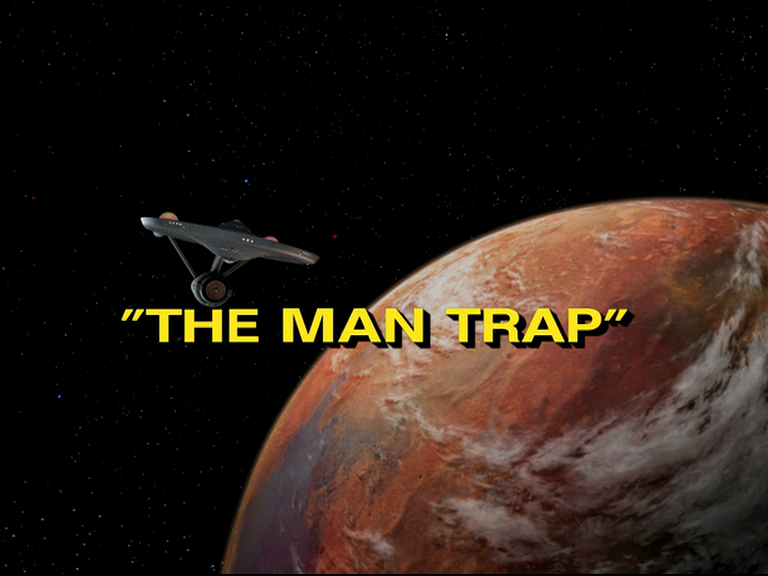
The Man Trap


How would this have looked in 1966? Impossibly weird or just another show set on a spaceship? It's easy to forget Star Trek did a lot of the heavy lifting for other television science fiction. When Roj Blake and his gang of freedom fighters find the Liberator in 1978 they can stand around discussing their new ship's teleport system knowing the viewer will accept it as one of those things from that show with Doctor Spock.

But what if you're a viewer in 1966? CBS has a repeat of My Three Sons and a Jerry Lewis film. ABC is showing The Tammy Grimes Show, followed by Bewitched. For some reason you don't fancy either of those so you switch to NBC. A voice-over tells you “Captain's log stardate 1513.1. Our position orbiting planet M113. On board the Enterprise Mr. Spock temporarily in command. On the planet, the ruins of an ancient and long dead civilisation. Ship's surgeon McCoy and myself are now beaming down to the planet's surface. Our mission...” And, in quick succession you see some sort of spaceship going round a planet. A weird guy in a blue top sitting in a room full of flashing lights looking at what might be a big window showing that planet again. And, 3 people appearing out of thin air in a sparkly glow. That's pretty much the first thirty seconds.

No attempt is made to ease the audience in gently. The closest thing to an explanation is Kirk's “space, the final frontier,” monologue. Even The Prisoner has an episode where Number 6 arrives in The Village and that's a series which takes pride in being wilfully obscure. Still, I'm not sure how exciting a purpose written first episode could be,” and this is the bridge... and this is Mr Spock, he's an alien from the planet Vulcan you know... and this is sick bay... and this is the transporter room....” With suspension of disbelief being such an important part of television science fiction maybe it's better to show the ship going about it's normal business. If this is all normal and routine to the crew maybe the audience will accept it even if they don't really get it at first.

So how did The Man Trap end up as the first broadcast episode? Herbert Solow (in the book Inside Star Trek) talks about meeting NBC in August to select the first episode from those that would be ready by September. The choices seem to have been The Man Trap, Charlie X, Where No Man Has Gone Before, The Naked Time, The Enemy Within, and Mudd's Women. The Man Trap and The Naked Time were the two serious candidates because they delivered on Kirk's promise of “strange new worlds” and The Man Trap was chosen. Associate Producer Robert H Justman suspected NBC viewed The Man Trap as “scarier and more exploitable” and pushed for The Naked Time but was overruled. Later he came to view The Man Trap as the better choice and I think he's right.

Look at what was available. Charlie X takes place entirely on the Enterprise and is a sweet, but slight, story about a teenage boy with psychic powers. Where No Man Has Gone Before was Star Trek's second attempt at a pilot, and is understandably a little rougher around the edges. The Naked Time is a great story but is about the crew acting strangely and so relies on the audience first getting to know the crew. It's also, and this is not a criticism, quite a funny episode which might raise false expectations about the rest of the series. The Enemy Within splits Kirk into good and evil versions; again not an idea with much traction until you know Kirk (also, do you want your first episode to be a transporter goes wrong story?). Finally, Mudd's Women is about space prostitutes.

The downside of choosing The Man Trap is it's a monster story. Not, like Arena or The Corbomite Manouver, a story which looks like a monster story to someone not paying attention. It's an honest to god monster stalking the ship killing the crew story. If you want people to take your new science fiction series seriously you probably don't want to start with one which makes it look like a monster of the week show. Especially not if your première is the day before the second series of Lost In Space starts. You can see why Robert Justman suspected NBC saw this as an exploitable episode. If you're not familiar with science fiction it probably most closely fits your expectations of the genre. Still, it's a good monster of the week story and manages to wrong-foot the audience slightly. As the last of its' species the salt vampire has some depth beyond the usual B-Movie “atomic fish beasts come to claim our Prom Queen”.

On the plus side, The Man Trap strikes a good balance between the characters. Kirk and Spock get to worry at the mystery of Nancy Crater while McCoy gets a lot of screen time from his relationship with Nancy and also when the shape shifting salt vampire doubles for him. Kirk and McCoy also get some good banter in sickbay. McCoy is explaining how crewman Darnell has had all the salt drained from his body and refers back to an earlier argument between himself and Kirk.

McCoy: Another error on my part
Kirk: (grins) I'm not counting them Bones, you in the mood for an apology?
McCoy: (smiles slightly) Forget it, I probably was mooning over [Nancy]
Kirk: (interrupts and turns suddenly businesslike) Perhaps you were

That wipes the smile off McCoy's face. It's a moment within the episode but it really sums up the complicated professional/personal relationship between the two. I also like Kirk's brusque “you bleed too much,” dismissal of Robert Crater when he pleads for clemency for the salt vampire.

Sulu, Yeoman Rand, and Uhura also get significant screen time. By the end of the episode we still haven't seen Scotty or had any real introduction to the abilities of the Enterprise; no warp drive, tractor beams, photon torpedos, or the Federation, but Spock does get to talk ominously about forcibly using truth serum on Robert Crater.

Enterprise crew deaths: 4. Crewmen Darnell, Sturgeon, Green and Barnhart.

Misc:

During the first sickbay scene there's something odd going on with the medical scanner in the background. At first it's blank but when the camera moves the red object in the picture above comes into view. It looks like someone left the cover off the medical scanner and we're seeing through the set and looking at some scaffolding.

UPDATE: Over on Gallifrey Base user Mr. Flibble told me the red object is the reflection of the medicine cabinet on the other side of sickbay. He's absolutely right. What confused me was the clarity of the object, there's not even the slightest distortion of the reflection and the way it glides in as the camera pans makes it look more like an object behind the set. Originally I wondered if the scanner screen might have been pulled out as a quick solution to the screen reflecting the camera crew, but that's obviously not the case.