Showing posts with label The Man Trap. Show all posts

Thursday, June 5, 2014

Turnabout Intruder

JANICE: The year we were together at Starfleet is the only time in my life I was alive.
KIRK: I never stopped you from going on with your space work.
JANICE: Your world of starship captains doesn't admit women. It isn't fair.
KIRK: No, it isn't. And you punished and tortured me because of it.


How should that line from Janice Lester be read? Does the word your refer directly to Kirk or to Starfleet in general? If Lester is talking about Starfleet as a whole then it can only be taken literally. Women cannot become starship captains. Alternatively, if Lester is only talking about Kirk then maybe she blames Kirk for allowing their relationship to wither because he's so obsessed with being a starship captain that he can't allow anything else to matter, not even a relationship which clearly meant a huge amount to Lester.

Star Trek fans have spent a lot of time debating exactly what Janice Lester means. Ultimately everybody brings their own interpretation to the table. Personally I think Lester is speaking literally. Starfleet does not allow women to become starship captains. There's no evidence to contradict this in the previous 78 episodes (and consider the wider culture, it wasn't until 1998 that Lieutenant Commander Darlene Iskra became the first woman appointed to command a US Navy ship). It's possible to argue that Kirk is just humouring Lester. He knows she's wrong but he's mindful of her condition and doesn't want their first meeting in years, and potentially their last meeting if she really is dying, to end in another argument. However even if Kirk is just trying to be polite there are other hints that Starfleet's policy is to exclude women from the captain's chair. During the court martial Lester in Kirk's body has the line "....she would not be allowed to serve as the captain," implying that even if Starfleet agreed that the mind of Kirk was trapped in Lester's body they still wouldn't allow Kirk-as-Lester to resume command of the Enterprise. Muddying the waters further are Kirk's ,"no it isn't," response to Lester's claim that "it isn't fair," and his unfinished final line of the episode. "Her life could have been as rich as any woman's, if only. If only..." If only... what? If only she'd not been utterly insane, or if only she'd known her place?

It's interesting that 45 years after this episode was made it is still possible to debate exactly what Lester means. Could this ambiguity be deliberate? it would have been the easiest thing in the world to tidy up the language and clarify whether Starfleet has a problem with Lester or her gender. The script for Turnabout Intruder was finalised in December 1968. The fuss over the Kirk/Uhura kiss in Plato's Stepchildren would still have been fresh in everyone's memory. Is it possible that someone on the writing staff didn't want to rule out the idea of women commanding starships, but was also concerned that the contemporary audience would find the idea a step too far into crazy science fiction? Whatever the case the later series and films would be happy to clarify this point; in 1973 Star Trek: The Animated Series showed Uhura taking command in the episode The Lorelei Signal.

It is of course possible that the confusion caused by Lester's line is the result of bad writing. There are other examples on display elsewhere. It's never made clear what is wrong with Lester. Everyone just assumes that she's going to die of radiation poisoning before the subject is quietly dropped about halfway through the episode when everyone gets distracted by Kirk's behaviour. The portrayal of security on the Enterprise is also odd. At times the ship feels more like ISS Enterprise from Mirror, Mirror, with the Captain allowed to get away with any excessive behaviour as long as he keeps security onside. The biggest offender is the end of the episode when the story just stops. Suddenly the transfer is unstable and Kirk and Lester pop back into their proper bodies; the end. Janice Lester and doctor Arthur Coleman, who murdered their way through the staff of the Camus II expedition and were prepared to murder their way through the senior staff of a starship, are simply allowed to wander off after Coleman promises to look after Lester.

All that said there are a lot of points where the writing is really pleasing and subtle. Kirk in Lester's body quickly realises that trying to explain the truth just makes people think Lester is paranoid. There's a great moment when he plays off Nurse Chapel's emotions by asking her, "is a visit by that very kind Mister Spock to be allowed?" It's also good to see that it's Kirk's impulsiveness, and his preference for action, that gets him deeper into trouble. His escape from sickbay just gets him recaptured and confined in isolation, and is also what gets Spock into trouble when he disobeys Lester-as-Kirk's order that no one should talk to Kirk-as-Lester. The loyalty Spock feels for Kirk is made clear by his immediate acceptance of what has happened to Kirk, once it becomes impossible for there to be any other explanation. There is also a good demonstration of Spock's pragmatism when he points out that although he believes Kirk belief is not enough. They must have evidence. There's also a couple of nice lines which show Kirk and Lester have radically different ideas about why their relationship failed. Lester-as-Kirk tells McCoy, "I walked out on her when it became serious," while Kirk-as-Lester later tells the court martial, "her intense hatred of her own womanhood made life with her impossible."

William Shatner is all over the place. At times he works really hard to convince the audience that someone different is driving Kirk's body. When Lester-as-Kirk first calls the Enterprise Shatner puts in a tiny hesitation on his, "Captain Kirk to the Enterprise," line and then fractionally jerks his head in surprise when Scott replies. He stands differently and is visibly tense when he first walks on to the bridge for the first time before beginning to relax. He nervously brushes a hand across his hair on the, "I walked out on her when it became serious," line as if to imply that on an unconscious level Lester knows this isn't the exact truth. The problem is William Shatner can't resist going for the obvious laugh, and he enjoys himself just a bit too much; as was the case in A Piece Of The Action. The scene where Lester-as-Kirk talks to Doctor McCoy while filing his nails stands out as an obvious example. It probably got a big laugh on set but it undermines Lester because it's been established that she hates her own femininity so this prissy little action makes no sense.

Behind the camera Donald R. Rode does his usual fine work as film editor. He edits together a couple of very short flashback scenes to the mind swap which work as neat pieces of visual story telling. The editing during the mind meld scene is also effective. After Spock breaks the link the pacing is deliberately slow with two wordless close-ups of Kirk and Spock before the tension is broken with Spock's line, "I believe you." Donald R. Rode also works in some genuine humour when the mind transfer begins to fail. He cuts between a close-up of William Shatner gurning on the bridge and a four shot of Kirk-as-Lester, Spock, McCoy, and Scotty in their cell. This is followed by a shot of Lester-as-Kirk on the bridge, and the camera slowly pulls back to reveal Chekov and Sulu staring at Kirk as if he was the crazy person on the bus. A moment which manages to be funny and also underlines how Kirk-as-Lester has lost command of the crew. At the end of the episode there's also a lovely moment when the acting and editing combine to create a wordless demonstration of why Kirk is able to lead and Lester is reduced to bluster and shouting.

KIRK: Can you do anything for her?
COLEMAN: I'd like to take care of her.
MCCOY: Of course. Come with me.

Harry Landers makes brief eye contact with DeForest Kelley before delivering Coleman's line. This is followed by a reaction shot of William Shatner raising his head, as if Kirk is also looking at McCoy. Finally DeForest Kelley looks back at Harry Landers before delivering McCoy's line. The effect is of wordless communication between Kirk and McCoy. It's not necessary for Kirk to ask whether Coleman can care for Lester. Kirk knows a look is enough to convey his opinion because he instinctively understands how to build a consensus with his officers. Regardless of the story logic of allowing Coleman to take charge of his partner in murder it's a nice contrast to the earlier scene where Lester-as-Kirk fails to convince McCoy that Coleman should take responsibility for Kirk-as-Lester and is reduced to barking out an order.

It's easy to see why a lot of fans regret this being the last episode of Star Trek's run on NBC. At the most basic level this feels like an unsatisfactory goodbye because Uhura is missing. Nichelle Nichols had another engagement. In a script which otherwise features all of the regular cast, it's a shame she should couldn't be present. The suggestion that women cannot be starship captains also means that the series leaves on a sour note. It's a reminder for the modern audience that for all Star Trek's progressive ideals it was a sixties television series created by sixties men with sixties attitudes. For a series which did such good work challenging social attitudes it's disappointing to see it had such a blind spot when it came to its own treatment of women.

Turnabout Intruder is a disappointment compared to how seasons one and two ended. Season one ended with Operation - - Annihilate! a more confident episode than the first broadcast episode The Man Trap which shows clear growth and progress for the series. Season two ended with Assignment: Earth an ambitious, if flawed, attempted to launch a Star Trek spin-off series. Turnabout Intruder is virtually a bottle show. Seven minutes into the episode we're back on the Enterprise for the duration of the story. The story isn't even uniquely Star Trek. It's an attempt to fit a standard body swap story into the Star Trek format. The Prisoner episode Do Not Forsake Me Oh My Darling was broadcast on CBS on 3rd August 1968, and The Avengers episode Who's Who?? before that on ABC, 19th May 1967. Going back further to 11th November 1963 there is also an episode of The Outer Limits called The Human Factor. Still for all its faults it's good that Star Trek ends on a story which underlines the loyalty the Enterprise crew have for each other.

Enterprise crew deaths: None.
Running total: 56

Thursday, February 6, 2014

That Which Survives

Redshirt has become such a generic term for a character who dies soon after being introduced that it has it's own Wikipedia entry. Different script writers use redshirt deaths in different ways. Nine unnamed crew die off screen in Where No Man Has Gone Before because an audience unfamiliar with Star Trek needs to have the damage to the Enterprise put into a context they can understand. "Ship's condition, heading back on impulse power only. Main engines burned out. The ship's space warp ability gone. Earth bases which were only days away are now years in the distance." Kirk's log entry means very little to someone new to Star Trek but nine dead is a concept which can be instantly grasped. An incident which killed nine crew must be serious. When crewman Darnell becomes the first Star Trek character to die in The Man Trap the purpose of his death is to tell us what the salt vampire does. In the case of By Any Other Name a quick and dirty fix to the story -to answer the question what happens to the Enterprise crew when the Kelvans take over- results in the memorable death of Yeoman Thompson.

It's an ongoing problem for
Star Trek that in order to underline the danger facing a landing party someone really needs to die but that someone can't be a member of the regular cast. It's not so much a story telling problem as a suspension of disbelief problem. No redshirts die in The Doomsday Machine (Commodore Decker doesn't count being a fully fledged guest character as opposed to the anonymous crew who join the choir invisible in Where No Man Has Gone Before). Despite this lack of crew death The Doomsday Machine is an exciting story well told and the audience allow themselves to be swept along and, for want of a better word, to pretend that they believe Kirk might die when the transporter fails at a crucial moment. In The Apple it doesn't matter how high the death toll rises. A conga line of redshirts could have fallen into Vaal's maw. It wouldn't solve the basic problem that watching the story grind through its four acts is dull. Without that audience engagement The Apple seems stupid and the multiple redshirt deaths simply underline the ludicrousness of the five survivors of the nine person landing party being the four regular cast and one woman who beamed down.

The third season of
Star Trek features the fewest redshirt deaths. Only seven by the broadcast of That Which Survives. At first glance it seems as if the production team are aware that regularly killing the supporting cast leaves the series open to parody and have decided to scale back the number of times it happens. Actually this is probably a symptom of the budget problems Robert Justman used to complain about. One simple money saving measure is to eliminate all those minor characters before filming starts. Having said that, looking at the list of third season episodes it's hard to spot ones where a few additional extras might have upped the ante and improved the story. The only obvious candidate is Whom Gods Destroy. If Kirk and Spock had beamed down with a few security guards for Garth to threaten, or confuse with his shape shifting ability, then the story might have seemed less static; the scene where Garth blows up Marta might make more sense if it was an Enterprise crew member rather than a woman to whom Kirk barely has any connection.

With all this in mind the teaser to
That Which Survives surprises when a woman appears in the transporter room and kills the unfortunate transporter operator. For the first act we seem to be watching a traditionally structured Star Trek. The landing party is trapped on a planet facing a threat and isolated from the resources of the Enterprise. In Whom Gods Destroy Kirk and Spock are trapped below a security screen. In The Apple it is Vaal which keeps the landing party and the ship separated. The Empath has the Enterprise leave orbit, and the story, because of a powerful solar flare. In That Which Survives the Enterprise is transported, "nine hundred and ninety point seven light years," from the planet. In theory this should make the end of act one, when Lieutenant D'Amato is also killed by the mystery lady, the point where all tension drains from the script. The landing party now consists of Kirk McCoy and Sulu, and there is no way any of them are going to be killed. However the teleplay is written by old hand John Meredyth Lucas, from a story by Michael Richards, and he does his best to make some changes to the formula.

Aware that threatening the lives of the landing party is a dead end for generating tension, the story switches back to the ship. Losira, the strange woman with the killer touch, appears back on the Enterprise and kills an engineer then sabotages the ship. This links the planet side and ship board stories more directly than normal. The story is opened out, rather than closed down when the audience realise no one else can die, and the power of Losira is emphasised. Another interesting variation on the normal story is that both the landing party and the Enterprise crew believe the others to be dead. The side effects of the power which flings the Enterprise across space make the landing party think the ship has been destroyed, and vice-versa. This leaves the landing party focusing on survival rather than simply thinking about getting back to the ship.

Elements of
That Which Survives feel like an attempt to tell a ghost story in a science fiction series; there's a mysterious planet haunted by a strange woman whose touch causes death. The recent Doctor Who story Hide was a similar attempt to tell a genre crossing story, and in both cases
the shift from a haunted house/planet story to science fiction is a little awkward as the story attempts to find a scientific explanation for the spooky events. One problem is that the climax to the Enterprise plot, Scotty's trip into the service crawlway to shut off the fuel, doesn't have any relation to the rest of the story. It's tense, and a good showcase for James Doohan, but it has nothing to do with the mystery of the strange planet or Losira.

Another problem with
That Which Survives is that the dialogue can be over-ripe. It's nicely sharp in places. Kirk's "if I'd wanted a Russian history lesson, I'd have brought along Mister Chekov," is great, as is Scotty's " I know what time it is. I don't need a blooming cuckoo clock, " as Spock insists on counting down the time remaining. Unfortunately in other places the dialogue skids over into the melodramatic. Sulu's "how can such people be, Captain? Such evil and she's so, so beautiful." Or, when McCoy wonders who killed D'Amato, Kirk's insightful, "something or someone did." Spock suffers from several particularly bad attacks of cute dialogue.

UHURA: Mister Spock! Are you all right?
SPOCK: Yes. I believe no permanent damage was done.
UHURA: What happened?
SPOCK: The occipital area of my head seems to have impacted with the chair.
UHURA: No, Mister Spock. I meant what happened to us?

SPOCK: ...Can you give me warp eight?
SCOTT: Aye, sir. And maybe a wee bit more. I'll sit on the warp engines myself and nurse them.
SPOCK: That position, Mister Scott, would not only be unavailing but also undignified.

SPOCK: Mister Scott, you have accomplished your task.
SCOTT: You might at least say thank you.
SPOCK: For what purpose, Mister Scott? What is it in you humans...
SCOTT: Never mind.
SPOCK: ...That requires an overwhelming display of emotion in a situation such as this? Two men pursue the only reasonable course of action indicated, and yet you feel that something else is necessary.

And so on. At times he's so weirdly literal, and funny-logical that it's tempting to wonder if Mr. Spock has been at McCoy's Saurian brandy. He's in character but acting very differently to normal. There are times when Leonard Nimoy seems to be struggling with playing funny-Spock. In the warp eight exchange his emphatic finger pointing is at odds with
Leonard Nimoy's normal tight control on Spock's movement. It gives us a glimpse of how Spock might have been handled differently in an alternate version of Star Trek where the character was played much more as comic relief.

Enterprise crew deaths: Three, Ensign Wyatt, Lieutenant D'Amato, and Crewman Watkins. The most crew to die in a single episode since
Obsession.
Running total: 53

Friday, March 29, 2013

Patterns Of Force

Patterns Of Force was made between 29th November and 6th December 1967, and broadcast on 16th February 1968. A Piece Of The Action was made between 2nd November and 9th November 1967, and broadcast on 12th January 1968. As Patterns Of Force is broadly A Piece Of The Action with Nazis it's easy to assume Patterns Of Force is an attempt to repeat the formula of A Piece Of The Action, but the genealogy of both stories is more complicated.

The concept for A Piece Of The Action first crops up as a suggested outline in Gene Roddenberry's original pitch document Star Trek Is...There a three line description reads, “PRESIDENT CAPONE. A parallel world, Chicago ten years after Al Capone won and imposed gangland statutes upon the nation.” Based on this George Clayton Johnson wrote an outline for an episode called The Syndicate which was refined into a treatment called Chicago II before being put to one side and forgotten while The Man Trap was developed. Separately writer Paul Schneider submitted an early outline for Patterns Of Force in December 1966 which was developed into a teleplay in early 1967. For some reason John Meredyth Lucas then wrote a new outline in June which was further developed through June and July 1967.

In the wake of The Trouble With Tribbles Gene L. Coon rediscovered George Clayton Johnson's treatment and decided it would make a good premise for another comedy episode. It's quite possible another factor in Gene L. Coon's decision to resurrect Chicago II was that the then in development script for Patterns Of Force, and Bread And Circuses, demonstrated stories about planets based on Earth history were practical. Then, for whatever reason Bread And Circuses was made and held back, Patterns Of Force slipped back in the production order, and A Piece Of The Action was broadcast first and looks like the story which originated the idea of doing planets based on historical periods.

So, it's time to raid the Desilu Studios' costume store again. There's no more depth to the use of Nazis in Patterns Of Force, than there is gangsters in A Piece Of The Action. They are just there to allow their costumes and iconography to act as an eye catching visual and grab the attention of any viewer flicking between channels. It works, Patterns Of Force looks great. It has visual appeal and freshness because it looks completely unlike any other Star Trek episode except A Piece Of The Action. The plot of both episodes is a simple adventure tale of capture and escape. There is no depth to the story, no analogy, or moral; beyond possibly the blindingly obvious one that totalitarian governments are bad, and peace is better than war. The subplot involving Federation observer John Gill and his daft plan to unite the anarchic planet of Ekos under a benign Nazi system, because it is “efficient” is as spurious a justification for the costumes as A Piece Of The Action's backstory involving the book Chicago Mobs Of The Twenties. Both are just there to force Kirk's hand in taking action. The situation on Ekos/Sigma Iotia II is the Federation's fault, so Kirk must attempt a repair.

The similarities between Patterns Of Force and A Piece Of The Action are strong enough that it's even possible to imagine a Nazi version of A Piece Of The Action in which the careless crew of the starship Horizon leave behind a book about the Nazi Party. Sigma Iotia II would have been broken up into a territories run by mini-Fhurers with each competing to be top dog. Comedy Gestapo officers would run around shouting at each other and the unnamed women who complain about Oxmyx and the “crummy street lights around here,” and lack of laundry pickup would have instead grumbled about the trains not running on time. The only question is whether NBC would have accepted a comedy Nazi episode? It's unlikely but not impossible. Hogan's Heroes had been running on CBS since 1965, but having said that Mel Brooks' The Producers was released to widespread accusations of bad taste roughly a month after Patterns Of Force aired. By 1968 comedy German soldiers were okay, but comedy Nazis were still a step too far.

In fact humour is the main difference between A Piece Of The Action and Patterns Of Force. A Piece Of The Action is unique because it was commissioned with the specific intention of making a deliberately funny story, whereas the humour in The Trouble With Tribbles appears to have evolved naturally as the script was developed. By contrast the tone of Patterns Of Force is all over the place. There are jokes in there, and some of them are good jokes. As might be expected Spock gets all the best moments. His, “you should make a very convincing Nazi,” to Kirk, and his perfectly timed raised eyebrow when deputy Melakon describes Spock's, “low forehead, denoting stupidity”. These moments sit awkwardly alongside attempts to emphasise the evil of the Ekotian regime.

ABROM: Isak, Uletta is dead. Shot down in the streets.
ISAK: She would've been my wife.
ABROM: She lived for five hours while they walked past her and spat on her. Our own people were unable to help her. Now you ask me to help strangers.
ISAK: If we adopt the ways of the Nazis, we're as bad as the Nazis.

Notice the names Abrom/Abraham Isak/Isaac, and the name of the twin planet Zeon/Zion. In the broadcast version there is no need for these disguised names. They add no depth to the story because what's on screen is literally about the Nazis and their treatment of the Jews. If the Nazi uniforms, symbols, and terminology were stripped out to leave a story about Kirk struggling to avert war between twin planets, then the disguised Hebrew names would add a little depth and point to an analogy. As it is their presence is just gilding the lily. It would be like making the planet killer from The Doomsday Machine, an analogy for nuclear weapons, look exactly the same as a Minuteman ICBM.

It's the realisation that all the Nazi imagery could be stripped from Patterns Of Force, and still leave a workable story which points to the biggest weakness of the episode. The element which makes Patterns Of Force so distinctive, the uniforms and symbols, is also the story's most redundant feature.

Enterprise crew deaths: None again. Seven whole weeks without anyone dying.
Running total: 43


Misc:
More distinctive than the episode itself is the Next Voyage trailer broadcast at the end of Return To Tomorrow. Next Time trailers normally open with a Captain's log voiceover and a shot of the Enterprise. Patterns Of Force begins stylishly with the Enterprise but the soundtrack is Isak's, “hide! They're right behind me. Hide! Hide!” The next image is the reveal of the Ekotians wearing SS Brownshirt uniforms from the episode teaser. Through the entire trailer there is no indication Patterns Of Force takes place on another planet. With the exception of a line from Kirk, “she captured a Zeon spy that was attempting to assassinate the Fuhrer,” the trailer is carefully edited to suggest Kirk and Spock are somehow fighting real Nazis. It would be really interesting to know what viewers at the time made of this. Did they think they were going to get another time travel episode?

Sunday, March 24, 2013

Return To Tomorrow

The Enterprise crew are in pursuit of a mystery and going where no man has gone before. Something beyond the limits of known space has activated the Enterprise distress relays and given the ship a course to follow. According to Spock the Enterprise has travelled, “hundreds of light years past where any Earth ship has ever explored.” It will take over three weeks for Starfleet to receive any messages the ship sends. As a concept this is pure distilled Star Trek, like the reception for the interplanetary ambassadors in JourneyTo Babel, but as a whole Return To Tomorrow is horribly slow, and dull.

Basically there simply isn't enough story to fill the 48 minutes running time. The core concept of the episode is a mindswap. Sargon, the sender of the mysterious signal, is a disembodied intelligence in a sphere who wants to borrow temporarily the bodies of Kirk, Spock, and Doctor Ann Mulhall; Diana Muldaur making the first of two Star Trek appearances, plus she'll be back as Doctor Pulaski for the second series of Star Trek: The Next Generation. Into the crew's bodies will be placed the minds of Sargon, his wife Thalassa, and Henoch, sole survivor from the other side in the conflict which destroyed their race and planet. The borrowed bodies will construct androids which will become the permanent homes of the three minds.

That's the set up to the story, but the transference itself doesn't take place until 22 minutes into the episode. It brings to mind associate producer John D. F. Black's advice to George Clayton Johnson about
The Man Trap script, “you don't get the creature aboard the ship fast enough.” Here it takes too long to get to the scene where Sargon, Thalassa, and Henoch once again feel the pleasure, and temptations, of being alive. Weirdly, having moved at a snails pace until now, the story suddenly leaps into action and two and a half minutes from the first mention of a metabolic inhibitor (the presence of these alien minds places great stress on the host bodies, Spock's body can easily cope but it's killing Kirk and Mulhall) act two ends by revealing Henoch is a bad'un. He plans to keep Spock's body for himself and will kill Sargon/Kirk with a doctored metabolic inhibitor. This stop/start storytelling continues into acts three and four. About 90 seconds pass between Kirk announcing, “Spock's consciousness is gone, we must kill his body, the thing in it,” to his regretful, “Spock,” as he examines what he thinks is the corpse of his first officer and friend. The lasting memory of Return To Tomorrow is of an episode which carefully ekes out moments of incident between scenes where the story stops and the characters make speeches at each other.


Some of the speeches are very good. Kirk, Spock, McCoy, Scotty, and Doctor Mulhall gather in the briefing room and debate the dangers of agreeing to Sargon's plan in a scene which ends with a line from Kirk which is a mission statement for Star Trek. “Risk is our business. That's what the starship is all about. That's why we're aboard her.” But that line follows four minutes of back and forth about whether to go ahead with something which the audience knows is going to happen because it's the subject of this week's episode. It's great to see the crew chewing the fat like this but by episode 49 the inter-character debate needs to do more than just pad out the running time. Here McCoy objects and is talked round by Kirk while Scotty is tempted by the promise of technological advances. The result is a four minute character scene which doesn't advance the plot or tell the audience anything new about the characters. The only new development is that it is Mulhall rather than Spock who gets to describe Sargon's offer as, “scientifically fascinating.” 

Scenes with Sargon and Thalassa are particularly trying on the patience. Taking their cues from the script both William Shatner and Diana Muldaur opt for measured, declamatory performances; as if they were auditioning for the Charlton Heston role in some Biblical epic. In addition these scenes are often smothered in George Duning's heavy on the strings music which crushes what little subtlety exists in exchanges like:

THALASSA: Oblivion together does not frighten me, beloved. Promise we'll be together.
SARGON: I promise, beloved.
THALASSA: Together forever.
SARGON: Forever beloved. Forever.


Leonard Nimoy makes a better impression as Henoch. While the novelty has worn off seeing Spock act out of character Nimoy makes the script work by playing against the evil intention of the lines. He's charming, pleasant, and sarcastic. His best moment comes early on when praising Spock's body: 

SPOCK: This is an excellent body, Doctor. I seem to have received the best of the three. Strength, hearing, eyesight, all far above your human norms. I'm surprised the Vulcans never conquered your race. 
MCCOY: Vulcans worship peace above all, Henoch.
SPOCK: Yes, of course, of course. Just as we do, Doctor. 

Nimoy plays Henoch like a politician who realises he has gone too far. His “of course, of course,” complete with a reassuring touch on McCoy's arm is very well done. 

Doctor McCoy is also very well written in this episode. With Kirk and Spock both acting out of character he is our link to regular Star Trek. He's the sardonic voice of sanity in the early scenes. Not only pointing out the insane risks of agreeing to Sargon's plan but also lightly mocking the plot as if he is also playing the voice of the viewer at home, “that's the most ridiculous statement I've ever heard.” McCoy's character is just going over old ground, in addition to the briefing scene above there is also a pre-beam down scene where he frets about the danger of using the transporter, but Deforest Kelly plays him very well, and makes the effort to add small moments like his glance at Scotty when dismissing “a list of possible miracles,” as a reason for allowing the transfer to take place.

On the other side of the camera Ralph Senensky is directing again. His work is more distinctive here than it was in Obsession, possibly this is a less demanding script which allows him more time to compose shots. When Sargon/Kirk 'dies' there's a fantastic low angled view of Kirk on the floor with Thalassa, McCoy, and Nurse Chapel kneeling by his body. There's also a great shot of Scotty and Thalassa discussing the android filmed through the framework of the android body. Senensky also seems to be one of the few directors to give director of photography Jerry Finnerman time to really indulge himself with the lighting. The Enterprise sets look brilliant in Return To Tomorrow, and are lit with great slabs of colour; purple in the transporter room and green in the briefing room.

Film editor Donald R. Rode also does some great work with the cutting, and tries to inject some pace into a story which tends towards the languid. There are two brilliant jump cuts, one from Sargon telling the crew they are free to leave to Scotty's outraged, “you're going to what?”, and the second from Kirk's, “we must kill [Spock's] body, the thing in it,” to Uhura screaming. Rode also knows when to allow Ralph Senensky's footage to work on its own terms. Kirk's, “risk is our business,” speech plays out almost uninterrupted as a slow zoom into a close-up of Kirk. Then once Kirk is done Rode cuts to reaction shots of McCoy (looking very unimpressed), Scotty, Mulhall, and Spock, before cutting back to the same big close-up of Kirk which he follows with a matched close-up of one of Sargon's spheres in sickbay. Rode's first work on Star Trek was The Doomsday Machine, and since then he has also worked on The Deadly Years, The Immunity Syndrome, and A Private Little War. He's one of the unsung behind the scenes heroes of Star Trek's second season, and frankly he deserves to have his praises sung as often as possible.

Enterprise crew deaths: It's now been six episodes since any member of the Enterprise crew died, matching the six episode death free period between Errand Of Mercy and Who Mourns For Adonais? If the crew can get through next week without anyone buying the farm it will be the longest death free period in Star Trek.

Running total: 43

Sunday, November 18, 2012

Catspaw

“Star Trek obviously solicits all-out suspension of disbelief but it won't work. It was an incredible mess of dreary complexities and confusion at the kick-off... By a generous stretch of the imagination it could lure a small coterie of the smallfry, though not happily time slotted in that direction. It's better suited to the Saturday morning kidvid bloc.”

Robert Justman and Herbert Solow quote from the The Weekly Variety's stinker of a review of The Man Trap in their book Inside Star Trek. It never gets any kinder than the section quoted above, also describing Shatner and Nimoy as, “wooden” and wondering, “how this lowercase fantasy broke into the sked.” Frustratingly the complete review doesn't appear online but the sections in Justman and Solow's book suggest the review reserves much of its criticism for surface details (“[Mr Spock] socalled chief science officer whose bizarre hairdo (etc.) is a dilly”) rather than anything much of substance. Having said that, the quoted section is very perceptive about Star Trek's scheduling. It may not have ended up on Saturday mornings but the series only achieved mass popularity in syndication after it was bought by Kaiser Broadcasting who targeted young males by putting Star Trek on at 6pm opposite their competitor's news broadcasts.

The Weekly Variety's review may be off target for The Man Trap but it sums up Catspaw very well because it does look look like, “lowercase fantasy suitable for smallfry”.

There's a lack of depth to Robert Bloch's script. It is very superficial, in a way no other
Star Trek script has been before. Even a flawed episode like The Apple contains a Garden of Eden metaphor; Kirk gets some maudlin reflection about the weight of command; McCoy and Spock have an ongoing debate about the right way to treat the feeders of Vaal; there's some “nudge nudge, wink wink,” talk about sex; and the suggestion that humans stagnate in paradise and need to suffer to achieve their potential (a recurring theme in Star Trek). The Weekly Variety's favourite episode The Man Trap uses the extinct buffalo as a metaphor for the salt vampire; McCoy must kill a creature which looks like the love of his life; there's the disturbing question of Crater's relationship with the salt vampire (he appears to have fallen in love with the creature which killed his wife because it can make itself look like the woman it killed- to quote Homer Simpson “who's gonna pay for that wedding?”); and even the title is a pun, like a real man trap the salt vampire is a snare for the unwary.

Viewers can watch both stories on one of several levels. They can question the motivation of characters and decide who is right and who is wrong. They can pick up hints of themes too risky for network television to talk about in any detail. They can draw parallels with other stories. Or, they can watch them purely as the exciting space adventures of Captain Kirk and his fight against Vaal, or the salt vampire.

However, it's not just lashings of subtext which make a story work. The Apple's discussion of sex among the feeders of Vaal is handled in such a juvenile way (Spock is embarrassed by the subject: why?) the script would probably be marginally better if it was removed. The weakest part of The Doomsday Machine is the planet killer/nuclear weapons parallel; if only because Kirk unambiguously spells out the message to the audience. Mirror, Mirror makes no attempt at allegory and the cast are driven by the desire to escape; one of the most basic motives possible.

Why then do Mirror, Mirror and The Doomsday Machine feel more sophisticated than Catspaw? Both episodes give us something different. The Doomsday Machine works because the threat to the Enterprise is doubled; externally from the planet killer and internally from the obsessed Commodore Decker. Mirror, Mirror shows us a world where friends are enemies and everything familiar seems dangerous and new.

In contrast Catspaw has nothing new to offer except the set dressing. Scrape away the skeletons, black cats, and torch lit dungeons and there's a familiar stew of ideas the audience has already been presented with too many times. In Bloch's earlier script What Are Little Girls Made Of? the android Andrea goes mad after being kissed by Kirk. Here Sylvia is driven insane by the rush of sensations in her new human body. Sylvia mentions a transmuter and we're off on a game of hunt-the-power source as seen in The Squire Of Gothos. As in The Return Of The Archons members of the Enterprise crew become zombie puppets under external control. Kirk attempts to seduce Sylvia as he did with Karidian's daughter Lenore in The Conscience Of The King. Catspaw ends up feeling juvenile because it's problems are threefold. The story has no depth, the setting is just about the only original element, and the motivations of Korob and Sylvia, the two aliens who drive the plot by accidentally tapping into the human collective unconsciousness and creating a planet of witches and haunted castles (another concept done before in The Squire Of Gothos where Trelane accidentally builds his world based on outdated images from Earth), are too vague and undefined to be of any real interest.

One of the few moments of real interest comes when Korob reminds Sylvia, “We have a duty to the old ones.” Bloch was a H.P. Lovecraft fan so it seems likely he intended the reference to refer to Lovecraft's Cthulhu mythos. Lovecraft described Cthulhu as, “a monster of vaguely anthropoid outline, but with an octopus-like head whose face was a mass of feelers,” which does slightly match the otherwise terrible puppets which represent the true forms of Korob and Sylvia at the end of the story. Also, if you are equipped with a dirty sense of humour, there's unintentional comedy in the moment Sylvia declares, “I am a woman. I am all women,” before kneeling before Kirk and placing her hands on his hips. It looks as if she is about to commit a most indecorous act. Sylvia may be all women but she's clearly no lady.

Given this script director Joseph Pevney does his best but, as with
The Apple, he's clearly struggling to engage with the material. Korob gets an unusual close-up when he argues with Sylvia. There's a terrific tracking shot as Kirk, Spock, and McCoy search the planet at the beginning of the episode; the trio walk down a shallow gulley which allows rocks to move in the foreground and background. The jump cut from the dungeon to throne room, as Kirk, Spock, and McCoy struggle with Sulu and Scotty, is effective and momentarily disorientating but weirdly the most effective piece of editing isn't in the episode itself. The Next Voyage advert for Catspaw includes the sequence where Sylvia demonstrates her ability to change between different female forms. As she changes someone, probably film editor Bruce Shoengarth, inserts short shots of the cat snarling as a transition between the different forms. It's more creepy and effective than anything in the episode.

Enterprise crew deaths: One, Lieutenant Jackson who does a spectacular belly flop onto the transporter pad after beaming up dead.
Running total: 35

Misc:
Journey Into Terror a 1965 episode of Doctor Who features the TARDIS crew landing in what appears to be the collective human unconscious while on the run from the Daleks. As in Catspaw, spooky haunted house imagery is the order of the day (along with Dracula and Frankenstein).
There must have been something in the air, or possibly the collective unconscious, during the mid sixties for two series on both sides of the Atlantic to reference Jung's theories in such similar ways, and so close together. Jung died in 1961 but his last book Man And His Symbols was published in 1964.
Possibly it was this which raised awareness of his work.

Wednesday, November 7, 2012

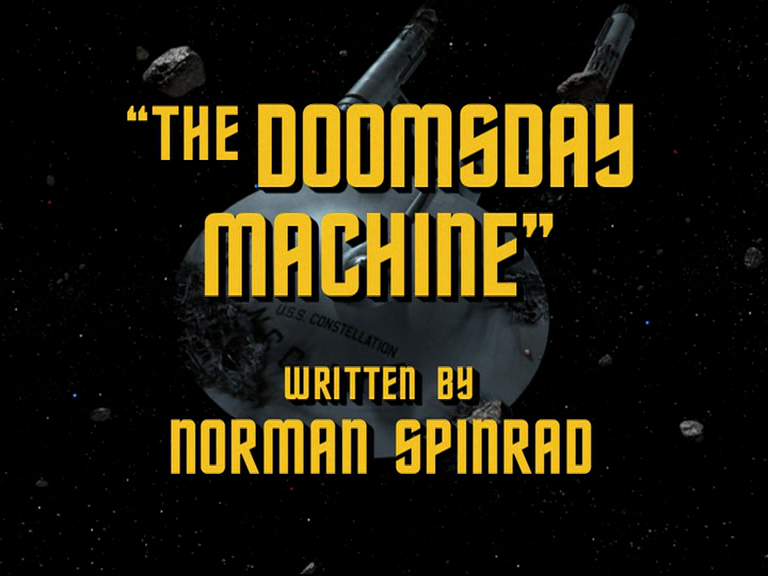
The Doomsday Machine

William Windom is brilliant as Commodore Matt Decker. It's probably the best performance by a guest star on a series not always notable for allowing guest stars to shine. Unless an actor is extremely good, or very lucky, they stand little chance of making an impression against Star Trek's regular cast and attendant science-fiction gubbins (winking lights, strange makeup, weird noises, bizarre creatures, etc). Pity poor Alfred Ryder credited as the guest star of The Man Trap when all the audience remembers is the salt vampire, or Robert Brown dropped at the last minute into a thankless role (technically two thankless roles) in The Alternative Factor and unable to make an impression against the special effects of that episode. There are actors who make Star Trek work for them. William Campbell, as Trelane in The Squire Of Gothos, and Ricardo Montalban, as Khan in Space Seed both take big central characters and make them their own. More impressively Mark Lenard, as the Romulan Commander with no name in Balance Of Terror, and Celia Lovsky as T'Pau in Amok Time both make very good impressions in considerably smaller roles than those given to Ricardo Montalban or William Campbell. Generally speaking though Star Trek tends to be a series which treats the guest star role as disposable. A slot which can be filled by simply giving the star something different to do (evil Kirk in The Enemy Within), or by a prop (Nomad in The Changeling), or a costume (the Gorn, Arena), or by not bothering with a guest star at all (Operation – Annihilate!).

William Windom is so good it comes as something of a disappointment to discover he thought the role, “seemed kind of silly, with the planet eater and spaceships. It's like doing a cartoon, so I acted accordingly!” As a fan, his blunt comment disappoints for two reasons. First because as a non-actor it's easy to assume an actor has to like the material to turn in a good performance (an assumption most actors would probably consider an insult to their professionalism). Secondly because The Doomsday Machine is great. It would be nice to think some of that greatness rubbed off on Windom and made him remember this job as different from the more run of the mill material. Still, it's a reasonable assessment from an actor with an amazingly long career, who seemed to regard television as the disposable portion of his work. The Doomsday Machine was one of ten jobs Windom had in 1967 (the others being parts in Run for Your Life, The Fugitive, Bob Hope Presents the Chrysler Theatre, Hour of the Gun, The Invaders, Custer, Gentle Ben, Dundee and the Culhane, and Judd for the Defense). Imagine how the job must have appeared from his perspective. Five days schlepping across Los Angeles to a soundstage at Desilu (a company past its prime), surrounded by the aforementioned blinking lights and actors in strange makeup, and being told to look scared at something the production team will add later.

There's a surprising similarity between Commodore Decker and Finney from Court Martial. Most obviously in both cases the production team dress the character in a gold coloured top, and give them stubble; apparently the ultimate sign in the 1960s of someone losing their mind. Both actors use the same performance style for their character; letting their voice crack, bulging their eyes, and making quick transitions between emotional states. The key difference is Windom's performance works while Richard Webb's seems melodramatic and over the top. Party this is down to the way each character is introduced to the audience. Court Martial spends a great deal of its running time telling us how everyone loves Finney; he's popular in Starfleet (certainly much more popular than Kirk judging by the welcome he gets at Starbase 11), and generally together enough to assemble (and fake evidence for) an elaborate revenge plot against Captain Kirk. When Finney is finally revealed as a ranting, barely in control madman there's a mismatch between what the audience has been told, and what they are shown, and Webb's performance seems wrong. By contrast The Doomsday Machine sets up two destroyed planetary systems, and a wrecked starship. After Matt Decker is introduced in a virtually catatonic state Windom's performance seems appropriate because his character has obviously gone through hell. Also, Windom is a better actor than Webb. That's not to run down Webb's performance too much because he's fine in Court Martial, but Windom is just astonishing.

KIRK: Matt, where's your crew?
DECKER: On the third planet.
KIRK: There is no third planet.
DECKER: Don't you think I know that? There was, but not anymore. They called me. They begged me for help, four hundred of them. I couldn't. I couldn't.

Windom brings those lines to life. His red-eyed, crumpled face delivery of “don't you think I know that,” is pure melodrama but it works perfectly and sets a doom-laden tone for the rest of the episode. It's no surprise to learn he used to self-deprecatingly refer to himself as Willie the Weeper.

It's the addition of Matt Decker to The Doomsday Machine which makes Norman Spinrad's script sing. His character defines the threat to the Enterprise, acting as a warning from the future of what Kirk could become if his luck ever runs out. Decker also doubles the threat to the Enterprise crew. There's the external threat from the planet killer, and the internal one from Decker who is obsessed with taking revenge against the machine which killed his crew. Decker's presence also makes Kirk more heroic. It's not accidental that Decker as a Commodore outranks both Spock and Kirk. If Decker was a mere Captain he would still be able to take charge of the Enterprise but there would be no drama in the scene where Kirk orders Spock to relieve Decker. It would simply be one Captain taking action against another, the scene only works because Kirk has to undercut the chain of command. The script also shows why Spock is a natural second in command. He knows Decker is wrong but he plays things by the book and follows regulations. He lacks Kirk's ability to make an intuitive leap and find another solution. Essentially Spock's plan is to keep confronting Decker with the facts until he listens to reason. “You tried to destroy it once before, Commodore. The result was a wrecked ship and a dead crew.” Spock doesn't understand emotion enough to realise that saying astonishingly brutal things like that don't help; especially not to someone still grieving over the deaths of 430 crew. The scenes where Decker assumes command of the Enterprise show what an asset Leonard Nimoy is to Star Trek. When Deforest Kelly yells, “do something,” Nimoy's stone-faced stare manages to project the impression that Spock's mind is going at a million miles an hour trying to find a way to relieve Decker of command; really Nimoy was probably wondering what to have for lunch.

The presence of Commodore Decker is also what separates the threat in The Doomsday Machine from the similar one posed by Nomad three episodes ago in The Changeling. Both are apparently unstoppable machines capable of wiping out planetary systems, and both pose a massive threat to the Enterprise. Apart from the difference in size, it's only Nomad's ability to talk which separates the two. The dividing line between good and average stories is very fine and it's easy to imagine transplanting elements from The Changeling into The Doomsday Machine. Nomad could easily have sterilized the Constellation crew, leaving Decker out for revenge and shocked by the threat posed by something so small. Or, Kirk could have beamed inside the planet killer and talked the controlling computer to death with illogic. Kirk is also dealing with a considerable ramping up of threat. Over the last year and a bit he's gone from dealing with a single salt vampire on the Enterprise, to planetary outbreaks of insanity, to machines capable of destroying entire planetary systems.

Marc Daniels, a solid workmanlike director, injects some flourishes into the bridge scenes. Most notably in a lovely tracking shot which starts on Sulu, follows a yellow shirted ensign round to Kirk who then walks in front of the bridge screen and around to Spock. Daniels must have been, understandably, proud of this shot as he repeats it with Kirk and Spock at the end of the episode. Film editor Donald R. Rode also does good work intercutting Kirk and McCoy searching the Constellation with Scotty and the damage control team examining engineering. He also manages to extend the final 30 second countdown to 90 seconds. Something which he makes tense, rather than silly, by cutting frantically between the Enterprise bridge, Scotty attempting to fix the transporter, the transporter room, exterior shots, and Kirk on the Constellation, “Gentlemen, I suggest you beam me aboard.”

Helping Donald R. Rode's cutting in the 30 second countdown is Sol Kaplan's astonishing score. As the planet killer closes on the Constellation, Kaplan gives us a pulsing rhythm which speeds up and increases the tension as the Constellation and the planet killer close on each other, and ends on cornets blaring as the planet killer is destroyed. Kaplan's music is what makes The Doomsday Machine such an outstanding Star Trek episode. It perfectly underscores big moments like Decker flying the shuttle into the planet killer's maw and small ones like the first sighting of the crippled Constellation. Just as important, Kaplan understands the value of silence. When the Enterprise is caught in the planet killer's tractor beam, and Spock threatens to relieve Decker on the grounds that his actions would amount to suicide, the whole scene plays out with no music, and instead the score is brought back on Sulu's line, “we're being pulled inside” to make the ending of act two more dramatic.

Kaplan also composes a theme for people using the transporter which leads to a great musical double-bluff as Kirk sets the timer running on Scotty's lashed up self-destruct system for the Constellation. In the build up to Kirk pressing the red button the music is playing the pulsing planet killer pursuit theme. As he presses the button a trumpet plays a little flurry which extends out into a single held note. The same note as the one which starts the already established transporter theme. As the film cuts to a shot of the transporter the music sounds as if it is making a transition between the theme for the planet killer and the one for the transporter and it tricks the audience into expecting to see Kirk beamed safely aboard. Instead the transporter gives out a puff of smoke, and the held note breaks up into a musical sting. Amusingly, Kaplan is the name of one of the unfortunate guards killed in The Apple (the 9th episode filmed, after The Doomsday Machine but shown the week before), he's the one zapped by lightning, maybe someone on the writing team was having a joke.

Enterprise crew deaths: None.
Running total: 34

Thursday, October 11, 2012

Who Mourns For Adonais?


Most obviously Who Mourns For Adonais? is very much of its time. At the top of the episode McCoy has a line about Lieutenant Carolyn Palamas, “one day she'll find the right man and off she'll go, out of the service.” A line which could be taken to mean married women cannot serve in Starfleet, or that once Palamas has found the right man she'll have no interest in a career. In a better episode this line might just provoke a shrug at the different values of 45 years ago but there are other problems with the script.

For starters Lieutenant Palamas doesn't have much in the way of a character. She fills the same role as Lieutenant McGivers in Space Seed; to be seduced by the guest villain until reminded of where her real loyalties lie. However McGivers had a reason to fall for Khan. She's a historian fascinated by strong men from history, she doesn't seem to fit in on board the Enterprise and her skills are under appreciated by Kirk. Palamas on the other hand doesn't have any comparable motive for falling for Apollo. At the start of the episode she's in a relationship with Scotty, then she beams down with the landing party and when Apollo starts putting his 5000 year old moves on her she's his. Passed from one member of the cast to another without any say in the matter like a football.

One minute Palamas is arguing with Apollo. “But why? What you've said so far makes no sense at all!” Then when Apollo invites her to frolic like the Greeks of old, “you will know what it is to be a goddess,” and Scotty objects and is zapped while drawing his phaser she doesn't really react. She might at least be expected to run over to Scotty and see if he's injured but Kirk does that. Next Apollo magics her into a new dress and takes her for a walk. “Come,” says Apollo and when Scotty intervenes he is thrown backwards across a table, in a well set up stunt, and knocked unconscious. Palamas isn't really that bothered, she doesn't attempt to leave Apollo's side, and goes off with him into the forest. She doesn't even ask if Scotty's all right. She saw the man she's been dating struck under the chin by a massively powerful being who claims to be the Greek god Apollo. She saw him thrown backwards with a crash of thunder to lie still on the ground. McCoy's diagnosis of Scotty as stunned doesn't occur until after Palamas has gone off with Apollo. Scotty could be dead for all Palamas knows. Now try watching her next scene which starts with Palamas' line, “oh it's lovely,” and ends with Apollo kissing her, and try to make sense of it from her perspective. This is not a complaint about 45 year old sexism. It's simply bad writing.

To be fair to Leslie Parrish, the actress who plays Palamas, she seems to be aware of this problem. She makes Palamas look afraid when all this is going on, but the end result is a character who appears to be frightened by the violence itself rather than showing any concern for Scotty. As if Apollo and Scotty were fighting over Palamas in a nightclub. That said Palamas does get to play an essential role in distracting Apollo at the end of the story, and she gets one of the script's best lines when she has to pretend to be studying Apollo to see how he copies human behaviour.

APOLLO: I am Apollo. I've chosen you.
CAROLYN: I'm sure that's very flattering, but I must get on with my work now.

Much more difficult is the scene towards the end where Apollo calls down a storm after he is angered by Palamas rejection. This can be read as a rape scene. Palamas is alone, and afraid. As the winds blow around her she clutches her dress and holds it down as if to protect herself. Apollo, semi-transparent, appears superimposed over storm clouds as if he is either riding the wind, or actually the storm itself. Then Lieutenant Palamas falls to the ground and shouts, “no,” before we see an extreme close-up of Apollo's face still superimposed over the storm, and then the image cuts to a slow zoom towards Palamas as if the audience is seeing her from Apollo's point of view. Obviously the storm could just be Apollo's anger but there is a precedent within Greek mythology, and even specific myths relating to Apollo himself, to suggest this scene could have a much darker symbolic meaning. Technically it's impressive work. Well edited and well scored, in fact the music throughout this episode is consistently excellent. It also works dramatically within the context of the story, but it's steering the programme into waters it is not really equipped to navigate. If it is intended to suggest Apollo raping Lieutenant Palamas, then it gives the ending of the episode, where the audience are invited to feel sympathy for Apollo, a completely inappropriate tone.

Scotty is subject to some very odd characterisation. He's not acting out of character because Scotty has tended to be written according to the needs of each script, and generally it's left to James Doohan to pull the disparate threads together and make Scotty seem like a person. We've seen him be quietly professional in The Naked Time and The Galileo Seven, distracted in Mudd's Women, and gung ho in A Taste Of Armageddon. In Who Mourns For Adonais? Scotty is written as a lovesick teenager. He cannot keep his eyes off Palamas. And when Apollo takes Palamas from him, his instinct is to lash out. Scotty attacks Apollo three times in the course of this episode. Each time to no effect and each time sustaining more and more damage. In Futurama's Star Trek spoof Where No Fan Has Gone Before there is a running joke about Welshy (Scotty's replacement after James Doohan declined to appear) being killed by Melllvar, and his corpse being electrocuted again and again whenever Melllvar becomes angry. Who Mourns For Adonais? could well be the source for that joke.

It's difficult not to feel that writer Gilbert Ralston is just being lazy. Scotty's madly in love with Palamas because it's simply the easiest way to jam a bit of conflict and peril into the second and third act, not because it's a story the writer wants to tell. If Ralston really wanted to write a story about Scotty in love he would have actually put some effort into making it look like Scotty and Palamas were in a relationship. As it is, it's all one way. Scotty can't keep his eyes of Palamas whereas she never really reciprocates. “Oh all right,” is her response to being invited for coffee, and while he calls her Carolyn she calls him Scotty. He fights and risks his life for a woman who never even puts her arm round him. It actually looks less like love and more like obsession; which is worrying considering Wolf In The Fold is coming up.

Ultimately this all affects suspension of disbelief. The triumph of Amok Time is it makes the audience believe Vulcan exists beyond the confines of the television screen. A strong and enjoyable script makes the audience willing to overlook the implausible elements which might otherwise remind them they are watching a story filmed on a soundstage on Gower Street in Hollywood. It's why Joseph Pevney's occasionally clumsy handling of the Gorn in Arena doesn't affect the overall episode; beyond some good natured ribbing about the quality of the costumes. Likewise it's why the obviously fake spore plants in This Side Of Paradise don't matter. If that episode had been filmed on a soundstage planet filled with equally weird looking alien vegetation they could have passed without notice. Filmed on location and contrasted with real plants and trees they might have wrecked the episode. In fact This Side Of Paradise is so confident it makes the plant's appearance the subject of a joke. “What exactly are we looking for anyway, sir?” asks Kelowitz. “Whatever doesn't look right, whatever that is,” replies Sulu (who worked in the botany department in The Man Trap) oblivious to the bizarre plant slightly to his left.

In Who Mourns For Adonais? the absence of believable reactions from Palamas and Scotty means the episode never gels. Michael Forest puts in very good work as Apollo, and makes some very wordy dialogue sound like actual speech. Walter Koenig makes the most of limited scenes as Chekov.

APOLLO: I am Apollo.
[Kirk reacts]
[McCoy reacts]
[MUSIC: dramatic chord!]
CHEKOV: And I am the tsar of all the Russias.


Not the funniest response in the world but it's an interesting way to puncture the mood by introducing a character prepared to give backchat to the antagonist. Star Trek has not really gone in for sending up the baddies before so this is an interesting direction for the series, and the new character.

Matt Jefferies works miracles on a story which requires Apollo to have his own temple. It's fun-sized in comparison to real temples but it's an impressive set element; possibly the biggest the series has used so far.

Also impressive is the shot which ends act one, Apollo tripling in size and towering over the landing party booming, “welcome to Olympus”. It may be Star Trek's most ambitious effects shot so far. The first effects shot, I think, combining two live action elements rather than using overlaid animation, like phasers, or a glass painting. It's made more complicated by being layered so Apollo stands in front of the temple, and then he himself is partially obscured by a marble table in the foreground (a process Wikipedia tells me is a called a travelling matte which means I know what it's called even if I don't really understand how it works). The contrast is a little bit wonky, and the lighting not quite right but it's impressive given the budget and time limitations Star Trek always faced. Another memorable, and bizarre, image is the shot of the hand gripping the Enterprise. In fact judged purely on the visual side, this is a strong episode. The one oddity is the editing decision which means the shot of the hand holding the Enterprise is not used to bookend the opening titles. It begins act one, but it also seems like the ideal shot to end the teaser.

Enterprise crew deaths: None, again. Apollo throws a lot of electricity around but there are no fatalities. Nobody gets Westinghoused. 
Running total: 26