Showing posts with label Space Seed. Show all posts

Wednesday, November 7, 2012

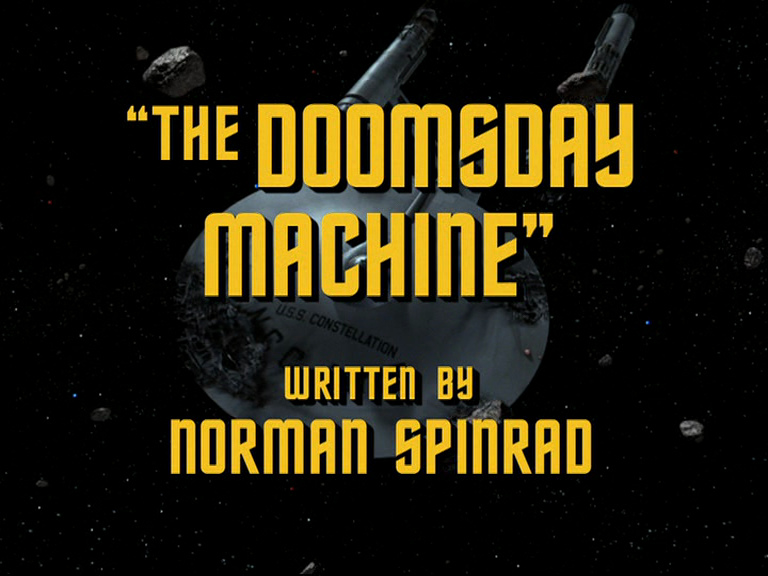
The Doomsday Machine

William Windom is brilliant as Commodore Matt Decker. It's probably the best performance by a guest star on a series not always notable for allowing guest stars to shine. Unless an actor is extremely good, or very lucky, they stand little chance of making an impression against Star Trek's regular cast and attendant science-fiction gubbins (winking lights, strange makeup, weird noises, bizarre creatures, etc). Pity poor Alfred Ryder credited as the guest star of The Man Trap when all the audience remembers is the salt vampire, or Robert Brown dropped at the last minute into a thankless role (technically two thankless roles) in The Alternative Factor and unable to make an impression against the special effects of that episode. There are actors who make Star Trek work for them. William Campbell, as Trelane in The Squire Of Gothos, and Ricardo Montalban, as Khan in Space Seed both take big central characters and make them their own. More impressively Mark Lenard, as the Romulan Commander with no name in Balance Of Terror, and Celia Lovsky as T'Pau in Amok Time both make very good impressions in considerably smaller roles than those given to Ricardo Montalban or William Campbell. Generally speaking though Star Trek tends to be a series which treats the guest star role as disposable. A slot which can be filled by simply giving the star something different to do (evil Kirk in The Enemy Within), or by a prop (Nomad in The Changeling), or a costume (the Gorn, Arena), or by not bothering with a guest star at all (Operation – Annihilate!).

William Windom is so good it comes as something of a disappointment to discover he thought the role, “seemed kind of silly, with the planet eater and spaceships. It's like doing a cartoon, so I acted accordingly!” As a fan, his blunt comment disappoints for two reasons. First because as a non-actor it's easy to assume an actor has to like the material to turn in a good performance (an assumption most actors would probably consider an insult to their professionalism). Secondly because The Doomsday Machine is great. It would be nice to think some of that greatness rubbed off on Windom and made him remember this job as different from the more run of the mill material. Still, it's a reasonable assessment from an actor with an amazingly long career, who seemed to regard television as the disposable portion of his work. The Doomsday Machine was one of ten jobs Windom had in 1967 (the others being parts in Run for Your Life, The Fugitive, Bob Hope Presents the Chrysler Theatre, Hour of the Gun, The Invaders, Custer, Gentle Ben, Dundee and the Culhane, and Judd for the Defense). Imagine how the job must have appeared from his perspective. Five days schlepping across Los Angeles to a soundstage at Desilu (a company past its prime), surrounded by the aforementioned blinking lights and actors in strange makeup, and being told to look scared at something the production team will add later.

There's a surprising similarity between Commodore Decker and Finney from Court Martial. Most obviously in both cases the production team dress the character in a gold coloured top, and give them stubble; apparently the ultimate sign in the 1960s of someone losing their mind. Both actors use the same performance style for their character; letting their voice crack, bulging their eyes, and making quick transitions between emotional states. The key difference is Windom's performance works while Richard Webb's seems melodramatic and over the top. Party this is down to the way each character is introduced to the audience. Court Martial spends a great deal of its running time telling us how everyone loves Finney; he's popular in Starfleet (certainly much more popular than Kirk judging by the welcome he gets at Starbase 11), and generally together enough to assemble (and fake evidence for) an elaborate revenge plot against Captain Kirk. When Finney is finally revealed as a ranting, barely in control madman there's a mismatch between what the audience has been told, and what they are shown, and Webb's performance seems wrong. By contrast The Doomsday Machine sets up two destroyed planetary systems, and a wrecked starship. After Matt Decker is introduced in a virtually catatonic state Windom's performance seems appropriate because his character has obviously gone through hell. Also, Windom is a better actor than Webb. That's not to run down Webb's performance too much because he's fine in Court Martial, but Windom is just astonishing.

KIRK: Matt, where's your crew?
DECKER: On the third planet.
KIRK: There is no third planet.
DECKER: Don't you think I know that? There was, but not anymore. They called me. They begged me for help, four hundred of them. I couldn't. I couldn't.

Windom brings those lines to life. His red-eyed, crumpled face delivery of “don't you think I know that,” is pure melodrama but it works perfectly and sets a doom-laden tone for the rest of the episode. It's no surprise to learn he used to self-deprecatingly refer to himself as Willie the Weeper.

It's the addition of Matt Decker to The Doomsday Machine which makes Norman Spinrad's script sing. His character defines the threat to the Enterprise, acting as a warning from the future of what Kirk could become if his luck ever runs out. Decker also doubles the threat to the Enterprise crew. There's the external threat from the planet killer, and the internal one from Decker who is obsessed with taking revenge against the machine which killed his crew. Decker's presence also makes Kirk more heroic. It's not accidental that Decker as a Commodore outranks both Spock and Kirk. If Decker was a mere Captain he would still be able to take charge of the Enterprise but there would be no drama in the scene where Kirk orders Spock to relieve Decker. It would simply be one Captain taking action against another, the scene only works because Kirk has to undercut the chain of command. The script also shows why Spock is a natural second in command. He knows Decker is wrong but he plays things by the book and follows regulations. He lacks Kirk's ability to make an intuitive leap and find another solution. Essentially Spock's plan is to keep confronting Decker with the facts until he listens to reason. “You tried to destroy it once before, Commodore. The result was a wrecked ship and a dead crew.” Spock doesn't understand emotion enough to realise that saying astonishingly brutal things like that don't help; especially not to someone still grieving over the deaths of 430 crew. The scenes where Decker assumes command of the Enterprise show what an asset Leonard Nimoy is to Star Trek. When Deforest Kelly yells, “do something,” Nimoy's stone-faced stare manages to project the impression that Spock's mind is going at a million miles an hour trying to find a way to relieve Decker of command; really Nimoy was probably wondering what to have for lunch.

The presence of Commodore Decker is also what separates the threat in The Doomsday Machine from the similar one posed by Nomad three episodes ago in The Changeling. Both are apparently unstoppable machines capable of wiping out planetary systems, and both pose a massive threat to the Enterprise. Apart from the difference in size, it's only Nomad's ability to talk which separates the two. The dividing line between good and average stories is very fine and it's easy to imagine transplanting elements from The Changeling into The Doomsday Machine. Nomad could easily have sterilized the Constellation crew, leaving Decker out for revenge and shocked by the threat posed by something so small. Or, Kirk could have beamed inside the planet killer and talked the controlling computer to death with illogic. Kirk is also dealing with a considerable ramping up of threat. Over the last year and a bit he's gone from dealing with a single salt vampire on the Enterprise, to planetary outbreaks of insanity, to machines capable of destroying entire planetary systems.

Marc Daniels, a solid workmanlike director, injects some flourishes into the bridge scenes. Most notably in a lovely tracking shot which starts on Sulu, follows a yellow shirted ensign round to Kirk who then walks in front of the bridge screen and around to Spock. Daniels must have been, understandably, proud of this shot as he repeats it with Kirk and Spock at the end of the episode. Film editor Donald R. Rode also does good work intercutting Kirk and McCoy searching the Constellation with Scotty and the damage control team examining engineering. He also manages to extend the final 30 second countdown to 90 seconds. Something which he makes tense, rather than silly, by cutting frantically between the Enterprise bridge, Scotty attempting to fix the transporter, the transporter room, exterior shots, and Kirk on the Constellation, “Gentlemen, I suggest you beam me aboard.”

Helping Donald R. Rode's cutting in the 30 second countdown is Sol Kaplan's astonishing score. As the planet killer closes on the Constellation, Kaplan gives us a pulsing rhythm which speeds up and increases the tension as the Constellation and the planet killer close on each other, and ends on cornets blaring as the planet killer is destroyed. Kaplan's music is what makes The Doomsday Machine such an outstanding Star Trek episode. It perfectly underscores big moments like Decker flying the shuttle into the planet killer's maw and small ones like the first sighting of the crippled Constellation. Just as important, Kaplan understands the value of silence. When the Enterprise is caught in the planet killer's tractor beam, and Spock threatens to relieve Decker on the grounds that his actions would amount to suicide, the whole scene plays out with no music, and instead the score is brought back on Sulu's line, “we're being pulled inside” to make the ending of act two more dramatic.

Kaplan also composes a theme for people using the transporter which leads to a great musical double-bluff as Kirk sets the timer running on Scotty's lashed up self-destruct system for the Constellation. In the build up to Kirk pressing the red button the music is playing the pulsing planet killer pursuit theme. As he presses the button a trumpet plays a little flurry which extends out into a single held note. The same note as the one which starts the already established transporter theme. As the film cuts to a shot of the transporter the music sounds as if it is making a transition between the theme for the planet killer and the one for the transporter and it tricks the audience into expecting to see Kirk beamed safely aboard. Instead the transporter gives out a puff of smoke, and the held note breaks up into a musical sting. Amusingly, Kaplan is the name of one of the unfortunate guards killed in The Apple (the 9th episode filmed, after The Doomsday Machine but shown the week before), he's the one zapped by lightning, maybe someone on the writing team was having a joke.

Enterprise crew deaths: None.
Running total: 34

Thursday, October 11, 2012

Who Mourns For Adonais?


Most obviously Who Mourns For Adonais? is very much of its time. At the top of the episode McCoy has a line about Lieutenant Carolyn Palamas, “one day she'll find the right man and off she'll go, out of the service.” A line which could be taken to mean married women cannot serve in Starfleet, or that once Palamas has found the right man she'll have no interest in a career. In a better episode this line might just provoke a shrug at the different values of 45 years ago but there are other problems with the script.

For starters Lieutenant Palamas doesn't have much in the way of a character. She fills the same role as Lieutenant McGivers in Space Seed; to be seduced by the guest villain until reminded of where her real loyalties lie. However McGivers had a reason to fall for Khan. She's a historian fascinated by strong men from history, she doesn't seem to fit in on board the Enterprise and her skills are under appreciated by Kirk. Palamas on the other hand doesn't have any comparable motive for falling for Apollo. At the start of the episode she's in a relationship with Scotty, then she beams down with the landing party and when Apollo starts putting his 5000 year old moves on her she's his. Passed from one member of the cast to another without any say in the matter like a football.

One minute Palamas is arguing with Apollo. “But why? What you've said so far makes no sense at all!” Then when Apollo invites her to frolic like the Greeks of old, “you will know what it is to be a goddess,” and Scotty objects and is zapped while drawing his phaser she doesn't really react. She might at least be expected to run over to Scotty and see if he's injured but Kirk does that. Next Apollo magics her into a new dress and takes her for a walk. “Come,” says Apollo and when Scotty intervenes he is thrown backwards across a table, in a well set up stunt, and knocked unconscious. Palamas isn't really that bothered, she doesn't attempt to leave Apollo's side, and goes off with him into the forest. She doesn't even ask if Scotty's all right. She saw the man she's been dating struck under the chin by a massively powerful being who claims to be the Greek god Apollo. She saw him thrown backwards with a crash of thunder to lie still on the ground. McCoy's diagnosis of Scotty as stunned doesn't occur until after Palamas has gone off with Apollo. Scotty could be dead for all Palamas knows. Now try watching her next scene which starts with Palamas' line, “oh it's lovely,” and ends with Apollo kissing her, and try to make sense of it from her perspective. This is not a complaint about 45 year old sexism. It's simply bad writing.

To be fair to Leslie Parrish, the actress who plays Palamas, she seems to be aware of this problem. She makes Palamas look afraid when all this is going on, but the end result is a character who appears to be frightened by the violence itself rather than showing any concern for Scotty. As if Apollo and Scotty were fighting over Palamas in a nightclub. That said Palamas does get to play an essential role in distracting Apollo at the end of the story, and she gets one of the script's best lines when she has to pretend to be studying Apollo to see how he copies human behaviour.

APOLLO: I am Apollo. I've chosen you.
CAROLYN: I'm sure that's very flattering, but I must get on with my work now.

Much more difficult is the scene towards the end where Apollo calls down a storm after he is angered by Palamas rejection. This can be read as a rape scene. Palamas is alone, and afraid. As the winds blow around her she clutches her dress and holds it down as if to protect herself. Apollo, semi-transparent, appears superimposed over storm clouds as if he is either riding the wind, or actually the storm itself. Then Lieutenant Palamas falls to the ground and shouts, “no,” before we see an extreme close-up of Apollo's face still superimposed over the storm, and then the image cuts to a slow zoom towards Palamas as if the audience is seeing her from Apollo's point of view. Obviously the storm could just be Apollo's anger but there is a precedent within Greek mythology, and even specific myths relating to Apollo himself, to suggest this scene could have a much darker symbolic meaning. Technically it's impressive work. Well edited and well scored, in fact the music throughout this episode is consistently excellent. It also works dramatically within the context of the story, but it's steering the programme into waters it is not really equipped to navigate. If it is intended to suggest Apollo raping Lieutenant Palamas, then it gives the ending of the episode, where the audience are invited to feel sympathy for Apollo, a completely inappropriate tone.

Scotty is subject to some very odd characterisation. He's not acting out of character because Scotty has tended to be written according to the needs of each script, and generally it's left to James Doohan to pull the disparate threads together and make Scotty seem like a person. We've seen him be quietly professional in The Naked Time and The Galileo Seven, distracted in Mudd's Women, and gung ho in A Taste Of Armageddon. In Who Mourns For Adonais? Scotty is written as a lovesick teenager. He cannot keep his eyes off Palamas. And when Apollo takes Palamas from him, his instinct is to lash out. Scotty attacks Apollo three times in the course of this episode. Each time to no effect and each time sustaining more and more damage. In Futurama's Star Trek spoof Where No Fan Has Gone Before there is a running joke about Welshy (Scotty's replacement after James Doohan declined to appear) being killed by Melllvar, and his corpse being electrocuted again and again whenever Melllvar becomes angry. Who Mourns For Adonais? could well be the source for that joke.

It's difficult not to feel that writer Gilbert Ralston is just being lazy. Scotty's madly in love with Palamas because it's simply the easiest way to jam a bit of conflict and peril into the second and third act, not because it's a story the writer wants to tell. If Ralston really wanted to write a story about Scotty in love he would have actually put some effort into making it look like Scotty and Palamas were in a relationship. As it is, it's all one way. Scotty can't keep his eyes of Palamas whereas she never really reciprocates. “Oh all right,” is her response to being invited for coffee, and while he calls her Carolyn she calls him Scotty. He fights and risks his life for a woman who never even puts her arm round him. It actually looks less like love and more like obsession; which is worrying considering Wolf In The Fold is coming up.

Ultimately this all affects suspension of disbelief. The triumph of Amok Time is it makes the audience believe Vulcan exists beyond the confines of the television screen. A strong and enjoyable script makes the audience willing to overlook the implausible elements which might otherwise remind them they are watching a story filmed on a soundstage on Gower Street in Hollywood. It's why Joseph Pevney's occasionally clumsy handling of the Gorn in Arena doesn't affect the overall episode; beyond some good natured ribbing about the quality of the costumes. Likewise it's why the obviously fake spore plants in This Side Of Paradise don't matter. If that episode had been filmed on a soundstage planet filled with equally weird looking alien vegetation they could have passed without notice. Filmed on location and contrasted with real plants and trees they might have wrecked the episode. In fact This Side Of Paradise is so confident it makes the plant's appearance the subject of a joke. “What exactly are we looking for anyway, sir?” asks Kelowitz. “Whatever doesn't look right, whatever that is,” replies Sulu (who worked in the botany department in The Man Trap) oblivious to the bizarre plant slightly to his left.

In Who Mourns For Adonais? the absence of believable reactions from Palamas and Scotty means the episode never gels. Michael Forest puts in very good work as Apollo, and makes some very wordy dialogue sound like actual speech. Walter Koenig makes the most of limited scenes as Chekov.

APOLLO: I am Apollo.
[Kirk reacts]
[McCoy reacts]
[MUSIC: dramatic chord!]
CHEKOV: And I am the tsar of all the Russias.


Not the funniest response in the world but it's an interesting way to puncture the mood by introducing a character prepared to give backchat to the antagonist. Star Trek has not really gone in for sending up the baddies before so this is an interesting direction for the series, and the new character.

Matt Jefferies works miracles on a story which requires Apollo to have his own temple. It's fun-sized in comparison to real temples but it's an impressive set element; possibly the biggest the series has used so far.

Also impressive is the shot which ends act one, Apollo tripling in size and towering over the landing party booming, “welcome to Olympus”. It may be Star Trek's most ambitious effects shot so far. The first effects shot, I think, combining two live action elements rather than using overlaid animation, like phasers, or a glass painting. It's made more complicated by being layered so Apollo stands in front of the temple, and then he himself is partially obscured by a marble table in the foreground (a process Wikipedia tells me is a called a travelling matte which means I know what it's called even if I don't really understand how it works). The contrast is a little bit wonky, and the lighting not quite right but it's impressive given the budget and time limitations Star Trek always faced. Another memorable, and bizarre, image is the shot of the hand gripping the Enterprise. In fact judged purely on the visual side, this is a strong episode. The one oddity is the editing decision which means the shot of the hand holding the Enterprise is not used to bookend the opening titles. It begins act one, but it also seems like the ideal shot to end the teaser.

Enterprise crew deaths: None, again. Apollo throws a lot of electricity around but there are no fatalities. Nobody gets Westinghoused. 
Running total: 26

Thursday, October 4, 2012

Amok Time

Amok Time is the episode which confirms Spock's position as Star Trek's breakout character. The first episode of the second series, the shop window episode, is given over to the character the viewers are most likely to recognise, the guy with the ears; a trick Star Trek would try again in a year with the much more exploitatively titled Spock's Brain. Amok Time is also the episode which creates Vulcan. Filling in acres of detail about Spock, his character, his planet, and his biology.

It's remarkable the episode got made. In 1952 CBS decided the word “pregnant” could not be used to describe the lead character in I Love Lucy, the acceptable terms were “expecting”, or “with child”. Five years later the same network refused to approve the début episode of gentle comedy Leave It To Beaver because the show's two child characters hide a baby alligator in a toilet cistern (the agreed compromise was that the toilet cistern could be shown but not the toilet itself). Nothing much had changed by 1967. Stephen E. Whitfield's The Making Of Star Trek is full of notes from NBC's Standards and Practices Department. Dagger Of The Mind: Please delete the underlined in Janice's speech, “I'm a damned attractive female.” Miri: Caution here where Janice opens her uniform to check on the progress of the disease; avoid exposure which would embarrass or offend. Space Seed: Caution on the embrace; avoid the open-mouth kiss. And yet Amok Time is an episode in which Mr. Spock must surrender to his throbbing biological urges and return home to claim his child bride; or die. "I realised that by creating a separate world, a new world with new rules, I could make statements about sex, religion, Vietnam, politics, and intercontinental missiles. Indeed, we did make them on Star Trek: we were sending messages and fortunately they all got by the network." Gene Roddenberry's often used quote has never seemed more appropriate. Certainly the implication of Amok Time is that NBC was happy to talk about sex, as long as it was alien sex.

That said, there is a certain amount of coy tap dancing round the subject. The most explicit Amok Time gets is this exchange.

SPOCK: It has to do with biology.
KIRK: What?
SPOCK: Biology.
KIRK: What kind of biology?
SPOCK: Vulcan biology.
KIRK: You mean the biology of Vulcans? Biology as in reproduction? Well, there's no need to be embarrassed about it, Mister Spock. It happens to the birds and the bees.
SPOCK: The birds and the bees are not Vulcans, Captain. If they were, if any creature as proudly logical as us were to have their logic ripped from them as this time does to us. How do Vulcans choose their mates? Haven't you wondered?
KIRK: I guess the rest of us assume that it's done quite logically.
SPOCK: No. No. It is not. We shield it with ritual and customs shrouded in antiquity. You humans have no conception. It strips our minds from us. It brings a madness which rips away our veneer of civilisation. It is the pon farr. The time of mating. There are precedents in nature, Captain. The giant eelbirds of Regulus Five, once each eleven years they must return to the caverns where they hatched. On your Earth, the salmon. They must return to that one stream where they were born, to spawn or die in trying.

Film editor James D. Ballas allows most of that scene to play out as a single shot which makes it a masterclass for comparing the acting styles of William Shatner and Leonard Nimoy. Shatner seems more inclined to play the scene lightly, looking for the sort of gentle laughs a sitcom might get out of a scene where the father of the family attempts to discuss the facts of life with a son. Nimoy plays it straight but makes the interesting choice to play against the intent of the scene. Instead of being embarrassed he makes Spock visibly angry at not only being forced to discuss something so deeply personal, but at having to keep explaining points to this stupid earthman. Both actors also reverse their usual body language so the more physical Shatner stands very still, while Nimoy writhes in shame. And, of course, the shot is impeccably set-up by director Joesph Pevney who has both actors stand in the centre of the frame, facing the camera, their stances identical with their hands behind their back. Capping the whole scene is Gerald Fried's evocative score.

What's remarkable about Amok Time is how right this all feels. After 29 episodes this influx of backstory could have been a clumsy graft, like suddenly revealing Scotty was married, instead it feels entirely appropriate. Theodore Sturgeon's script puts the audience in the same shoes as Kirk and McCoy, suddenly exponentially increasing their knowledge of Spock and Vulcan. Within the Star Trek universe it makes you realise what a closed world Vulcan must be. More so even than the USSR at the time the episode was written. Almost like North Korea today. Plus, it's a terrific example of a wish backfiring. Spock is ashamed of his human half and wants to be more Vulcan then with the onset of his Pon farr he realises he is more Vulcan than he hoped. It's a lovely moment which shines a light at the heart of his character and the conflict between his Vulcan and human ancestry.

The what's-wrong-with-Spock mystery is only half the episode. At the beginning of act three Kirk, Spock, and McCoy beam down to Vulcan where the duplicitous logic of Spock's bride T'Pring manoeuvres Kirk and Spock into fighting each other. The greatest achievement of the episode may be that Vulcan extends beyond the boundaries of the studio set. Throwaway lines give it history, “[that's] T'Pau. The only person to ever turn down a seat on the Federation Council,” and a sense of place, “It's lovely. I wish the breeze were cooler.” Even better, the series has the self confidence not to worry about making Vulcan customs look silly. The black masked Vulcan carrying an axe, the blizzard of alien words (koon-ut-kal-if-fee, kroykah, plak-tow), the constant jingling of bells all look, and sound, a little silly. It would have been the easiest thing in the world for the production team to play it safe and cut them from the script but they didn't. And Amok Time is a better episode as a result. Customs often look weird to outsiders. In the same way that Guardsmen wearing Bearskins, or Beefeaters, or Morris Dancers end up looking indistinguishable from Monty Python's Flying Circus fish-slapping dance. Being presented in all its wind-chimed, bell ringing glory, gives Vulcan more depth and the alien words benefit from being put in a context which the audience cannot grasp but is obviously there. Removing anything from the script in case the audience might laugh would leave the series looking terribly po-faced. Worse it would remove a magnificent piece of editing when Spock is “deep in the plak-tow.” The two bell ringers march round the plinth Spock and T'Pau are standing on. A sequence of rapid cuts follows; a close-up of Spock, a close-up of the bells, a dutched angle close-up of T'Pau; T'Pring; Kirk; McCoy; Stonn. All backgrounded by the bells jingling and Gerald Fried's fighting music (also known as the national anthem of Decapod 10 from Futurama). It's brilliantly bizarre, the closest Star Trek ever got to a genuine sixties freak out. And just when you think it can't get any better a thunderflash goes off sending a plume of smoke curling into the sky. All that's missing is a fisheye lens close-up of Spock (like we'd see in season three's The Tholian Web).

Amok Time is one of those episodes where everyone seems excited to be involved and has raised their game. Extra care has been taken over even small details. When William Shatner takes the lirpa he drops his arm as if the weapon is heavier than he expected. The blood effect on his wound is slightly gorier and more realistic than might normally be seen. Someone has even taken extra care over the photograph of T'Pring as a child. It's barely on screen for three seconds and yet a set has been constructed for the background. In fact, someone seems to have gone to the trouble of constructing a unique set because it's not one I recall seeing in the episode. It would have been easy, and cheap, to photograph the young T'Pring against a neutral background. That extra money was found to make even a still photo look as good as possible shows everyone concerned wanted Amok Time to look great. And the end result of the production team's pride in their work is that sense that Vulcan is a living world. Even the photograph of T'Pring raises all sorts of questions. Who took the picture, Spock's parents? Young Spock himself? Does he have other pictures of T'Pring? Or a photo album of images from Vulcan? Speculation opened up simply because someone put a more than normal effort into an image on screen for three seconds.

Star Trek is not a series which does introductions but the other notable event of Amok Time is the first appearance of Ensign Chekov. Not that you'd notice from the way he's filmed that he was any different from the other interchangeable bridge crew we saw in season one, but finally, the gang's all here. 

Enterprise crew deaths: None, again. It's been a good few weeks for the Enterprise crew.
Running total: 26

Saturday, September 1, 2012

The Alternative Factor

The Alternative Factor was a troubled production. Contracted guest star John Drew Barrymore failed to turn up for the first day of filming causing delays while Robert Brown was cast in his place. Before that the script had an entire sub-plot removed, a romance between Lazarus and Lieutenant Charlene Masters. It's been speculated the sub-plot was cut at a late stage because Janet MacLachlan, the actress cast, was African American and John Drew Barrymore was Caucasian, and there was concern television stations in the American south would simply refuse to air the episode. Frankly, it's more likely the sub-plot was cut because it contains risible dialogue.

LAZARUS: I have moved through eternity to find you. You know that, don't you? When we first saw each other... you must have felt it.
CHARLENE: I...I...you were like a wounded eagle...
LAZARUS: An eagle looks a long time for his mate... and once he finds her, he never leaves her. I have looked a long time...

It's a cheap shot but given the dialogue above it's no surprise John Drew Barrymore was a no show. Using less eagle references Space Seed would cover the same territory more effectively with the relationship between Khan and Lieutenant McGivers.

How much does this background detail matter? Should we excuse an episode's faults by pointing to production chaos? When Star Trek started running out of usable scripts Gene L. Coon wrote the first draft script of Arena in a weekend. William Shatner's father died during filming of The Devil In The Dark and production eventually had to close down for a day. Jill Ireland was ill during filming of This Side Of Paradise and all her location scenes had to be filmed elsewhere. Chaos doesn't automatically produce a bad episode. The strange thing about The Alternative Factor is that everybody concerned seems to have given up simultaneously. As if all the accumulated stress of making the whole Star Trek series was dumped on this one episode.

As always a bad episode starts with a poor script. The setup of The Alternative Factor is reasonably straightforward. There are two universes. The Star Trek universe, let's call it universe A, and a second, opposite universe, which we'll call universe 1 in a tribute to Futurama. Connecting the two is a corridor which acts as a safety valve. The people of universe 1 discovered the corridor and popped into universe A (by now it should be clear these names are being used in an attempt to generate the same confusion as the episode). The knowledge that an identical version of himself existed was too much, Lazarus A went mad and vowed to destroy Lazarus 1. If the two should ever meet outside of the safety valve corridor then both universes will be destroyed. This much is clear. The rest of The Alternative Factor is lost under terrible scripting, poor characterisation, and a general contempt for narrative.

Take the protagonist(s) Lazarus. In a process which seems to be random and beyond the control of either version of the character they swap between universes. No reason is given for this extraordinary ability. It just happens. What's missing is not Star Trek: Voyager style made-up science, “friction between elecromagnetic waves and luminiferous Ether led to a build-up of Vril on the sector gears of the higher-order columns,” but a simple explanation. Is the transfer related to the expedition the people from universe 1 took to universe A? Did Lazarus 1 cause it? Was it an accident? Is it what drove Lazarus A mad? It's as if The Enemy Within started with Kirk already split in two and no reason given for how this occurred. The audience is simply expected to accept Lazarus has this ability, and that the timing, and effects caused by the switch are dependant on the scripts requirements at that moment.

The first time the episode shows the effect of the switch is in the teaser. The Enterprise shakes, there is the sound of an explosion, and on screen a photograph of a starfield and nebula is overlaid to convey the galactic effect of the event we are being shown. Spock describes what the Enterprise sensors recorded. “For a split second each time, everything within range of our instruments seemed on the verge of winking out.... the entire magnetic field in this solar system simply blinked. The planet below, the mass of which we're measuring, attained zero gravity.... non-existence.” The second time is, if anything, even more dramatic. This time as well as the overlaid photograph and sound effects there is dialogue with added echo. “No! You've come back in, is it? Well, don't stop. Here I am. Come at me again. We'll finish it!” Plus the picture flares to white, like lightning, there's a blurring effect as if vaseline has been smeared on the camera lens, and it looks as if a wind machine was taken on location to blow foliage around. The third time. Nothing.

When the third transfer takes place the writer has a series of script problems to resolve. Kirk and Spock have another 20 minutes of script before they realise the link between the transfer process and the cosmic winking out. However, the writer also needs to get Lazarus 1 onto the Enterprise so he can learn about dilithium crystals. Kirk and Spock also need to think Lazarus A and Lazarus 1 are the same person, but the writer would like to generate some tension by cuing the audience in on this so they can know something the characters do not. The writer's solution to these multiple problems is the laziest one possible, while Lazarus A is treated in sickbay by Doctor McCoy he swaps places with Lazarus 1, and the effect previously described by Starfleet as reported, “in every quadrant of the galaxy and far beyond,” suddenly become unnoticeable to Doctor McCoy who has stepped into a different room.

This scene also contains the first of many examples of truly terrible characterisation. Lazarus A's treatment by McCoy, and switch with Lazarus 1, is not shown, it is reported to us when Kirk and McCoy have a scene in sickbay. The scene ends with this exchange.

KIRK: Where is he?
MCCOY: I don't know, Jim. This is a big ship. I'm just a country doctor.

McCoy let Lazarus wander off. His patient instantly went from injured to healthy and McCoy just let him leave sickbay. This is the writers solution to the problem of keeping Kirk and Spock ignorant of Lazarus' true nature, while also getting Lazarus 1 to where he can learn about dilithium crystals. First the cosmic effects of the transfer process are dialled back, then McCoy shows no professional interest or intellectual curiosity in a patient who heals in seconds, and finally McCoy allows Lazarus to walk out of sickbay. Show, don't tell is the adage of scripting but it is clear the reason this scene is reported to the audience is because any attempt to show it directly would look laughable.

Kirk also has to act stupid for the plot to work. Kirk allows Lazarus to roam the Enterprise corridors even though he believes Lazarus to be a ranting madman. Then, after two dilithium crystals have been stolen Kirk, Spock, Lazarus, and three security guards beam down to the planet to look for them. Lazarus walks away from the group by himself, and no one does anything to stop him. Later when Lazarus is back in sickbay (he fell off a cliff, the second time he does this in one episode) under guard and being interrogated by Kirk we get this immortal dialogue.

MCCOY: He's got to get some rest, Jim. And would you get that muscleman out of my Sickbay. [gestures at the security guard]
KIRK: Dismissed. [The guard leaves]

Unbelievably McCoy requests Lazarus be left unguarded. Despite Lazarus being a proved lair who, rants madly about nothing getting in the way of his vengeance, who is also prime suspect in the theft of two dilithium crystals and an attack on two of the Enterprise crew, and who has also already walked out of sickbay once in this episode. Naturally Kirk agrees. Lazarus promptly walks out of sickbay, rewires the energising circuit to start a diversionary fire, and steals two more dilithium crystals.

So far this review has only discussed the awful script. For the sake of balance the bizarre directing and editing decisions should also be mentioned. When Lazarus A and Lazarus 1 exchange places they meet in the corridor between universes. While there they fight, or at least slowly wrestle. To show this corridor is outside the normal universe the footage is shown in negative (the closing titles to The Squire Of Gothos show a still of Kirk in the corridor before it has been processed to look like an inverted image) and the camera is tilted from side to side. By any standards this is a dull fight. It's slow, and filmed with a single camera so the usual tricks to make fights more exciting, fast edits and closeups and different angles, are not available here. The first time the fight is shown it takes up almost a minute of screen time, subsequent repeats of the footage are shorter but as it is shown for the fourth time it's hard not to believe the audience is expected to find this interesting not because the images are fascinating in their own right, but just because it's a different colour to normal.

It's also worth keeping an eye on the two security guards in the background of the final fight between Kirk and Lazarus A. For some reason the director wants them in the back of shot but has apparently instructed the pair not to move at all. “Stand back,” Kirk orders them, as the pair make no move to get involved. As Shatner manfully struggles with Robert Brown the one on the right keeps smirking, as if he is trying not to blow the take by laughing out loud.

Lastly, Kirk's reaction shot at the end of McCoy's, “this is a big ship. I'm just a country doctor,” line is held just a fraction too long. As a result it looks as if Kirk is about to give McCoy a mouthful of abuse for his lax attitude towards patient care and sickbay security.

What it comes down to is this, This Side Of Paradise is an episode where a good script fires the enthusiasm of the production team, and the cast respond to that enthusiasm and put in good work, which enthuses the production team even more, which makes the cast work better, and so on. The whole episode is lifted by a feedback loop of enthusiasm. The Alternative Factor is the opposite. A stupid and drab script, and a production team apparently depressed by additional problems, results in the cast putting in workmanlike performances. No one really seems to care and the end result is the worst episode of Star Trek's first season.

But having said that, there's the ending. Not Kirk's feeble attempt at profundity. “But what of Lazarus? What of Lazarus?” Just the concept itself. Spending eternity locked in a corridor between universes being attacked by a lunatic. It has an odd way of gripping the imagination. Certainly on the few occasions I've watched this episode it's been something I've thought about afterwards. What would it be like to be in that situation? Can either of the pair die? Can they be hurt or injured? The simple fact I've tried to imagine what it would be like shows I've engaged with the ending. Even the worst episode of Star Trek, so far, works on at least one level.

Enterprise crew deaths: None. 
Running total: 26

Friday, August 3, 2012

A Taste Of Armageddon

Passage of time stops us from seeing some stories properly. Watching Space Seed without thinking of Star Trek II: The Wrath Of Khan is like trying not to think of blue elephants. Tomorrow Is Yesterday used to be a story about the Enterprise crew travelling back in time to the near present, now it's a story about them travelling back in time to a historical period. Likewise the gap between now and the 1967 broadcast of The City On The Edge Of Forever is larger than the gap between when that story aired, and when it was set in 1930 (some of the production team probably had memories of 1930, Gene Roddenberry was born in 1921, Robert Justman and Gene L. Coon in 1926).

So, time makes fools of us all. That's fairly obvious. Unfortunately for some Star Trek episodes what it also does is remove us from the original context. Breaking the connection between
a then current event and a writer making it into a story. Maybe the reason Dagger Of The Mind feels so flat is because it refers back to some specific event or scandal in 1960s' psychiatry, and with the roots of the story forgotten by a modern audience the episode loses some of its meaning. 

A Taste Of Armageddon has been luckier. It works as a story on its own terms. You don't need to know the allegory to appreciate a story where Kirk visits a planet fighting an insane war, and decides to get both sides talking with his own personal brand of intervention. Other stories weren't so lucky (space hippies). According to David Gerrold in his book The World Of Star Trek it's an allegory of Vietnam body counts. These came about because the US was fighting to preserve the South Vietnamese government rather than invade the north. Measuring progress was difficult and so the idea was to count the number of enemy deaths. Kill enough of the enemy and the war could be won by simple attrition. Put in this context A Taste Of Armageddon snaps into focus. The relevance of computers calculating the numbers of dead on either side of the never ending war between the planets Eminiar VII and Vendikar, and the required population obediently marching into disintegration machines so reality matches the numbers, suddenly makes sense not only as a story but within a real world context.

A Taste Of Armageddon hits similar plot beats to The Return Of The Archons ; the Enterprise visits a planet to find out what happened to a vanished Federation ship; there's a computer which, in one way or another, controls the lives of the inhabitants; the Enterprise landing party is cut off from the ship when it comes under attack; Kirk destroys the computer forcing the inhabitants to take control of their lives. However, within that similar plot framework both episodes tell suitably different stories and of the two A Taste Of Armageddon is superior. Partly, this is because Kirk has to work harder in A Taste Of Armageddon. He makes decisions, and takes action, and argues his case to Anan 7, Mea 3, and the High Councillors; all of whom are quite happy to keep the 500 year status quo. Kirk's decision to destroy the war computers is more morally grey, and so more interesting, than when he confuses the Landru computer to death. Once Spock joins Kirk in the High Council chamber Kirk is in a position of strength. The landing party have reclaimed their communicators and phasers. Kirk could just leave. No one on Eminiar VII wants to go back to physical warfare. There is no underground movement like the one on Beta III. Kirk uses saving his crew as an excuse to intervene. As an outsider he can see the bigger picture. As he says, “Death, destruction, disease, horror. That's what war is all about, Anan. That's what makes it a thing to be avoided. You've made it neat and painless. So neat and painless, you've had no reason to stop it.” The war has lasted 500 years, it could go on forever. But is Kirk right to give these horrors of war back to people who have clearly expressed a desire not to see them return?

Although the population of Eminiar VII is represented by the standard dozen or so extras they've being given slightly different actions to perform. When Spock nerve pinches a guard, people mill around and rubberneck. Kirk has to tell them to get out of the way before he blows up one of the disintegration machines. Later, when Spock rescues Ambassador Fox, extras run as Spock's armed party approaches. This is more than just a society of leaders and security guards and as a result it feels like the most fully realised world we've seen so far in Star Trek.

A Taste Of Armageddon gives the audience a new Federation official to roll their eyes at, Ambassador Fox. Although not quite as one dimensional as Galactic High Commissioner Ferris from The Galileo Seven, his early actions are deliberately and unfavourably contrasted with Kirk's. 

UHURA: Captain, message coming in from Eminiar Seven. Sir, it's code seven-ten.
KIRK: Are you sure?
UHURA: Positive. It repeats over and over.
FOX: Is that supposed to mean something?
KIRK: Code seven-ten means under no circumstances are we to approach that planet. No circumstances what so ever.
FOX: You will disregard that signal, Captain.
KIRK: Mister Fox, it is their planet.
FOX: Captain, in the past twenty years, thousands of lives have been lost in this quadrant. Lives that could have been saved if the Federation had a treaty port here. We mean to have that port and I'm here to get it.
KIRK: By disregarding code seven-ten, you might well involve us in an interplanetary war.
FOX: I'm quite prepared to take that risk.
KIRK: You are. I'm thinking about this ship, my crew.
FOX: I have my orders, Captain, and now you have yours. You will proceed on course. Achieve orbit status and just leave the rest to me. You're well aware that my mission gives me the power of command. I now exercise it. You will proceed on course. That's a direct order.

The audience is meant to tut at the stupidity and inflexibility of Fox, and punch the air when Scotty refuses to obey his orders and lower the Enterprise shields. Later Fox does change his mind when he discovers the extent of Anan 7's duplicity but for large parts of the story he's there just to be wrong. Surely there needs to be a better reason for creating an irritating character beyond allowing the writer to nudge the audience in the ribs and go, “check out this dunce” In the end teleplay writers Robert Hamner and Gene L. Coon are so keen to get Fox into trouble they trip themselves up. Fox beams down while the Enterprise shields are still up; something Coon has forgotten he mentioned as impossible in his own script for Arena. The cumulative effect of characters like Ferris, and Fox, is not to make the Enterprise crew look good in comparison but to make the Federation look bad.

Something else which makes the Federation look bad is General Order 24. When Anan 7 contacts the Enterprise Kirk yells, “General Order Twenty Four. Two hours! In two hours!” Subsequent dialogue fills us in on what General Order 24 involves.


KIRK: ...You heard me give General Order Twenty Four. That means in two hours the Enterprise will destroy Eminiar Seven.
ANAN: Planetary defence System, open fire on the Enterprise!
SECURITY: I'm sorry, Councilman. The target has moved out of range.
ANAN: You wouldn't do this. Hundreds of millions of people.
KIRK: I didn't start it, Councilman, but I'm liable to finish it.

and

SCOTT: Open a channel, Lieutenant. This is the commander of the USS Enterprise. All cities and installations on Eminiar Seven have been located, identified, and fed into our fire-control system. In one hour and forty five minutes the entire inhabited surface of your planet will be destroyed.

It's clearly not a bluff. Once Kirk has recovered his communicator he contacts the Enterprise to reiterate his instructions and, once the war computers are destroyed, takes time to contact the Enterprise to cancel implementation of the order. While the audience is never told the exact wording of General Order 24 it must be a reasonably explicit instruction to destroy a civilisation or the infrastructure of a civilisation. How else could Scotty know to respond to Kirk's brief order by targeting all cities and installations on Eminiar VII? And, given that the Federation has written instructions to make sure their crews follow the correct procedure when destroying civilisations, how often does this happen?

Crew deaths: None, again. Nobody has died since Arena which was five episodes ago.
Running total: 25

Monday, July 30, 2012

Space Seed

What made Khan Noonien Singh so appealing to Harve Bennett when he was developing the second Star Trek film? One answer comes from listing all the obstacles (people, aliens, concepts) Kirk has overcome in the episodes aired up to Space Seed. Take out all the ones obviously unsuitable as movie baddies (space drunkeness, the children on Miri's planet, the world where imagination becomes reality, etc), and the ones who end their episode dead (salt vampire we hardly knew ye), and you are left with Charlie, Harry Mudd, Balok, the Talosians, off-screen Romulans, Trelane, the Gorn and the Metrons, and Khan. Eight individuals from the 22 episodes aired. Anyone who crosses Kirk doesn't often survive.

By the time Turnabout Intruder airs this list will be longer but a story in which Janice Lester teams up with the brains from The Gamesters of Triskelion to make Kirk, Harry Mudd, and Balok compete in a tranya drinking match is almost certainly not going to make a great film. More seriously, someone like Charlie could return but it would take a lot of care to avoid writing a script which did not simply rehash that episode. A lot of characters are one shot concepts designed to illuminate a specific theme the writer wants to discuss. Fear of the unknown in The Corbomite Maneuver, or the painfulness of adolescence in Charlie X. Take these characters out of the context of their story and they don't work, or have to be changed so much it negates the point of bringing them back. Others, like specific Klingon or Romulan officers, could come back as part of their military regime but simply going, “let's do a film with Klingons or Romulans” won't move the film development process forwards.

Harry Mudd is an exception because his character is written so broadly; effectively a prototype for what the Ferenghi will become. He could just keep coming back. All that's required is a con or caper to involve him. It's even possible to imagine slotting him into existing episodes, The Trouble With Tribbles, wouldn't be massively different if he replaced trader Cyrano Jones. However, just because it's easy to shape a story around Harry Mudd that doesn't make him a character you could use at the dramatic heart of a story.

Khan is another exception. (Trelane may be a third. The similar character Q shows the concept of a god-like alien tormenting the Enterprise D crew can support a lot of different stories. Still I'm not completely certain Trelane, as originally imagined as child god, would work. He doesn't easily fit into a story which doesn't involve him playing games with the Enterprise crew until Kirk outwits him. How many times could Kirk do this before the god-like alien starts to look ineffective?). Khan genuinely has built in sequel potential. At the most basic level his massive arrogance means his defeat by Kirk will rankle, and he'll always be looking for a chance to even the score. Plus, Kirk leaves him on a planet to build a civilisation in his own image. Spock even speculates about returning to Ceti Alpha V in 100 years to see what Khan has done. Both Khan's character, and the situation he finishes the episode in are open ended. In fact his sequel potential is so obvious I can't help wondering if one of the writers, Gene L. Coon and Carey Wilber, was thinking along these lines at the time and, rather like the time travel ending of The Naked Time, was discretely setting events up for a second story which never happened.

It also helps that Khan is expertly played by Ricardo Montalban. As in Charlie X, and The Squire Of Gothos, we have an actor taking a part and running with it. Montalban brings an already well written character to life, and gives him the power, charisma, and magnetism the role needs. And the script needs Montalban's input. Not because it's bad, it isn't, but because it's incredibly wordy. One of the unusual things about Space Seed is the lack of action. A story about a genetic superman taking over the Enterprise could reasonably be expected to be very physical, full of fist fights and action sequences, but it isn't. Anyone could make the part of Khan work if it was a Darth Vader-like role involving picking people up by the neck and flinging bodies around but Montalban has to sell us on both Khan's physicality and intellect, and he does it so well it's easy to see why Harve Bennett wanted Khan for the second film.

Slightly less successful is Lieutenant Marla McGivers, who falls for Khan in a big way, and helps him in his attempt to take over the Enterprise. The problem is she's a bit of a wet fish. Her character is nicely established as someone who fantasises about strong historical figures -Napoleon, Richard the Lionheart, Leif Ericson- but it's harder to spot what Khan sees in her. She mainly seems to spend her time looking doe-eyed at Khan as he psychologically bullies her. Perhaps this is what Khan wants? Presumably the female genetic superwomen in his group would share Khan's arrogance so maybe he's on the lookout for someone he can dominate rather than to have children. Kirk also seems to have very little time for McGivers, and isn't worried about criticising her in front of the bridge crew, “here's a chance for that historian to do something for a change,” he says as he prepares an away team to board the SS Botany Bay. It's not clear exactly when McGiver's recognises Khan although after he storms out of a formal dinner she goes to his quarters and worries him by saying, “I know who you are,” but he's been on board for hours by this point. McGivers seems to be a pretty solid historian. She's studied great men of history. She identifies the sleeper ship, knows when it was in use, and knows how the revival process resuscitates the leader first. Either she knows who Khan is from more or less the moment she first sees him, or at least that's the point where she begins to hope this mystery man might be Khan. Put it this way, if you were a historian who discovered an 200 year old ice packed figure, wearing a bicorne hat, with his hand tucked into his jacket, frozen alive on a French Frigate called the Elba wouldn't you at least wonder if he might be Napoleon?

The first 30 minutes of the story pass quickly. It's a surprise to get to Khan's takeover of the Enterprise and realise the episode is already more than half over. The hijacking of the Enterprise is a good example of how to write an exciting sequence which contains no action. The whole scene is set on the bridge and begins with security alerting Kirk to Khan's escape. One by one Kirk's orders to the crew fail because Khan has already anticipated them; communication channels are jammed, atmospheric controls are cut off, neural gas cannot be used to knock out the hijackers, and the turbo elevators are inoperative. Kirk comes to a surprised halt as the elevator door fails to open, and it's surprising how effective this one simple visual is to an audience who have got used to doors swishing open automatically. Several things impress about this scene. Firstly we get a sense of the effectiveness of the bridge crew as they switch from relaxed routine to dealing with the emergency. Secondly, although the scene is short it sells the idea that hijacking the Enterprise is really difficult. And, thirdly, it's confirmation of everything Khan has been saying through the episode. The bridge crew are good, but he's better.

While the script is enjoyable it's not perfect. The climax particularly disappoints. Up to now the dialogue has been really good, with Kirk and Khan jabbing at each other with words, so it's more of let down when the stunt doubles run in and begin exchanging punches. Worse this fight comes after a whole episode of being told Khan is superior to regular humans, including an awesome scene in which Khan first pulls open the locked door to his quarters by hand and then knocks a stuntman flying (Montalban sells the scene where he pulls the door open, and the stuntman does a fantastic backflip as Khan catches him under the chin). The idea Kirk could go toe to toe with Khan just doesn't work. Especially not with Kirk fresh out of a decompression chamber. Still, the ending does provide a character point. Kirk wins by cheating, he clubs Khan with some sort of tool he pulls out of the engineering panel. It must grate with Khan that the superior man was beaten in an unfair fight. Two episodes ago Court Martial ended in engineering with Kirk fighting Finney in a race against time to prevent Finney's sabotage from destroying the Enterprise. Now, Space Seed ends in engineering with Kirk fighting Khan in a race against time to prevent Khan's sabotage from destroying the Enterprise. Court Martial was made as episode 14, and Space Seed as episode 24, so it's unfortunate that when aired only one episode separates two stories which end so similarly.

When Khan is revived he wants to know how long he has been asleep, “two centuries we estimate,” Kirk tells him. Along with the “I am going to lock you up for two hundred years”/ “That ought to be just about right” joke from Tomorrow Is Yesterday this pretty much confirms that, whatever the consensus now, the sixties production team thought Star Trek was set in the 22nd Century rather than the 23rd. It's also odd to hear characters talking so glibly about the terrible history of the 1990s. “A strange, violent period in your history,” Spock says. “Your Earth was on the verge of a dark ages. Whole populations were being bombed out of existence.” It's difficult to believe these dates were chosen at random. If Gene L. Coon and Carey Wilbur wanted a more futuristic feel they would either have been less specific about the years Khan ruled, 1992 to 1996 as Spock tells us, or they would probably have gone for a date after the millennium. The 1990's represent a time the Star Trek target audience could reasonably expect to see, Carey Wilbur died in 1998 aged 81. These dates have the double advantage of allowing the audience to hear the characters talk about their personal future as if it was the ancient past, and giving the audience a frisson of excitement in much the same way James Cameron gives the date of Judgement Day as August 29th 1997 in 1991's Terminator 2: Judgment Day.

Crew deaths: None, again. Assuming the security guard Khan hits is just knocked unconscious.
Running total: 25