Showing posts with label Court Martial. Show all posts

Thursday, January 31, 2013

Wolf In The Fold


One week after Obsession asked the audience to consider the question “will Kirk sacrifice everything for vengeance?” To which the only answer can be no. Wolf In The Fold asks the audience, “has Scotty suddenly become a murderer?”

How much does this matter? The audience goes into Obsession knowing Kirk's desire for revenge at all costs will take place within strictly defined boundaries. He's not going to strap himself to the anti-matter as bait and shriek, “from hell's heart I stab at thee,” before detonating. The episode succeeds or fails not on the strength of the ending, but on the way the story is told, and Obsession works because it is packed with incident. When the Enterprise crew discover the cloud vampire can travel through space it opens up the story. Kirk is no longer trying to track down a single monster skulking on a planet. Suddenly there's a high speed pursuit. Then the creature turns to attack and invades the ship becoming only the second foe to directly breach the sanctity of the Enterprise under its own power; Trelane was the first; others like Nomad are brought on board.

By contrast Dagger Of The Mind asks the audience, “is there something rotten in the Tantalus penal colony?” The episode fails because the script fills the next three acts with Kirk investigating, and finding that everything in the colony is good, before the reveal at the end of act three that there is something nasty going on after all. The episode doesn't attempt to make the investigation itself interesting or different (the one exception being the introduction of the Vulcan mind meld). There's no acknowledgement that setting up a place as nice, and then revealing it to have a dark secret, is an antique piece of storytelling. The script plods on as if the viewer has never encountered this type of story before and expects us to be amazed at the twist that Doctor Adams, the only other major character in the story, is actually the villain.

So is Wolf In The Fold like Obsession or Dagger Of The Mind? At the start it does look like Wolf In The Fold expects the audience to sit through 48 minutes of seeing Scotty accused of murder, before the surprise reveal of his innocence in the last act. In the teaser, even before the first murder is committed, the script heaps on unconvincing psychobabble to try and make the viewer believe something is wrong with Scotty.

MCCOY: ... Don't forget, the explosion that threw Scotty against a bulkhead was caused by a woman.
KIRK: Physically he's all right. Am I right in assuming that?
MCCOY: Oh, yes, yes. As a matter of fact, considerable psychological damage could have been caused. For example, his total resentment toward women.

But having set up the plot Robert Bloch's script seems to realise it's a narrative dead end to wring drama out of Scotty's predicament. Instead the story takes a turn towards farce, trapping Scotty in more unlikely and implausible situations. There are three murders, and each one makes Scotty look increasingly guilty. One of the problems for a writer is that the audience is often ahead of you in terms of plot development. The script does seem to acknowledge it knows the watching audience are waiting for Kirk and Spock to pull some technological rabbit out of a hat and clear Mr. Scott's name. At least, the watching adult audience knows Scotty can't be the killer. It's important to make the distinction between the way children and adults watch television. I can remember being a much more innocent viewer and essentially taking it on trust that what was shown was really happening.* If I saw Wolf In The Fold when I was younger I would have been horrified at what Scotty was doing.

There is certainly plenty of incident along the way. Aside from the murders we have a planet of prostitutes. “A completely hedonistic society,” as McCoy tells Scotty. Obviously the script can't come flat out and say it, but there are enough hints for dirty minded people like myself. Lines of dialogue trail off into meaningful ellipsis. Looking around the club Scotty asks, “you mean to tell me all these women, that all this is..?” Shortly afterwards Kirk tells McCoy, “I know a little place across town where the women...” Jealousy is disapproved of on Argelius II and men there should not get upset when they see the woman they love flirting with other men. In act two there's a séance, and in act three a courtroom scene. Two weeks after a similar one in The Deadly Years. The courtroom scene here is shorter, and has a better mix of characters. It does spend some time rehashing the plot from acts one and two, but generally it does a better job of moving the story on than the competency hearing in The Deadly Years.

It's worth taking stock of the plot at the end of act two when all three murders have been committed, and trying to work out how the viewer at home might expect the story to develop. Heroes falsely accused of murder are not a new development. Richard Kimble was on the run in The Fugitive from 1963 to August 1967. Obviously Scotty will be proved innocent, and if the murderer isn't a regular it has to be one of the guest cast.

Tark: 10-1. He's the father to Kara the first victim and appears to have no connection or motive for the second and third deaths. He's also not present for the killing of Lieutenant Tracy.

Morla: 5-1. Kara's fiancé. He has a motive for killing Kara, jealousy. Maybe killing her gave him a taste for murder? Like Tark he's not present when Lieutenant Tracy is murdered, but this is a science fiction show so he could have some unlikely gimmick which allows him to be the killer.

Mr. Hengist: evens. He's a petty bureaucrat more concerned about procedure and stopping Kirk muscling in on the investigation than finding out the truth. Like the first two suspects he's not present for the death of Lieutenant Tracy but before leaving he does see her beam down. He also seems too keen to railroad Scotty for the murder. However, in television drama the more suspicious a character the more likely they are to be innocent. He's the person you might expect to apologise to Kirk at the end of the episode by saying something like, “I may not agree with your methods but you get results.”

Prefect Jaris: 2-1 (favourite). Highest official on the planet Argelius II. Two murders take place in his house. His wife Sybo is the third victim. Jaris is also the last person to have the knife before it disappears prior to the murder of Lieutenant Tracy. He suggests Lieutenant Tracy use the “small chamber below this room” where she is killed. Could he have staged the first two murders to divert suspicion when he kills his wife? Jaris chides Kirk with the line, “you're behaving very much like a man who is desperately trying anything to save his friend. Would you be as desperate to save Argelius as a space port for your Starfleet?” Is there a political motive there? Later he mentions “I have already heard talk of closing Argelius to space vehicles.” Blaming three brutal murders on an off-worlder could allow him to consolidate power, and dispose of a troublesome wife at the same time. He is on screen with Kirk, McCoy, Scotty, and his wife at the time of the second murder (a solid alibi) but this is a science fiction show so we could be dealing with clones, or evil duplicates.

Find someone who hasn't seen Wolf In The Fold. Sit them down in front of the DVD and pause at the end of act two. Ask them who they think is the murderer. I'm quietly confident Jaris will be the main suspect.

Of course, none of the above suspects are guilty of murder. The revelation Robert Bloch has up his sleeve is unique. It is simultaneously brilliant and utterly stupid, like a scriptwriting version of Schrödinger’s cat. The murders were actually committed by Jack the Ripper. An immortal, non-corporeal killer, who feeds on the fear of his victims, is capable of possessing people, and is currently animating Mr. Hengist. Probably no one saw that coming. The reveal of the true murderer is mad but actually quite clever. Two clues have been hiding in plain sight for quite some time. First is the location of the story on Argelius II, the planet of the prostitutes. Where else might you expect Jack the Ripper to strike? Secondly there is Sybo's use of the name Redjac. Corrupting Jack's nickname of Red Jack like this is doubly clever. It conceals the identity of the killer from any viewer familiar with Ripper history, and it also makes sense for an empath on another world to be unsure about the precise pronunciation of an unfamiliar name.

From this point on the plot takes a turn towards the endearingly bonkers as Jack possesses the Enterprise computer and threatens everyone with a horrible death. He is finally driven back into Hengist's body and beamed into deep space. To stop Jack's threats making the crew scared, and allowing Jack to feed on their fear, Kirk orders the crew to be tranquillized. Frankly the crew don't look tranquillized, they all look stoned so who knows what McCoy is pumping into them. Certainly Mr. Sulu is in no condition to steer the ship, and the scenes of the happy crew look a lot like those with the orb from the Woody Allen film Sleeper.

Two elements of the plot are left unclear. Firstly, was Mr Scott's hand on the dagger? This is understandably underplayed, the production team wouldn't want any hint that Scotty was involved in the killings. Jack's ability to move from person to person would seem to make it easier for him to possess someone close to the victim rather than try to do the deed as Hengist, and then cloud any witnesses' minds. Scotty's memory loss would then be explained by his mind being overwhelmed by Jack's presence rather than any induced amnesia. In the case of the first two killings the script seems to lean towards implicating Jack in Scotty's body. For the murder of Sybo it's not so clear. Scotty talks about standing up to help Sybo and finding something in the way. “Cold, it was, like a stinking draught out of a slaughterhouse, but it wasn't really there.” This sounds like Jack in his true form. Possibly killing Sybo in panic when it hears her shouting out his names.

Secondly, when does Hengist die? Is it when Kirk punches him, or has he been a corpse animated by Jack all along? It looks as if Jack has been using Hengist's body for years, possibly since he came to Argelius from Rigel. Jack/Hengist tries to escape when accused of being the killer so he knows he is guilty, there's no amnesia, which suggests that whatever did the killing is also the driving force in Hengist's body. It might be possible to argue that Jack leaving Hengist's body is what kills him, except that Jack is later driven out of Jaris with no ill effects. Then when Jack repossess Hengist the body leaps back into life as if nothing had happened. The idea of a walking corpse fits well with the way Bloch played with concepts like possession in Catspaw. There's a degree of gruesome appeal to the idea of Jack finding a good place to store Hengist's body, then leaving to possess someone else, then killing, and then returning to reanimate Hengist once more.

One weakness of Wolf In The Fold is its attitude to women. Bloch presents us with a world where all the women are apparently available to any man who wants them, and no man should be jealous about sharing his woman with any number of other men. Kirk and McCoy have brought Scotty to Argelius II so he can learn to like women again by leering at them, and it is implied having sex with them. Spock says that Jack kills women to feed on their fear because, “women are more easily and more deeply terrified, generating more sheer horror than the male of the species,” a statement crying out for a [CITATION NEEDED]. The women of Wolf In The Fold are to be lusted after, killed, or protected.

One last question. Why choose Scotty? For Kirk to be involved story logic dictates it has to be one of the Enterprise crew, but it's unsatisfying to imagine Robert Bloch picking Scotty at random. Like the joke at the end of The Simpsons episode Das Bus where the children are marooned on an island, “...and eventually they were rescued by, oh, let's say... Moe.” If anyone can be the suspect then choose Sulu. The poor guy's been underexposed this year. His character is turning into a chair with a helmsman attached. It's only going to get worse with George Takei's nine week absence for reshoots on the John Wayne film The Green Berets.

Bloch must have put some thought into the decision. Kirk can't be the suspect, otherwise the show becomes Kirk on trial, and Bloch has accidentally rewritten Court Martial. It can't be Spock because he's never going to be a candidate for a brutal, frenzied crime. McCoy could have been the suspect, and it would have paralleled the original Jack the Ripper crimes where the murderer appears to have had some anatomical knowledge. However, going into too much medical detail about the Ripper crimes would probably be too much for NBC. One way or another Scotty has become the go to character for physical and mental trauma. Apollo beats him up in Who Mourns For Adonais and he's put through the emotional wringer by Lieutenant Palamas; he's killed in The Changeling (he gets better); possessed in Catspaw; aged in The Deadly Years; and now this. Truly he's the Timex of Star Trek characters; he takes a licking and keeps on ticking. 

Enterprise crew deaths: 1. Lieutenant Tracy the penultimate victim of Jack the Ripper. 
Running total: 43

*to the extent that I remember watching an animated version of Rikki-Tikki-Tavi (quite possibly this Chuck Jones version from 1975) and bursting into tears when it looked as if Rikki-Tikki-Tavi hadn't survived the climactic fight. Months later, I saw a repeat of the same cartoon and burst into tears at the same point, because I was convinced that this time Rikki-Tikki-Tavi must have died. Of course it's possible I was just a very dull child.

Wednesday, November 7, 2012

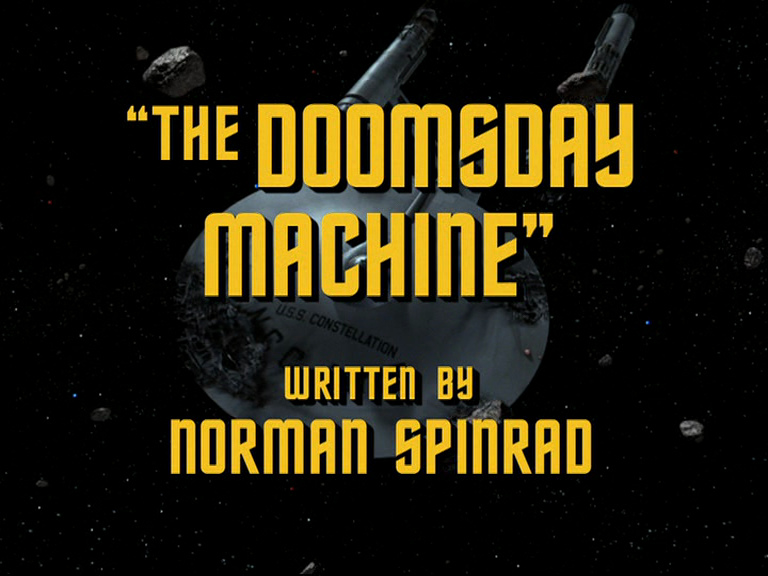
The Doomsday Machine

William Windom is brilliant as Commodore Matt Decker. It's probably the best performance by a guest star on a series not always notable for allowing guest stars to shine. Unless an actor is extremely good, or very lucky, they stand little chance of making an impression against Star Trek's regular cast and attendant science-fiction gubbins (winking lights, strange makeup, weird noises, bizarre creatures, etc). Pity poor Alfred Ryder credited as the guest star of The Man Trap when all the audience remembers is the salt vampire, or Robert Brown dropped at the last minute into a thankless role (technically two thankless roles) in The Alternative Factor and unable to make an impression against the special effects of that episode. There are actors who make Star Trek work for them. William Campbell, as Trelane in The Squire Of Gothos, and Ricardo Montalban, as Khan in Space Seed both take big central characters and make them their own. More impressively Mark Lenard, as the Romulan Commander with no name in Balance Of Terror, and Celia Lovsky as T'Pau in Amok Time both make very good impressions in considerably smaller roles than those given to Ricardo Montalban or William Campbell. Generally speaking though Star Trek tends to be a series which treats the guest star role as disposable. A slot which can be filled by simply giving the star something different to do (evil Kirk in The Enemy Within), or by a prop (Nomad in The Changeling), or a costume (the Gorn, Arena), or by not bothering with a guest star at all (Operation – Annihilate!).

William Windom is so good it comes as something of a disappointment to discover he thought the role, “seemed kind of silly, with the planet eater and spaceships. It's like doing a cartoon, so I acted accordingly!” As a fan, his blunt comment disappoints for two reasons. First because as a non-actor it's easy to assume an actor has to like the material to turn in a good performance (an assumption most actors would probably consider an insult to their professionalism). Secondly because The Doomsday Machine is great. It would be nice to think some of that greatness rubbed off on Windom and made him remember this job as different from the more run of the mill material. Still, it's a reasonable assessment from an actor with an amazingly long career, who seemed to regard television as the disposable portion of his work. The Doomsday Machine was one of ten jobs Windom had in 1967 (the others being parts in Run for Your Life, The Fugitive, Bob Hope Presents the Chrysler Theatre, Hour of the Gun, The Invaders, Custer, Gentle Ben, Dundee and the Culhane, and Judd for the Defense). Imagine how the job must have appeared from his perspective. Five days schlepping across Los Angeles to a soundstage at Desilu (a company past its prime), surrounded by the aforementioned blinking lights and actors in strange makeup, and being told to look scared at something the production team will add later.

There's a surprising similarity between Commodore Decker and Finney from Court Martial. Most obviously in both cases the production team dress the character in a gold coloured top, and give them stubble; apparently the ultimate sign in the 1960s of someone losing their mind. Both actors use the same performance style for their character; letting their voice crack, bulging their eyes, and making quick transitions between emotional states. The key difference is Windom's performance works while Richard Webb's seems melodramatic and over the top. Party this is down to the way each character is introduced to the audience. Court Martial spends a great deal of its running time telling us how everyone loves Finney; he's popular in Starfleet (certainly much more popular than Kirk judging by the welcome he gets at Starbase 11), and generally together enough to assemble (and fake evidence for) an elaborate revenge plot against Captain Kirk. When Finney is finally revealed as a ranting, barely in control madman there's a mismatch between what the audience has been told, and what they are shown, and Webb's performance seems wrong. By contrast The Doomsday Machine sets up two destroyed planetary systems, and a wrecked starship. After Matt Decker is introduced in a virtually catatonic state Windom's performance seems appropriate because his character has obviously gone through hell. Also, Windom is a better actor than Webb. That's not to run down Webb's performance too much because he's fine in Court Martial, but Windom is just astonishing.

KIRK: Matt, where's your crew?
DECKER: On the third planet.
KIRK: There is no third planet.
DECKER: Don't you think I know that? There was, but not anymore. They called me. They begged me for help, four hundred of them. I couldn't. I couldn't.

Windom brings those lines to life. His red-eyed, crumpled face delivery of “don't you think I know that,” is pure melodrama but it works perfectly and sets a doom-laden tone for the rest of the episode. It's no surprise to learn he used to self-deprecatingly refer to himself as Willie the Weeper.

It's the addition of Matt Decker to The Doomsday Machine which makes Norman Spinrad's script sing. His character defines the threat to the Enterprise, acting as a warning from the future of what Kirk could become if his luck ever runs out. Decker also doubles the threat to the Enterprise crew. There's the external threat from the planet killer, and the internal one from Decker who is obsessed with taking revenge against the machine which killed his crew. Decker's presence also makes Kirk more heroic. It's not accidental that Decker as a Commodore outranks both Spock and Kirk. If Decker was a mere Captain he would still be able to take charge of the Enterprise but there would be no drama in the scene where Kirk orders Spock to relieve Decker. It would simply be one Captain taking action against another, the scene only works because Kirk has to undercut the chain of command. The script also shows why Spock is a natural second in command. He knows Decker is wrong but he plays things by the book and follows regulations. He lacks Kirk's ability to make an intuitive leap and find another solution. Essentially Spock's plan is to keep confronting Decker with the facts until he listens to reason. “You tried to destroy it once before, Commodore. The result was a wrecked ship and a dead crew.” Spock doesn't understand emotion enough to realise that saying astonishingly brutal things like that don't help; especially not to someone still grieving over the deaths of 430 crew. The scenes where Decker assumes command of the Enterprise show what an asset Leonard Nimoy is to Star Trek. When Deforest Kelly yells, “do something,” Nimoy's stone-faced stare manages to project the impression that Spock's mind is going at a million miles an hour trying to find a way to relieve Decker of command; really Nimoy was probably wondering what to have for lunch.

The presence of Commodore Decker is also what separates the threat in The Doomsday Machine from the similar one posed by Nomad three episodes ago in The Changeling. Both are apparently unstoppable machines capable of wiping out planetary systems, and both pose a massive threat to the Enterprise. Apart from the difference in size, it's only Nomad's ability to talk which separates the two. The dividing line between good and average stories is very fine and it's easy to imagine transplanting elements from The Changeling into The Doomsday Machine. Nomad could easily have sterilized the Constellation crew, leaving Decker out for revenge and shocked by the threat posed by something so small. Or, Kirk could have beamed inside the planet killer and talked the controlling computer to death with illogic. Kirk is also dealing with a considerable ramping up of threat. Over the last year and a bit he's gone from dealing with a single salt vampire on the Enterprise, to planetary outbreaks of insanity, to machines capable of destroying entire planetary systems.

Marc Daniels, a solid workmanlike director, injects some flourishes into the bridge scenes. Most notably in a lovely tracking shot which starts on Sulu, follows a yellow shirted ensign round to Kirk who then walks in front of the bridge screen and around to Spock. Daniels must have been, understandably, proud of this shot as he repeats it with Kirk and Spock at the end of the episode. Film editor Donald R. Rode also does good work intercutting Kirk and McCoy searching the Constellation with Scotty and the damage control team examining engineering. He also manages to extend the final 30 second countdown to 90 seconds. Something which he makes tense, rather than silly, by cutting frantically between the Enterprise bridge, Scotty attempting to fix the transporter, the transporter room, exterior shots, and Kirk on the Constellation, “Gentlemen, I suggest you beam me aboard.”

Helping Donald R. Rode's cutting in the 30 second countdown is Sol Kaplan's astonishing score. As the planet killer closes on the Constellation, Kaplan gives us a pulsing rhythm which speeds up and increases the tension as the Constellation and the planet killer close on each other, and ends on cornets blaring as the planet killer is destroyed. Kaplan's music is what makes The Doomsday Machine such an outstanding Star Trek episode. It perfectly underscores big moments like Decker flying the shuttle into the planet killer's maw and small ones like the first sighting of the crippled Constellation. Just as important, Kaplan understands the value of silence. When the Enterprise is caught in the planet killer's tractor beam, and Spock threatens to relieve Decker on the grounds that his actions would amount to suicide, the whole scene plays out with no music, and instead the score is brought back on Sulu's line, “we're being pulled inside” to make the ending of act two more dramatic.

Kaplan also composes a theme for people using the transporter which leads to a great musical double-bluff as Kirk sets the timer running on Scotty's lashed up self-destruct system for the Constellation. In the build up to Kirk pressing the red button the music is playing the pulsing planet killer pursuit theme. As he presses the button a trumpet plays a little flurry which extends out into a single held note. The same note as the one which starts the already established transporter theme. As the film cuts to a shot of the transporter the music sounds as if it is making a transition between the theme for the planet killer and the one for the transporter and it tricks the audience into expecting to see Kirk beamed safely aboard. Instead the transporter gives out a puff of smoke, and the held note breaks up into a musical sting. Amusingly, Kaplan is the name of one of the unfortunate guards killed in The Apple (the 9th episode filmed, after The Doomsday Machine but shown the week before), he's the one zapped by lightning, maybe someone on the writing team was having a joke.

Enterprise crew deaths: None.
Running total: 34

Friday, September 7, 2012

The City On The Edge Of Forever

It's very good, but is it the best Star Trek episode ever? No. Although your opinion may differ. (For what it's worth I'm aware of the complicated background to the episode and the arguments down the years about the rewriting of Harlan Ellison's script by then story editor Steven W. Carabatsos, Gene L. Coon, D.C. Fontana, and Gene Roddenberry. I'm just not going there. As with The Alternative Factor what counts is what appears on screen; and hopefully that's the only time The Alternative Factor gets grouped with The City On The Edge Of Forever)

The central weakness of the episode is Edith Keeler. There's frequently a heavy handedness to the way her character is written as if whoever put the final draft together felt that the woman Captain Kirk fell in love with had to be more than extraordinary. It's not enough for her to run a soup-kitchen and be be kind and generous and compassionate. Edith is also written as if she had a direct line to the future. At the Twenty-First Street Mission she gives a speech after the evening meal. “Now I don't pretend to tell you how to find happiness and love when every day is just a struggle to survive, but I do insist that you do survive because the days and the years ahead are worth living for. One day soon man is going to be able to harness incredible energies, maybe even the atom. Energies that could ultimately hurl us to other worlds in some sort of spaceship. And the men that reach out into space will be able to find ways to feed the hungry millions of the world and to cure their diseases. They will be able to find a way to give each man hope and a common future, and those are the days worth living for. Our deserts will bloom.”

When Spock and Leila fall in love in This Side Of Paradise the relationship works precisely because it is not presented to us as The Romance Of The Century. They are simply two people who make each other happy. By contrast Edith's speech above is just unsubtle, and obvious. It's the same problem which affects The Corbomite Maneuver and Court Martial the need to compress maximum information into the minimum amount of time. In those two episodes the result was Navigator Bailey the universe's most incompetent bridge officer, and rambling madman Ben Finney. In The City On The Edge Of Forever the script beats the audience over the head with Edith's qualities. The audience is supposed to be surprised Kirk falls in love with Keeler, after that speech it would be more surprising if he didn't.

Another weakness with the speech is the way it is played. Either Joan Collins, or Joseph Pevney the director, has decided the speech should be played with hesitancy. A literal transcription of the speech would look like this. “One day.. soon... man.. is going to be able to harness.. incredible energies... maybe even the atom.... Energies that could ultimately hurl us to other worlds in... in.. some sort of spaceship... And the men that reach out into space will be able to find WAYS! to feed the hungry millions of the world and to cure their diseases.” The effect of playing that speech with pauses is to make it sound as if she is making it up on the spur of the moment. Yet one of the other people using the mission tells Kirk, and the audience, that listening to Edith talk is how they always pay for their meal. The intent of the speech, that Kirk should be captivated by Edith's rock-solid belief in a better future, and the delivery, hesitant and uncertain, undercut each other. It looks like Kirk falls in love with her because she talks about atomic power and spaceships. It gives the impression he'd have fallen in love with any science-fiction writer.

To be fair, the writing for Keeler is a lot sharper elsewhere in the script, such as the exchange when she first meets Kirk, and Spock, who have snuck into the mission basement.

KIRK: Excuse us, miss. We didn't mean to trespass. It's cold outside.
EDITH: A lie is a poor way to say hello. It isn't that cold.

That's how you write a character who is intelligent and not afraid to stand up for themselves. That's a believable character for Kirk to fall in love with, someone who isn't afraid to challenge his poor behaviour when they first meet. The same is true later in the episode when it's made clear Kirk and Edith share a core philosophy.

EDITH:... I think that one day they'll take all the money they spend now on war and death
KIRK: And make them spend it on life?
EDITH: Yes. You see the same things that I do. We speak the same language.

Unfortunately for William Shatner and Joan Collins This Side Of Paradise has already set the bar for romance in Star Trek. Both Shatner and Collins are charismatic and likeable, but neither of them are able to act at the same level as Leonard Nimoy and Jill Ireland. The City On The Edge Of Forever has no equivalent of the transporter room scene where Leila realises she has lost Spock for a second time. When Shatner and Collins have the screen to themselves they never capture that same intensity. The friendship between Kirk and Spock, and the joy when Kirk and Spock are reunited with McCoy, are more convincing and better played. However, having said that, there is a lovely moment, both scripted and acted, as Spock and Kirk review Edith's potential future.

KIRK: The President and Edith Keeler.
SPOCK: It would seem unlikely, Jim. A few moments ago, I read a 1930 newspaper article.
KIRK: We know her future. Within six years from now, she'll become very important. Nationally famous

Shatner perfectly captures Kirk's pride at the idea of Edith meeting FDR. As if he believes history itself is giving her a stamp of approval and validating all those qualities he sees in her.

There's also a pleasing attention to detail with the other characters. Just before using the Guardian Kirk orders Scotty, “when you think you've waited long enough. Each of you will have to try it. Even if you fail, at least you'll be alive in some past world somewhere.” It's a small moment but by showing us Kirk thinking about his crew it brings the characters to life. As do exchanges like this one.

MCCOY: Some heart flutter. Better risk a few drops of cordrazine.
KIRK: Tricky stuff. Are you sure you want to risk [The hypo hisses and Sulu opens his eyes.]
MCCOY: You were about to make a medical comment, Jim?
KIRK: Who, me, Doctor?

And for a script which is so unsubtle about Edith Keeler, there's a delicacy to the way it introduces the audience to the idea of using the Guardian to travel in time, and alter the past. Right before McCoy escapes into history Kirk asks Spock if they could take McCoy back to the day before and avoid the accidental overdoes of cordrazine. That one line, and Spock's reply about the difficulty of stepping through on a specific day seeds the audience with the idea that the Guardian can be used to travel in time, and alter history, and that it is a difficult and dangerous process.

What also surprises about the script is the pacing. Edith Keeler's big introductory speech takes place 22 minutes into a 48 minute episode. This is a story packed with incident and yet the episode never feels rushed. McCoy accidentally overdoses on cordrazine and goes insane. A mysterious artefact allows travel into the past (and presumably the future). History must be restored to the correct path. Adventures in 1930s New York. Kirk falls in love. Another writer could have built an entire script just from the idea of a race against time manhunt for a temporarily insane McCoy on the surface of a dead planet. There is almost enough material in here for two or three separate episodes. This is a common factor with several of the better episodes of Star Trek: The Corbomite Manouver, Arena, This Side Of Paradise, The Devil In The Dark. It's not exclusively true. Some good stories are quite spartan in comparison, Balance Of Terror for example, but it often does seem to be a common factor that good stories pack in material. By contrast disappointing stories like The Alternative Factor or The Return Of The Archons tend to overextend a single idea. The Alternative Factor mainly involves Kirk getting more and more annoyed with Lazarus, until he realises Lazarus is two separate people, and blows up their spaceship trapping the pair forever.

Once again Joseph Peveny puts in solid work as director. Location filming on the Desilu backlot, seen in Miri and The Return Of The Archons, uses tight camera angles, clever use of extras, and period vehicles to bring the streets to life. All this background detail came at a cost, the total budget for this episode was $245,316, compared to the series average of around $190,000. Look at the tracking shot as Kirk and Spock run away from the Policeman, there are a lot of extras on set. Plus, some simple but effective use of sound effects with the noise of a dog barking. Edith's death is well staged. It's filmed at night and nicely foreshadowed when Kirk and Edith head off to the cinema. As they step into the road a car screeches to a halt and Kirk pulls Edith back.

Film editor James D. Ballas puts together an effective sequence for Edith's date with destiny. An unusual optical zoom is used to pull sharply into Kirk's shocked face, and Edith's as she walks across the road. The choice of shots is also interesting. The obvious way to play the sequence would be to concentrate on Shatner's face, and have him react to off screen noises; a squeal of breaks, a thump, and maybe shouts of alarm. Instead Peveny, or Ballas, goes for the opposite approach. As Kirk holds McCoy he faces away from the camera, it's McCoy's reactions which tell us what is happening, and then we cut to a wider shot showing Edith dead in the road with people running to help. We don't see Kirk's face until the accident is completely over, when the enormity of what he has done has sunk in. Even when he releases McCoy, Kirk never looks round at Edith's body. Kirk walks towards a wall and leans on it, still not looking round, and we fade to the Guardian's planet, and then Kirk, Spock, and McCoy returning. There is lovely passage of time in those three shots. The audience never finds out how long it has been since the accident, although Kirk and Spock have had time to change out of the civilian clothes they wore in 1930s New York. There's very little dialogue, there doesn't need to be. Kirk's silence, and final line, tells us all we need to know.

Enterprise crew deaths: None, again.
Running total: 26

Monday, July 30, 2012

Space Seed

What made Khan Noonien Singh so appealing to Harve Bennett when he was developing the second Star Trek film? One answer comes from listing all the obstacles (people, aliens, concepts) Kirk has overcome in the episodes aired up to Space Seed. Take out all the ones obviously unsuitable as movie baddies (space drunkeness, the children on Miri's planet, the world where imagination becomes reality, etc), and the ones who end their episode dead (salt vampire we hardly knew ye), and you are left with Charlie, Harry Mudd, Balok, the Talosians, off-screen Romulans, Trelane, the Gorn and the Metrons, and Khan. Eight individuals from the 22 episodes aired. Anyone who crosses Kirk doesn't often survive.

By the time Turnabout Intruder airs this list will be longer but a story in which Janice Lester teams up with the brains from The Gamesters of Triskelion to make Kirk, Harry Mudd, and Balok compete in a tranya drinking match is almost certainly not going to make a great film. More seriously, someone like Charlie could return but it would take a lot of care to avoid writing a script which did not simply rehash that episode. A lot of characters are one shot concepts designed to illuminate a specific theme the writer wants to discuss. Fear of the unknown in The Corbomite Maneuver, or the painfulness of adolescence in Charlie X. Take these characters out of the context of their story and they don't work, or have to be changed so much it negates the point of bringing them back. Others, like specific Klingon or Romulan officers, could come back as part of their military regime but simply going, “let's do a film with Klingons or Romulans” won't move the film development process forwards.

Harry Mudd is an exception because his character is written so broadly; effectively a prototype for what the Ferenghi will become. He could just keep coming back. All that's required is a con or caper to involve him. It's even possible to imagine slotting him into existing episodes, The Trouble With Tribbles, wouldn't be massively different if he replaced trader Cyrano Jones. However, just because it's easy to shape a story around Harry Mudd that doesn't make him a character you could use at the dramatic heart of a story.

Khan is another exception. (Trelane may be a third. The similar character Q shows the concept of a god-like alien tormenting the Enterprise D crew can support a lot of different stories. Still I'm not completely certain Trelane, as originally imagined as child god, would work. He doesn't easily fit into a story which doesn't involve him playing games with the Enterprise crew until Kirk outwits him. How many times could Kirk do this before the god-like alien starts to look ineffective?). Khan genuinely has built in sequel potential. At the most basic level his massive arrogance means his defeat by Kirk will rankle, and he'll always be looking for a chance to even the score. Plus, Kirk leaves him on a planet to build a civilisation in his own image. Spock even speculates about returning to Ceti Alpha V in 100 years to see what Khan has done. Both Khan's character, and the situation he finishes the episode in are open ended. In fact his sequel potential is so obvious I can't help wondering if one of the writers, Gene L. Coon and Carey Wilber, was thinking along these lines at the time and, rather like the time travel ending of The Naked Time, was discretely setting events up for a second story which never happened.

It also helps that Khan is expertly played by Ricardo Montalban. As in Charlie X, and The Squire Of Gothos, we have an actor taking a part and running with it. Montalban brings an already well written character to life, and gives him the power, charisma, and magnetism the role needs. And the script needs Montalban's input. Not because it's bad, it isn't, but because it's incredibly wordy. One of the unusual things about Space Seed is the lack of action. A story about a genetic superman taking over the Enterprise could reasonably be expected to be very physical, full of fist fights and action sequences, but it isn't. Anyone could make the part of Khan work if it was a Darth Vader-like role involving picking people up by the neck and flinging bodies around but Montalban has to sell us on both Khan's physicality and intellect, and he does it so well it's easy to see why Harve Bennett wanted Khan for the second film.

Slightly less successful is Lieutenant Marla McGivers, who falls for Khan in a big way, and helps him in his attempt to take over the Enterprise. The problem is she's a bit of a wet fish. Her character is nicely established as someone who fantasises about strong historical figures -Napoleon, Richard the Lionheart, Leif Ericson- but it's harder to spot what Khan sees in her. She mainly seems to spend her time looking doe-eyed at Khan as he psychologically bullies her. Perhaps this is what Khan wants? Presumably the female genetic superwomen in his group would share Khan's arrogance so maybe he's on the lookout for someone he can dominate rather than to have children. Kirk also seems to have very little time for McGivers, and isn't worried about criticising her in front of the bridge crew, “here's a chance for that historian to do something for a change,” he says as he prepares an away team to board the SS Botany Bay. It's not clear exactly when McGiver's recognises Khan although after he storms out of a formal dinner she goes to his quarters and worries him by saying, “I know who you are,” but he's been on board for hours by this point. McGivers seems to be a pretty solid historian. She's studied great men of history. She identifies the sleeper ship, knows when it was in use, and knows how the revival process resuscitates the leader first. Either she knows who Khan is from more or less the moment she first sees him, or at least that's the point where she begins to hope this mystery man might be Khan. Put it this way, if you were a historian who discovered an 200 year old ice packed figure, wearing a bicorne hat, with his hand tucked into his jacket, frozen alive on a French Frigate called the Elba wouldn't you at least wonder if he might be Napoleon?

The first 30 minutes of the story pass quickly. It's a surprise to get to Khan's takeover of the Enterprise and realise the episode is already more than half over. The hijacking of the Enterprise is a good example of how to write an exciting sequence which contains no action. The whole scene is set on the bridge and begins with security alerting Kirk to Khan's escape. One by one Kirk's orders to the crew fail because Khan has already anticipated them; communication channels are jammed, atmospheric controls are cut off, neural gas cannot be used to knock out the hijackers, and the turbo elevators are inoperative. Kirk comes to a surprised halt as the elevator door fails to open, and it's surprising how effective this one simple visual is to an audience who have got used to doors swishing open automatically. Several things impress about this scene. Firstly we get a sense of the effectiveness of the bridge crew as they switch from relaxed routine to dealing with the emergency. Secondly, although the scene is short it sells the idea that hijacking the Enterprise is really difficult. And, thirdly, it's confirmation of everything Khan has been saying through the episode. The bridge crew are good, but he's better.

While the script is enjoyable it's not perfect. The climax particularly disappoints. Up to now the dialogue has been really good, with Kirk and Khan jabbing at each other with words, so it's more of let down when the stunt doubles run in and begin exchanging punches. Worse this fight comes after a whole episode of being told Khan is superior to regular humans, including an awesome scene in which Khan first pulls open the locked door to his quarters by hand and then knocks a stuntman flying (Montalban sells the scene where he pulls the door open, and the stuntman does a fantastic backflip as Khan catches him under the chin). The idea Kirk could go toe to toe with Khan just doesn't work. Especially not with Kirk fresh out of a decompression chamber. Still, the ending does provide a character point. Kirk wins by cheating, he clubs Khan with some sort of tool he pulls out of the engineering panel. It must grate with Khan that the superior man was beaten in an unfair fight. Two episodes ago Court Martial ended in engineering with Kirk fighting Finney in a race against time to prevent Finney's sabotage from destroying the Enterprise. Now, Space Seed ends in engineering with Kirk fighting Khan in a race against time to prevent Khan's sabotage from destroying the Enterprise. Court Martial was made as episode 14, and Space Seed as episode 24, so it's unfortunate that when aired only one episode separates two stories which end so similarly.

When Khan is revived he wants to know how long he has been asleep, “two centuries we estimate,” Kirk tells him. Along with the “I am going to lock you up for two hundred years”/ “That ought to be just about right” joke from Tomorrow Is Yesterday this pretty much confirms that, whatever the consensus now, the sixties production team thought Star Trek was set in the 22nd Century rather than the 23rd. It's also odd to hear characters talking so glibly about the terrible history of the 1990s. “A strange, violent period in your history,” Spock says. “Your Earth was on the verge of a dark ages. Whole populations were being bombed out of existence.” It's difficult to believe these dates were chosen at random. If Gene L. Coon and Carey Wilbur wanted a more futuristic feel they would either have been less specific about the years Khan ruled, 1992 to 1996 as Spock tells us, or they would probably have gone for a date after the millennium. The 1990's represent a time the Star Trek target audience could reasonably expect to see, Carey Wilbur died in 1998 aged 81. These dates have the double advantage of allowing the audience to hear the characters talk about their personal future as if it was the ancient past, and giving the audience a frisson of excitement in much the same way James Cameron gives the date of Judgement Day as August 29th 1997 in 1991's Terminator 2: Judgment Day.

Crew deaths: None, again. Assuming the security guard Khan hits is just knocked unconscious.
Running total: 25

Sunday, July 15, 2012

Court Martial


Isaac Asimov had a book published in 1968 called Asimov's Mysteries. A collection of science fiction stories which worked according to the rules of the mystery genre. Asimov wrote in his introduction to the book,

“I was told that 'by its very nature' science fiction would not play fair with the reader. In a science fiction story, the detective could say, 'But as you know, Watson, ever since 2175, when all Spaniards learned to speak French, Spanish has been a dead language. How came Juan Lopez, then, to speak those significant words in Spanish'. Or else, he could have his detective whip out an odd device and say, 'as you know, Watson, my pocket-frannistan is perfectly capable of detecting the hidden jewel in a trice.'
You don't spring new devices on the reader and solve the mystery with them. You don't take
advantage of future history to introduce ad hoc phenomena. In fact, you carefully explain all facets of the future background well in advance so the reader may have a decent chance to see the solution. The fictional detective can make use only of facts known to the reader in the present or of 'facts' of the fictional future, which will be carefully explained beforehand.”

Asimov became firm friends with Roddenberry, and a supporter of Star Trek. Would he have approved of Court Martial? The story certainly fits the criteria Asimov gives in the above quote.

Inside the trial format is a straightforward mystery. Is Kirk lying, or is the infallible computer wrong? Kirk says he followed procedure during an ion storm and went to red alert before jettisoning a research pod which was endangering the ship. Kirk admits he killed the pod's occupant Ben Finney, but he says Finney was too slow in leaving the pod after Kirk went to red alert. The computer says Kirk jettisoned the pod before going to red alert, and is therefore either lying or incompetent. The script doesn't cheat by relying on made-up devices like Asimov's fantastically named pocket-frannistan. Instead Spock makes a logical deduction from the available evidence. He programmed the computer, and now he can beat it at chess whereas previously the best he could hope for was a draw. Therefore someone has tampered with the computer to change the records it holds.

The closest the episode gets to gimmickry is the ending where the trial moves to the Enterprise bridge after the ship has been evacuated. The Enterprise's internal microphones are massively amplified allowing the people involved in the trial to hear the heartbeats of everyone on board. One by one, McCoy uses a noise cancelling microphone on the trial personnel to remove their heartbeats until only one can still be heard; Finney's. The man Kirk supposedly killed is still alive. He faked his own death, and the evidence against Kirk, and is still hiding on the Enterprise. Even here the story plays fair. Finney's presence on the Enterprise could have been presented by showing an inch by inch bow to stern search of the Enterprise, or by using the ship's sensors. The whole sequence with the microphone is simply a more visually, and audibly, interesting solution.

The major cast all put in good performances. In one short scene William Shatner is brilliant when Kirk is asked to explain in his own words what happened. Shatner plays the scene quietly with very little movement, or expression, and his voice stays clipped and level. Kirk starts out subdued and you can visibly see his confidence grow as he begins to hope he might turn this situation round. It's a performance helped by the directors decision to shoot the scene as a slow zoom into a close-up of Shatner's face, and the editor's decision to play the scene with a minimum of cutting to reaction shots. For a second it's possible to believe Kirk has won the court round by sheer force of personality before the inevitable crushing blow as Areel Shaw shows Finney's faked visual extract from the Enterprise logs.

Unfortunately the story comes with a massive side order of melodrama. Heightened emotions and situations are the order of the day. The tone is set when Finney's daughter bursts into Commodore Stone's office and hysterically accuses Kirk of killing her father. Then we get Cogley the computer hating lawyer. Kirk's old flame Areel Shaw being forced to prosecute him (“Because, Jim Kirk, my dear old love, I am the prosecution, and I have to do my very best to have you slapped down hard. Broken out of the service, in disgrace.”). Lots of courtroom action with people shouting “objection” and “sustained”. And finally poor old Ben Finney.

In the review of The Corbomite Maneuver I talked about television's need to compress maximum information into the minimum time. There we had Navigator Bailey the world's worst bridge officer. Here we have rambling Ben Finney. Cacking, paranoid, bug-eyed, unshaven Ben Finney who, talks about himself in the third person; the ultimate sign of TV madness. “Except for Finney, and his one mistake a long time ago, but they don't forget.” Finney's one mistake was to leave a circuit open to the atomic pile on the USS Republic. Ensign Kirk found and logged the mistake which could have destroyed the ship, and Finney went to the bottom of the promotion pile where he nursed a grudge against Kirk which turned into hate.

It's not that Finney's revenge plan against Kirk lacks sense, it's that Finney as he appears on screen doesn't seem to be the person to carry it out. If this was a spur of the moment idea he comes across as someone who no longer possesses the skills for the fast but detailed work we must assume is required to reprogramme a computer before records are accessed, and leave no obvious traces. Alternatively, if this is a plan which has been maturing for some time it seems unlikely no one has noticed just how mad Finney has become while he waits for the exact combination of circumstances necessary for his plan. It's ironic that in the episode where we first see the Enterprise personnel officer we also see Finney, her greatest failure. 

Bubbling away in the background of Court Martial are a couple of odd moments regarding the planet Vulcan. During the courtroom scenes Spock is referred to, and describes himself, as Vulcanian. Nothing odd about that, although it sounds a little clumsy. Except, in the opening moments of act one Kirk goes to the M11 Starbase club where he greets one of his ex-Academy classmates with the line, “I haven't seen you since the Vulcanian expedition.” Expedition in this case sounds like it is being used in the military sense of the word, which is strange, but also reminded me of this exchange from The Conscience Of The King.

SPOCK: My father's race was spared the dubious benefits of alcohol.
MCCOY: Now I know why they were conquered.

The Conscience Of The King was filmed 12th, Court Martial 14th, and in the middle was The Galileo Seven where the stranded crew display hostility to Spock which is out of keeping with their status as Starfleet Officers, if not completely inappropriate. Could these be remnants of unused backstory for Spock or the planet Vulcan? Was someone on the production team toying with the idea, or under the impression, that Vulcan had been at war with, and conquered by, Earth? These are still early days for the series.
New ideas are always being tried out, and sometimes rejected. Having set up a model for time travel in The Naked Time a different one was used in Tomorrow Is Yesterday. Or look at the way Sulu is shuffled from  astrosciences to helmsman. Even concepts like the Federation, or photon torpedoes, which today are core parts of Star Trek, didn't appear until Arena. 

Kirk also gets a couple of moments which shine an odd light on his backstory. None of the old classmates Kirk meets in the M11 Starbase club seem happy to see him again. One, Timothy, all but accuses Kirk of murdering Finney, and appears to speak for the others when he says, “Ben was a friend of ours.” This scene has a very real story purpose to get the episode off to a good dramatic start, and to contrast Kirk's casual attitude with the very real danger to his career. However it seems odd in the light of Kirk's service record. Think of all the things we've seen him do. It's easy to understand why Commodore Stone starts the investigation into Kirk's actions. He has no choice. It's harder to understand the response of the other Captains but it ties in with information from earlier episodes. In Where No Man Has Gone Before, Mitchell talks about Kirk at the Academy, “A stack of books with legs. The first thing I ever heard from upperclassmen was, Watch out for Lieutenant Kirk. In his class, you either think or sink.” Then in Shore Leave Kirk describes himself as, “absolutely grim.” Their dislike here makes it easy to imagine Kirk as a bookish little prig who was hated by his fellow students. The incident on the USS Republic probably confirmed their bad opinion of Kirk as a nasty little cheeser who wouldn't even give his friend a break.

Crew deaths: None, although if Kirk really is that disliked in Starfleet, it's funny to imagine all the other dead crewmen have faked their own deaths and are also hiding on the Enterprise hoping to get Kirk charged with murder.
Running total: 25