Showing posts with label The Simpsons. Show all posts

Thursday, April 10, 2014

The Savage Curtain

Genghis Khan runs away. That's the moment which best illustrates the flawed and silly nature of this episode. It might seem an odd moment to pick in a story which begins with Enterprise meeting Abraham Lincoln floating in space (never has that stock footage of the bridge screen over Sulu's shoulder looked more inappropriate he just carries on driving the Enterprise as if Abraham Lincoln floating in space is something he sees every other day). A story where Kirk and Spock are fighting for the safety of the Enterprise and their lives in a philosophical death match between good and evil. A battle set up by the rock monster inhabitants of the planet to determine whether good or evil is stronger. A battle in which Kirk and Spock are joined on the side of good by Abraham Lincoln and Surak the Vulcan against Genghis Khan; Kahless the Unforgettable "the Klingon who set the pattern for his planet's tyrannies"; Zora of Tiburon "who experimented with the body chemistry of subject tribes on Tiburon"; and Colonel Green " who led a genocidal war early in the 21st century on Earth."

Following the death of Lincoln, Kirk and Spock are attacked by the opposing four. In a sparsely choreographed fight Kirk grapples with Genghis Khan for a bit before throwing him to the ground and Genghis Khan runs away. That's Genghis Khan, who united the Mongols, and founded the Mongol Empire which stretched from the Caspian Sea to the Sea of Japan. Does Genghis Khan sound like the sort of person who would run away after a scuffle? Follow that thought. Does Genghis Khan sound like the sort of person who would meekly follow the orders of a weasel like Colonel Green? In fact isn't there something annoyingly simplistic about applying labels like "good" and "evil" to historical individuals as complex as Abraham Lincoln and Genghis Khan?

Fans of The Simpsons sometimes use the term Zombie Simpsons to describe new episodes of the series which seem to lack the heart and spirit of earlier shows. The Savage Curtain is Zombie Star Trek. The Savage Curtain constantly gives the impression of a story assembled by people who don't understand Star Trek but have a list of elements which have been used successfully in the past. It explains the characterisation of Genghis Khan or rather the lack of characterisation. Genghis Khan and Zora of Tiburon don't get any lines because there isn't enough space in the story for eight characters, nine if you include the Excalbian. The script isn't interested in Genghis Khan, or how he might react as a person, but simply wants to use the name "Genghis Khan" as a shorthand for "this person is bad." It also explains the treatment of Surak's pacifism. This is no story like Day Of The Dove where Kirk must ironically fight for an end to violence. The script isn't interested in examining pacifism as a point of view, or seeing how people who believe in it might be tested. It's just a label to slap on Surak which allows him to be killed in a way that demonstrates the evil of the baddies.

Like Arena there's an alien with ambiguous god-like powers who forces Kirk into a fight. Gene Coon shuffled the Metrons on and off screen as quickly as possible to avoid the audience thinking about them too much, they're nothing more than a plot device to set up the fight between Kirk and the Gorn captain, but in The Savage Curtain the rock-like Excalbian sticks around for the whole story. Kirk even challenges the Excalbian's motives at the end of the story and there's a bizarre attempt to claim some sort of moral equivalence between the two.

KIRK: How many others have you done this to? What gives you the right to hand out life and death?
ROCK: The same right that brought you here. The need to know new things.

Arena tests Kirk. He's alone and must use his wits to beat the Gorn. In The Savage Curtain he's part of a larger team and it's just a case of good and evil punching each other until one side falls down. In fact in The Savage Curtain even the fight itself is pointless. It's a fight to the death in a series where Kirk and Spock cannot be seen to kill. This is partly because the pair are heroes who cannot do anything too unheroic but mostly because NBC's Standards and Practices won't allow anything too graphic. Arena makes Kirk not being allowed to kill into a strength by having him spare the Gorn when it is at his mercy. The Savage Curtain simply glosses over the fate of the evil side by making it unclear what has happened. At one point Kirk jabs Kahless in the stomach with a blunt stick and the Klingon folds up on the floor in a foetal position. Is he dead or just winded? Then Kirk judo throws Colonel Green to the ground and we cut to an angle where Green's body is concealed behind a rock. There's an ominous musical sting, and Kirk looks grim, but again it's not clear if Colonel Green is dead or unconscious. This casual attitude to violence, and the consequences of violence, actually ends up being more offensive than if we'd seen Kirk directly taking the lives of Kahless and Colonel Green.

Undoubtedly everyone who's ever watched The Savage Curtain has had more fun thinking up unlikely battles for the Excalbians to stage (The Beatles vs The Monkees, or science vs religion). In the end The Savage Curtain is just another story to toss on the pile of episodes to laugh at.

Enterprise crew deaths: None.
Running total: 56

Thursday, February 13, 2014

The Lights Of Zetar


The last hundred survivors of the dead planet Zetar survive through sheer force of will in a non-corporeal form. They have travelled through space for over a thousand years looking for a body which they can take over and live out the remainder of their lives. In the course of their search they killed everyone on Memory Alpha; a planetoid set up by the Federation as a central library containing the total cultural history and scientific knowledge of all Federation members. The lens through which writers Jeremy Tarcher and Shari Lewis focus this story is a romance between Scotty and Lieutenant Mira Romaine a Starfleet specialist supervising the transfer of equipment to Memory Alpha.

A Scotty love story! Has no one learned anything from Who Mourns For Adonais? The answer is yes. A little. This time Scotty is at least involved in a relationship which seems mutual. Unlike the loveless relationship in Who Mourns For Adonais? where Scotty was willing to sacrifice his life for a woman who barely seemed to recognise that he existed; the height of her passion was a reluctant, "all right," when he invited her for coffee.

Apart from that there's very much the sense that The Lights Of Zetar could be Who Mourns For Adonais? with the Apollo plot taken out and the Zetar survivors plot slotted into its place. In both stories Scotty acts utterly obsessed to the extent of disobeying direct orders from Kirk. In both stories there is also the sense that someone on the production team simply looked down a list of episodes and saw there had already been a recent Kirk love story, a Spock love story, a McCoy love story, and a Chekov love story; the only two regular cast not to get a love story are Uhura and Sulu who are both rarely asked to do anything interesting. It's the generic nature of the love plot which really grates; Scotty could be Sulu or Chekov or Lieutenant Kyle. It's like the joke at the end of The Simpsons episode Das Bus where the children are marooned on an island and the narrator says “... eventually they were rescued by, oh, let's say... Moe.”

S
tar Trek is great at telling unique emotional stories for Kirk and Spock. The City On The Edge Of Forever couldn't be about another character falling for Edith Keeler, and there's something endearing about Kirk's reluctance to talk about Ruth in Shore Leave; as if he is embarrassed by the unexpected reappearance of this ghost from his past. Unfortunately when it comes to other characters the scripting suddenly becomes utterly interchangable. "McCoy falls in love...Chekov falls in love...Scotty falls in love." Anyone could have caught a terminal disease and fallen in love in For The World Is Hollow And I Have Touched The Sky. Still this might simply be a reflection of how television worked at the time; maybe carefully worked out character stories were strictly for the lead actors. For all I know on Gunsmoke Chester Goode, Festus Haggen, and Doc Adams were all having interchangeable romances on a weekly basis. At the end of the episode Scotty gazes moon-eyed at Lieutenant Romaine and says, "now we have all the time in the world". We never hear about Lieutenant Romaine again.

It's frustrating that Jeremy Tarcher and Shari Lewis have foregrounded the Scotty love story. The other concepts are really interesting. There's a spiritual element to the Zetarians who drift around the universe as disembodied minds, possessing people, forcing them to speak in tongues, and giving Lieutenant Romaine the power of second sight. Their psychedelic colours and appearance in extreme close-ups of Lieutenant Romaine's eye probably springs more from Dave Bowman's trip beyond the infinite in 2001: A Space Odyssey which premièred in Los Angeles on 4th April 1968.


Memory Alpha is the Library of Alexandria for the Federation. It is destroyed because, "when the library complex was assembled, shielding was considered inappropriate to its totally academic purpose. Since the information on the Memory planet is available to everyone, special protection was deemed unnecessary. " The line is probably a quick story fix; like M-5's unexpected and never again mentioned ability to generate a force field in The Ultimate Computer. During story development someone probably wondered why everyone on the Enterprise survived their encounter with the Zetarians unlike the people on Memory Alpha. It makes the Federation seem sweetly naive, as if they never expected anyone to attack a library. The line implies that Memory Alpha has no shielding whatsoever, not even against natural radiation which is strange considering cosmic radiation was a known hazard of space travel by 1968. Apparently anyone using Memory Alpha will be sterilized whenever a nearby star coughs. There's also an odd line from Spock about the loss of Memory Alpha being "a disaster for the galaxy," and "irretrievable," because the memory core is burned out. The script seems to be suggesting that Memory Alpha holds its information in an electronic format which is not backed up. It's easy to watch The Lights Of Zetar today and assume Memory Alpha is like the internet but it's not. It's a genuine space library and Spock's line is a relic of days when information was harder to duplicate.

Enterprise crew deaths: None.

Running total: 53

Thursday, January 31, 2013

Wolf In The Fold


One week after Obsession asked the audience to consider the question “will Kirk sacrifice everything for vengeance?” To which the only answer can be no. Wolf In The Fold asks the audience, “has Scotty suddenly become a murderer?”

How much does this matter? The audience goes into Obsession knowing Kirk's desire for revenge at all costs will take place within strictly defined boundaries. He's not going to strap himself to the anti-matter as bait and shriek, “from hell's heart I stab at thee,” before detonating. The episode succeeds or fails not on the strength of the ending, but on the way the story is told, and Obsession works because it is packed with incident. When the Enterprise crew discover the cloud vampire can travel through space it opens up the story. Kirk is no longer trying to track down a single monster skulking on a planet. Suddenly there's a high speed pursuit. Then the creature turns to attack and invades the ship becoming only the second foe to directly breach the sanctity of the Enterprise under its own power; Trelane was the first; others like Nomad are brought on board.

By contrast Dagger Of The Mind asks the audience, “is there something rotten in the Tantalus penal colony?” The episode fails because the script fills the next three acts with Kirk investigating, and finding that everything in the colony is good, before the reveal at the end of act three that there is something nasty going on after all. The episode doesn't attempt to make the investigation itself interesting or different (the one exception being the introduction of the Vulcan mind meld). There's no acknowledgement that setting up a place as nice, and then revealing it to have a dark secret, is an antique piece of storytelling. The script plods on as if the viewer has never encountered this type of story before and expects us to be amazed at the twist that Doctor Adams, the only other major character in the story, is actually the villain.

So is Wolf In The Fold like Obsession or Dagger Of The Mind? At the start it does look like Wolf In The Fold expects the audience to sit through 48 minutes of seeing Scotty accused of murder, before the surprise reveal of his innocence in the last act. In the teaser, even before the first murder is committed, the script heaps on unconvincing psychobabble to try and make the viewer believe something is wrong with Scotty.

MCCOY: ... Don't forget, the explosion that threw Scotty against a bulkhead was caused by a woman.
KIRK: Physically he's all right. Am I right in assuming that?
MCCOY: Oh, yes, yes. As a matter of fact, considerable psychological damage could have been caused. For example, his total resentment toward women.

But having set up the plot Robert Bloch's script seems to realise it's a narrative dead end to wring drama out of Scotty's predicament. Instead the story takes a turn towards farce, trapping Scotty in more unlikely and implausible situations. There are three murders, and each one makes Scotty look increasingly guilty. One of the problems for a writer is that the audience is often ahead of you in terms of plot development. The script does seem to acknowledge it knows the watching audience are waiting for Kirk and Spock to pull some technological rabbit out of a hat and clear Mr. Scott's name. At least, the watching adult audience knows Scotty can't be the killer. It's important to make the distinction between the way children and adults watch television. I can remember being a much more innocent viewer and essentially taking it on trust that what was shown was really happening.* If I saw Wolf In The Fold when I was younger I would have been horrified at what Scotty was doing.

There is certainly plenty of incident along the way. Aside from the murders we have a planet of prostitutes. “A completely hedonistic society,” as McCoy tells Scotty. Obviously the script can't come flat out and say it, but there are enough hints for dirty minded people like myself. Lines of dialogue trail off into meaningful ellipsis. Looking around the club Scotty asks, “you mean to tell me all these women, that all this is..?” Shortly afterwards Kirk tells McCoy, “I know a little place across town where the women...” Jealousy is disapproved of on Argelius II and men there should not get upset when they see the woman they love flirting with other men. In act two there's a séance, and in act three a courtroom scene. Two weeks after a similar one in The Deadly Years. The courtroom scene here is shorter, and has a better mix of characters. It does spend some time rehashing the plot from acts one and two, but generally it does a better job of moving the story on than the competency hearing in The Deadly Years.

It's worth taking stock of the plot at the end of act two when all three murders have been committed, and trying to work out how the viewer at home might expect the story to develop. Heroes falsely accused of murder are not a new development. Richard Kimble was on the run in The Fugitive from 1963 to August 1967. Obviously Scotty will be proved innocent, and if the murderer isn't a regular it has to be one of the guest cast.

Tark: 10-1. He's the father to Kara the first victim and appears to have no connection or motive for the second and third deaths. He's also not present for the killing of Lieutenant Tracy.

Morla: 5-1. Kara's fiancé. He has a motive for killing Kara, jealousy. Maybe killing her gave him a taste for murder? Like Tark he's not present when Lieutenant Tracy is murdered, but this is a science fiction show so he could have some unlikely gimmick which allows him to be the killer.

Mr. Hengist: evens. He's a petty bureaucrat more concerned about procedure and stopping Kirk muscling in on the investigation than finding out the truth. Like the first two suspects he's not present for the death of Lieutenant Tracy but before leaving he does see her beam down. He also seems too keen to railroad Scotty for the murder. However, in television drama the more suspicious a character the more likely they are to be innocent. He's the person you might expect to apologise to Kirk at the end of the episode by saying something like, “I may not agree with your methods but you get results.”

Prefect Jaris: 2-1 (favourite). Highest official on the planet Argelius II. Two murders take place in his house. His wife Sybo is the third victim. Jaris is also the last person to have the knife before it disappears prior to the murder of Lieutenant Tracy. He suggests Lieutenant Tracy use the “small chamber below this room” where she is killed. Could he have staged the first two murders to divert suspicion when he kills his wife? Jaris chides Kirk with the line, “you're behaving very much like a man who is desperately trying anything to save his friend. Would you be as desperate to save Argelius as a space port for your Starfleet?” Is there a political motive there? Later he mentions “I have already heard talk of closing Argelius to space vehicles.” Blaming three brutal murders on an off-worlder could allow him to consolidate power, and dispose of a troublesome wife at the same time. He is on screen with Kirk, McCoy, Scotty, and his wife at the time of the second murder (a solid alibi) but this is a science fiction show so we could be dealing with clones, or evil duplicates.

Find someone who hasn't seen Wolf In The Fold. Sit them down in front of the DVD and pause at the end of act two. Ask them who they think is the murderer. I'm quietly confident Jaris will be the main suspect.

Of course, none of the above suspects are guilty of murder. The revelation Robert Bloch has up his sleeve is unique. It is simultaneously brilliant and utterly stupid, like a scriptwriting version of Schrödinger’s cat. The murders were actually committed by Jack the Ripper. An immortal, non-corporeal killer, who feeds on the fear of his victims, is capable of possessing people, and is currently animating Mr. Hengist. Probably no one saw that coming. The reveal of the true murderer is mad but actually quite clever. Two clues have been hiding in plain sight for quite some time. First is the location of the story on Argelius II, the planet of the prostitutes. Where else might you expect Jack the Ripper to strike? Secondly there is Sybo's use of the name Redjac. Corrupting Jack's nickname of Red Jack like this is doubly clever. It conceals the identity of the killer from any viewer familiar with Ripper history, and it also makes sense for an empath on another world to be unsure about the precise pronunciation of an unfamiliar name.

From this point on the plot takes a turn towards the endearingly bonkers as Jack possesses the Enterprise computer and threatens everyone with a horrible death. He is finally driven back into Hengist's body and beamed into deep space. To stop Jack's threats making the crew scared, and allowing Jack to feed on their fear, Kirk orders the crew to be tranquillized. Frankly the crew don't look tranquillized, they all look stoned so who knows what McCoy is pumping into them. Certainly Mr. Sulu is in no condition to steer the ship, and the scenes of the happy crew look a lot like those with the orb from the Woody Allen film Sleeper.

Two elements of the plot are left unclear. Firstly, was Mr Scott's hand on the dagger? This is understandably underplayed, the production team wouldn't want any hint that Scotty was involved in the killings. Jack's ability to move from person to person would seem to make it easier for him to possess someone close to the victim rather than try to do the deed as Hengist, and then cloud any witnesses' minds. Scotty's memory loss would then be explained by his mind being overwhelmed by Jack's presence rather than any induced amnesia. In the case of the first two killings the script seems to lean towards implicating Jack in Scotty's body. For the murder of Sybo it's not so clear. Scotty talks about standing up to help Sybo and finding something in the way. “Cold, it was, like a stinking draught out of a slaughterhouse, but it wasn't really there.” This sounds like Jack in his true form. Possibly killing Sybo in panic when it hears her shouting out his names.

Secondly, when does Hengist die? Is it when Kirk punches him, or has he been a corpse animated by Jack all along? It looks as if Jack has been using Hengist's body for years, possibly since he came to Argelius from Rigel. Jack/Hengist tries to escape when accused of being the killer so he knows he is guilty, there's no amnesia, which suggests that whatever did the killing is also the driving force in Hengist's body. It might be possible to argue that Jack leaving Hengist's body is what kills him, except that Jack is later driven out of Jaris with no ill effects. Then when Jack repossess Hengist the body leaps back into life as if nothing had happened. The idea of a walking corpse fits well with the way Bloch played with concepts like possession in Catspaw. There's a degree of gruesome appeal to the idea of Jack finding a good place to store Hengist's body, then leaving to possess someone else, then killing, and then returning to reanimate Hengist once more.

One weakness of Wolf In The Fold is its attitude to women. Bloch presents us with a world where all the women are apparently available to any man who wants them, and no man should be jealous about sharing his woman with any number of other men. Kirk and McCoy have brought Scotty to Argelius II so he can learn to like women again by leering at them, and it is implied having sex with them. Spock says that Jack kills women to feed on their fear because, “women are more easily and more deeply terrified, generating more sheer horror than the male of the species,” a statement crying out for a [CITATION NEEDED]. The women of Wolf In The Fold are to be lusted after, killed, or protected.

One last question. Why choose Scotty? For Kirk to be involved story logic dictates it has to be one of the Enterprise crew, but it's unsatisfying to imagine Robert Bloch picking Scotty at random. Like the joke at the end of The Simpsons episode Das Bus where the children are marooned on an island, “...and eventually they were rescued by, oh, let's say... Moe.” If anyone can be the suspect then choose Sulu. The poor guy's been underexposed this year. His character is turning into a chair with a helmsman attached. It's only going to get worse with George Takei's nine week absence for reshoots on the John Wayne film The Green Berets.

Bloch must have put some thought into the decision. Kirk can't be the suspect, otherwise the show becomes Kirk on trial, and Bloch has accidentally rewritten Court Martial. It can't be Spock because he's never going to be a candidate for a brutal, frenzied crime. McCoy could have been the suspect, and it would have paralleled the original Jack the Ripper crimes where the murderer appears to have had some anatomical knowledge. However, going into too much medical detail about the Ripper crimes would probably be too much for NBC. One way or another Scotty has become the go to character for physical and mental trauma. Apollo beats him up in Who Mourns For Adonais and he's put through the emotional wringer by Lieutenant Palamas; he's killed in The Changeling (he gets better); possessed in Catspaw; aged in The Deadly Years; and now this. Truly he's the Timex of Star Trek characters; he takes a licking and keeps on ticking. 

Enterprise crew deaths: 1. Lieutenant Tracy the penultimate victim of Jack the Ripper. 
Running total: 43

*to the extent that I remember watching an animated version of Rikki-Tikki-Tavi (quite possibly this Chuck Jones version from 1975) and bursting into tears when it looked as if Rikki-Tikki-Tavi hadn't survived the climactic fight. Months later, I saw a repeat of the same cartoon and burst into tears at the same point, because I was convinced that this time Rikki-Tikki-Tavi must have died. Of course it's possible I was just a very dull child.

Sunday, January 13, 2013

The Deadly Years

The Deadly Years is a good example of the balancing act faced by any writer hoping to sell a script to Star Trek. You need an exciting, unique concept, and you also need a script which is actually achievable under the production limitations of the series. You can submit your idea about the Enterprise landing party being attacked by a slug 1000 feet tall but it's probably not going to get past Gene L. Coon's desk. Unless you've written the greatest 1000 feet tall slug attack script ever. A script so good that not making it actually causes the production team some distress at which point they will start looking at ways to make it practical (“what if the slug is only ten feet tall?”, “will 1000 regular sized slugs work instead?”).

By all accounts this is the process The City On The Edge Of Forever went through (with fewer slugs). A whittling down of Harlan Ellison's original script to remove expensive elements like a hike across the terrain of the Guardian's world, including shots of mountains and a distant city, while hopefully staying true to the core of the story. Even after cutting back on the scale The City On The Edge Of Forever was one of Star Trek's most demanding scripts, costing $245,316 against a first series average of $190,000, and taking seven and a half days to film rather than the standard six. The reason the production team went to all this effort can be seen in a Robert Justman memo to John D. F. Black, “without a doubt this is the best and most beautifully written screenplay we have gotten to date and possibly we'll ever get this season.” Harlan Ellison's script was one the production team felt they had to make.
 

The script of The Deadly Years doesn't compare to The City On The Edge Of Forever but it does have an irresistible concept. The idea that Kirk, Spock, McCoy, Scotty and the unfortunate Lieutenant Galway all begin rapidly ageing. It's a threat the audience can grasp instantly. Ageing the main cast has tremendous visual appeal, and it gives the actors something different to do; playing older than an actor's age is a real challenge. On the downside old age make-up is complicated, expensive, and time consuming to apply. The script doesn't just call for the actors to gain a few decades they are continually ageing so the amount of make-up required keeps increasing. Plus, the script doesn't just need one actor ageing up, but five. In the book The World Of Star Trek William Shatner recalls spending three hours in the make-up chair, so that's around nine hours of make-up for those sickbay scenes featuring aged Kirk, Spock, and McCoy.

The compromise which makes the episode affordable is the competency hearing to decide if Kirk is still fit for command. For ten minutes, a fifth of the episode, the action is restricted to one set and everything is kept as simple as possible. Most of the characters stay seated so camera moves are simplified and much of the cutting is just between wide shots of the briefing room and single shots of characters. The lighting is very basic, which presumably reduces setting up times between shots. And although Scotty is present he is the only character not to get a big single close-up, the closest the camera gets to his face is when Scotty appears in a two shot with Doctor McCoy, which suggests his old age make-up has been simplified to reduce preparation time. Also the courtroom events unfold in real time which means the ageing make-up can be fixed for a significant section of the episode. 

Unfortunately the one thing everyone notices about The Deadly Years is it drags badly during the competency hearing. The bulk of act three is taken up with courtroom drama as characters rehash incidents the audience saw in act two. It would be wonderful to replace this hearing with something more dramatic, possibly a sub-plot where the infected landing party stay quarantined on Gamma Hydra IV, as in Miri, and search for a cure while the Enterprise rushes off for help from Starbase 10 and is attacked by Romulans, but that isn't possible. This is not to imply that the hearing is just ten minutes of dead air. The obvious discomfort of the Enterprise crew as they testify against Kirk is well handled. As is Kirk's constant confusion over which planet the Enterprise is currently orbiting, and Shatner's little old man chuckle as he demands the hearing ask him questions to prove he is fit to command.

Another money saving measure is the Romulan attack at the end of the episode. For budgetary reasons no actors are hired to play Romulans but this actually enhances their mystery rather than looking cheap. Writing about Errand Of Mercy I complained, “Any script with the Romulans must, or at least should, waste time explaining why each new trespass [of the neutral zone] does not result in war. Worse, if one side or the other allows multiple breaches of the zone then they start to look weak. Why tell us that breaching the zone is considered an act of war, if that's not what's shown on screen.” The Deadly Years answers that complaint very nicely by establishing that Romulan's don't talk. They are not interested in diplomacy or complaining about violations of their territory. If you cross the neutral zone you will be destroyed, and then the Romulan's will go back to their mysterious business. They are made more alien by not apparently caring about breaches of the zone beyond destroying the ship responsible.

Less successful is the reason the Enterprise breaches the neutral zone in the first place. After Kirk is removed from command Commodore Stocker (for a change the Federation official of the week is nice and well meaning rather than nasty) takes over and orders the Enterprise to fly directly through the neutral zone to the superior medical facilities at Starbase 10. The Star Trek production team made a big deal about believability. Stephen E. Whitfield's The Making Of Star Trek includes an except from the Star Trek writers guide in which prospective writers are asked to find “the major Star Trek format error in the following 'teaser' from a story outline.” What follows is an outline for a scene involving the Enterprise being attacked. As the ship faces destruction Kirk puts his arms around his Yeoman and embraces her. To explain why the scene is wrong the guide suggests imagining it as taking place on the U. S. S. Detroit a Navy destroyer as it faces destruction from an enemy gunboat on a suicide mission; “would Captain E. L. Henderson... turn and hug a comely female WAVE who happened to be on the ship's bridge?” No he wouldn't, the guide concludes. Equally, following a serious accident on a military exercise in West Germany in 1967 would a US Army officer commandeer a Jeep and order it to drive in a straight line through East German territory to bring the critically injured to the superior medical facilities in West Berlin? No he wouldn't, and no matter how naive the script tries to make Commodore Stocker with lines like, “if I could talk to [the Romulans], explain to them why we violated the Neutral Zone,” this is a major believability failure.

The purpose of this scene seems to be to contrast Kirk's direct experience with Stocker's lack of ability, and to make the audience reflect on the foolishness of a system which devalues Kirk's experience just because he is old and a little confused on the fine details. In other words to comment directly on the way the elderly are treated in western society. While this is a laudable message it's undercut by the rest of the script which is about the horror of growing old and has a very unsympathetic view of the elderly. Kirk is tetchy, forgetful, irrational, paranoid, and falls asleep in his chair on the bridge. The message is also undercut by the ending. Understandably the production team wanted a newly young Kirk to leap onto the bridge and save the day but this nullifies any potential message about wisdom being as valuable as youth.

Joseph Pevney directs again, in fact in broadcast order he has now directed three episodes in a row. Although the direction in the competency hearing is largely kept simple he does throw in a few moments of visual flair. The best is when Spock questions Yeoman Atkins. The camera follows Spock around the briefing room and ends on a three shot with Spock and Atkins in the foreground, and Uhura in the background reacting. Once Atkins has been dismissed Spock walks to the front of the frame, picks up one of the electronic clipboards, and walks back to the middle of the shot and begins talking to Uhura. Outside of the competency hearing Pevney has more time to create memorable shot compositions. The best occurs right at the start when Chekov enters one of the buildings on Gamma Hydra IV. Shot from inside looking out, the frame is largely dark with just the slit of the doorway showing the surface of the planet and its lurid orange sky. As Chekov comes through the door he walks into shadow until he stands silhouetted against the exterior. Groping his way forwards in the darkness the camera pulls back, showing us a room full of dimly lit shapes, until the lights suddenly come on and we see the corpse of Alvin. This sequence looks great, but it also demonstrates how the director has to work as a problem solver and compose shots to explain story points clearly. Chekov is a young ensign, but he's seen death before, and shot more matter of factly (Chekov enters the building, sees the corpse, panics, and runs out) this could have looked silly. As it is the use of darkness, and the lights suddenly coming on, and the decision to use weird old age make-up on the body rather than just having an extra lie down, all puts the emphasis on this being a shocking moment. Chekov is scared because it's unexpected not because he's seen a dead man. 

The Deadly Years works best when it keeps the focus of the story on out of control ageing, being elderly before your time, and the mixture of pity and embarrassment the Enterprise crew feel at the degeneration of Kirk's abilities. At times it is like proto-body horror, with Kirk's ageing traitor body being a precursor to the sort of thing David Cronenberg would do infinitely more gorily in the late 1970s. Perhaps in the end it's better the story stays away from obvious messages about respecting the wisdom of our elders because that can be a trite message and combining it with scenes of Kirk as a grumpy old man would have made for a confusing mix.

Crew deaths: 1, Lieutenant Galway. 
Running total: 37 

Misc:
This week one of the background pictures of the closing titles is a photograph of regular extra William Blackburn dressed as a Tellarite, from Journey To Babel, for a make-up test.

Monday, April 9, 2012

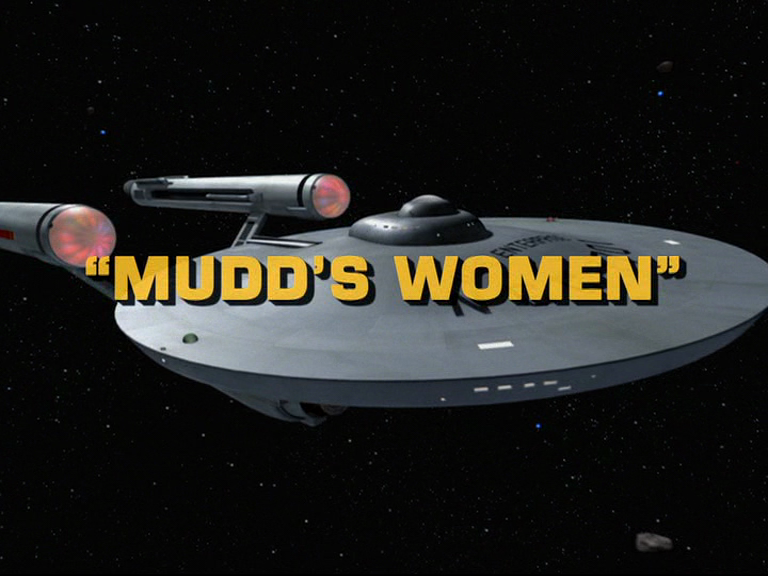
Mudd's Women


'THE WOMEN. Duplicating a page from the “old west”; hanky-panky aboard with a cargo of women destined for a far-off colony.' After Charlie X (and possibly Where No Man Has Gone Before) Mudd's Women becomes the next episode to have its roots in Gene Roddenberry's 1964 Star Trek proposal. The document known as Star Trek is... includes the first description of the series as a “Wagon Train” concept, or “Wagon Train to the stars” as Roddenberry later refined the phrase when pitching the series. Wagon Train being a series which ran from 1957 to 1965, and a good metaphor for the Enterprises' five year mission travelling from planet to planet without ever reaching a destination.

We'll never know whether thinking of Star Trek in terms of Wagon Train, and the history of the wild west more generally, was what gave Roddenberry the idea for The Women but that one sentence outline now sounds less like a plot for hijinks in space than this exchange from The Simpsons when the family visit a western ghost town.

GUIDE: Founded by prostitutes in 1849, and serviced by prostitute express riders who could bring in a fresh prostitute from Saint Joe in three days; Bloodbath Gulch quickly became known as a place where a trail hand could spend a month's pay in three minutes.
HOMER: Three minutes! [whistles]
MARGE: I never realized history was so filthy! 
GUIDE: First on our tour is the whore house; then we'll visit the cathouse, the brothel, the bordello, and finally the old mission.
MARGE: Oh, thank heaven!
GUIDE: Lots of prostitutes in there! 

Mudd's Women is at its most grating during act 1. Particularly when Eve, Magda, and Ruth slink through the halls of the Enterprise accompanied by sexy saxophone music, talking in breathy voices, and being ogled by the crew. The trio could be a batch of Austin Powers' Fembots; sadly without smoke coming out of their jubblies. We're only six episodes in but Star Trek has already treated its' female cast badly (go-go mini skirts, Yeoman Smith from Where No Man Has Gone Before and also Dr. Dehner brushing aside Gary Mitchell 's apology for calling her a “walking freezer unit” by telling him professional women can overcompensate, Rand's interrogation in The Enemy Within) and I don't trust the series to be doing anything except presenting these scenes at face value. 

Yet over acts two and three the script undercuts this disappointing start as Kirk, Spock, and McCoy begin speculating over exactly how these three women have got the crew of the Enterprise behaving like a bunch of horny frat boys. Well Kirk and McCoy at least. The script calls for Spock mostly to just react to events around him which Leonard Nimoy does very well, smirking and raising his eyebrows to demonstrate how these Earth emotions are far beneath him. The best moment comes when Kirk and McCoy hold an impromptu conference on the bridge and try to work out whether there could be a more sinister reason for the ladies being lovely; inter cut with shots of Spock eavesdropping and, once again, smirking and raising his eyebrows as if he's already got it all figured out and is waiting for everyone else to catch up. 

KIRK: What are they Bones?
MCCOY: You mean are they alien illusions that sort of thing?
KIRK: [as if realising what he's asked is ludicrous, but still wanting an answer] I asked you first.

Things fall apart a little in the last act when Eve realises she doesn't want a millionaire, just a man to care for her. The grumpy leader of the lithium miners discovers that he wants a wife not a clothes horse. And, Eve is tricked into finding out that believing in herself has the same effect as the performance enhancing Venus pills Mudd was giving her. Still, the scripts biggest weakness may be its insistence on constantly portraying Harry Mudd as a loveable rogue. He's not. He's a bastard who appears quite happy to let 430 people die when he tries to manoeuvre Kirk into choosing between the destruction of his ship or letting Mudd go free.

Enhancing the appearance of the episode is some stylish and unusual direction from Harvey Hart. From the opening moments of the teaser with it's low angles and use of a hand held camera it's obvious Hart is thinking about the end result and putting in more effort than other directors; later there's a striking match cut between Eve holding a Venus pill and Spock holding a burned out Lithum crystal. Hart seems fond of framing shots, and moving the camera, so lines come from actors positioned around the frame rather than the normal technique of cutting between close-ups and reaction shots. Sadly this seems to have resulted in a slower shooting pace than Star Trek could allow. Hart went one day over schedule and the producers also felt the resultant footage was difficult to edit. Hart wasn't invited back to Star Trek which is a shame, I'd love to have seen what he could have done with other scripts.

Enterprise crew deaths: None. Again. It's been a good couple of weeks for the Enterprise crew.
Running total: 17