Showing posts with label Arena. Show all posts

Thursday, April 10, 2014

The Savage Curtain

Genghis Khan runs away. That's the moment which best illustrates the flawed and silly nature of this episode. It might seem an odd moment to pick in a story which begins with Enterprise meeting Abraham Lincoln floating in space (never has that stock footage of the bridge screen over Sulu's shoulder looked more inappropriate he just carries on driving the Enterprise as if Abraham Lincoln floating in space is something he sees every other day). A story where Kirk and Spock are fighting for the safety of the Enterprise and their lives in a philosophical death match between good and evil. A battle set up by the rock monster inhabitants of the planet to determine whether good or evil is stronger. A battle in which Kirk and Spock are joined on the side of good by Abraham Lincoln and Surak the Vulcan against Genghis Khan; Kahless the Unforgettable "the Klingon who set the pattern for his planet's tyrannies"; Zora of Tiburon "who experimented with the body chemistry of subject tribes on Tiburon"; and Colonel Green " who led a genocidal war early in the 21st century on Earth."

Following the death of Lincoln, Kirk and Spock are attacked by the opposing four. In a sparsely choreographed fight Kirk grapples with Genghis Khan for a bit before throwing him to the ground and Genghis Khan runs away. That's Genghis Khan, who united the Mongols, and founded the Mongol Empire which stretched from the Caspian Sea to the Sea of Japan. Does Genghis Khan sound like the sort of person who would run away after a scuffle? Follow that thought. Does Genghis Khan sound like the sort of person who would meekly follow the orders of a weasel like Colonel Green? In fact isn't there something annoyingly simplistic about applying labels like "good" and "evil" to historical individuals as complex as Abraham Lincoln and Genghis Khan?

Fans of The Simpsons sometimes use the term Zombie Simpsons to describe new episodes of the series which seem to lack the heart and spirit of earlier shows. The Savage Curtain is Zombie Star Trek. The Savage Curtain constantly gives the impression of a story assembled by people who don't understand Star Trek but have a list of elements which have been used successfully in the past. It explains the characterisation of Genghis Khan or rather the lack of characterisation. Genghis Khan and Zora of Tiburon don't get any lines because there isn't enough space in the story for eight characters, nine if you include the Excalbian. The script isn't interested in Genghis Khan, or how he might react as a person, but simply wants to use the name "Genghis Khan" as a shorthand for "this person is bad." It also explains the treatment of Surak's pacifism. This is no story like Day Of The Dove where Kirk must ironically fight for an end to violence. The script isn't interested in examining pacifism as a point of view, or seeing how people who believe in it might be tested. It's just a label to slap on Surak which allows him to be killed in a way that demonstrates the evil of the baddies.

Like Arena there's an alien with ambiguous god-like powers who forces Kirk into a fight. Gene Coon shuffled the Metrons on and off screen as quickly as possible to avoid the audience thinking about them too much, they're nothing more than a plot device to set up the fight between Kirk and the Gorn captain, but in The Savage Curtain the rock-like Excalbian sticks around for the whole story. Kirk even challenges the Excalbian's motives at the end of the story and there's a bizarre attempt to claim some sort of moral equivalence between the two.

KIRK: How many others have you done this to? What gives you the right to hand out life and death?
ROCK: The same right that brought you here. The need to know new things.

Arena tests Kirk. He's alone and must use his wits to beat the Gorn. In The Savage Curtain he's part of a larger team and it's just a case of good and evil punching each other until one side falls down. In fact in The Savage Curtain even the fight itself is pointless. It's a fight to the death in a series where Kirk and Spock cannot be seen to kill. This is partly because the pair are heroes who cannot do anything too unheroic but mostly because NBC's Standards and Practices won't allow anything too graphic. Arena makes Kirk not being allowed to kill into a strength by having him spare the Gorn when it is at his mercy. The Savage Curtain simply glosses over the fate of the evil side by making it unclear what has happened. At one point Kirk jabs Kahless in the stomach with a blunt stick and the Klingon folds up on the floor in a foetal position. Is he dead or just winded? Then Kirk judo throws Colonel Green to the ground and we cut to an angle where Green's body is concealed behind a rock. There's an ominous musical sting, and Kirk looks grim, but again it's not clear if Colonel Green is dead or unconscious. This casual attitude to violence, and the consequences of violence, actually ends up being more offensive than if we'd seen Kirk directly taking the lives of Kahless and Colonel Green.

Undoubtedly everyone who's ever watched The Savage Curtain has had more fun thinking up unlikely battles for the Excalbians to stage (The Beatles vs The Monkees, or science vs religion). In the end The Savage Curtain is just another story to toss on the pile of episodes to laugh at.

Enterprise crew deaths: None.
Running total: 56

Saturday, December 7, 2013

Plato's Stepchildren

The teaser for Plato's Stepchildren is really effective. A lot of this is due to Alexander, played by Michael Dunn with a twitchy nervous energy. His opening info-dump packed lines should fall flat on the screen but he makes the exposition work by portraying Alexander as someone who just cannot stop his mouth from running. "...Platonians. I'm sure you've never heard of us. Our native star is Sahndara. Millennia ago, just before it went nova, we managed to escape. Our leader liked Plato's ideas Plato, Platonius. See? In fact, our present philosopher-king, Parmen, sometimes calls us Plato's children, although we sometimes think of ourselves more as Plato's stepchildren."

At this point we're barely 90 seconds into the episode and Alexander's character is already solidly established as someone a little odd and lacking in social skills; Kirk, Spock, and McCoy certainly think so judging by the look they exchange over Alexander's head as he rambles on and on, and the trio pretend to listen politely. When Alexander says, "excuse me, someone's waiting for you," and then twitches and dances backwards out of the scene it could be taken as yet another aspect of his strange character but it isn't. The Platonians have telepathic powers, and there's another nicely handled moment when Parmen snatches McCoy's hypospray and it floats through the air (it's a shame the cleaned up prints make the wires more visible). Finally the teaser ends not on a reaction close-up of the landing party as might normally be expected, but on Alexander in pain and worried.

This really should feel tired and second hand. Just another bunch of toga wearing demi-gods, as previously seen in
Arena and Who Mourns For Adonais? but instead it feels fresh. In the space of two and a half minutes the teaser sets up some intriguing characters and has the audience asking the question all good teasers should raise; what's going on here and what's going to happen to Kirk, Spock, and McCoy?

Act one continues the trend mixing nice understated moments, the contrast between Alexander's struggle to move his chess pieces and the effortless telekinesis of Eraclitus, and bigger moments like Parmen's telepathic delirium. Ultimately your opinion of the story will depend on how you view the later acts when Parman tries to force McCoy into staying by humiliating Kirk and Spock, and later also bringing Uhura and Nurse Chapel down from the Enterprise. Personally I find the humiliation scenes go on too long. They make up the bulk of act two and it's possible to go through a whole suite of emotions while watching; anger, embarrassment (for the characters), boredom, embarrassment (for the actors), horror, embarrassment (for yourself at the fear of being caught watching Kirk pretending to be a horse). Then, after act three provides a recovery period the humiliation scenes start up again, this time with Kirk and Spock dressed in vile red and green togas. It's difficult to know how to read these scenes. The audience is meant to be outraged at the Platonian's humiliation of the Enterprise crew for their own entertainment, but it's also being done for the entertainment of the audience. At what point does the sadism of the Platonians blur into titillation for the audience? Probably around the point where Parmen brings out the implements of torture and Spock menaces Nurse Chapel with a red-hot poker and Kirk starts cracking a whip around Uhura; had someone on the production team seen a bootleg copy of The Avengers episode A Touch Of Brimstone? It went into syndication on American television in 1969.

Apart from those togas what surprises most about the story is how lush it looks. It's easy to mock Star Trek's tendency to use the style of ancient Greece as a symbol for strange alien power, but being able to pull costumes and sets from storage must allow tight budgets to be stretched further than normal and the result is some visually pleasing, and surprisingly large and complex sets. Art director
Matt Jefferies has added a small square pond behind the main throne room, and behind that is a view of greenery and a horizon. The whole set has real depth and looks bigger than Apollo's temple in Who Mourns For Adonais? although it is almost certainly smaller. In addition director of photography Al Francis lights the sets beautifully and the result is a rich and colourful world. I can't help feeling guilty for criticising Al Francis in my review of The Tholian Web because here he does sterling work.

Ultimately it's not the big set piece scenes of act two and four which stick in the memory and make the episode work, it's little moments. Bruce Schoengarth the film editor uses some great reaction shots of Philana as she smirks or looks bored or disdainful; she gets surprisingly few lines but her regular reaction shots allow her a constant presence in the story. The slow realisation that Alexander's nervous desire to constantly please is due to hundreds of years of literally being pushed around. The two fops Dioniyde and Eraclitus who mock Kirk and Spock during the revels. "Oh, how faithless and fickle." "Make up your minds." The laughter and applause which accompanies the revels and makes those scenes feel like some bizarre sitcom. Liam Sullivan's delivery of Parmen's line, "how can you let this go on?" which ends act two and Leonard Nimoy's subdued and broken Spock at the start of act three; somehow more shocking than any of the indignities inflicted on him by the Platonians.

Enterprise crew deaths: None again, a six episode run of no deaths for the Enterprise crew.
Running total: 48

Sunday, October 6, 2013

Spectre Of The Gun

CHEKOV: Where are we now, Captain?
KIRK: Spock, evaluation?
SPOCK: Obviously this represents the Melkotian's concept of an American frontier town, circa 1880.
MCCOY: It's just bits and pieces. It's incomplete.
SPOCK: Perhaps the Melkotians have insufficient data about this era.
KIRK: Or perhaps this is all they require to complete the pattern of our death.

The set design is what elevates Spectre Of The Gun. Gene L. Coon's script is fun but run of the mill by his own standards. It's a mash-up of Arena (powerful aliens force Kirk into a fight to the death to punish him for trespassing on their territory, at the end Kirk's refusal to kill convinces them to give him a second chance) and A Taste Of Armageddon. Spectre Of The Gun and A Taste Of Armageddon both use the same mechanism to get the Enterprise crew into the story; the Enterprise trespasses into a sector of space against the express wishes of the inhabitants. In both cases Kirk is under express orders to make contact but his attitude couldn't be more different. In A Taste Of Armageddon Kirk displays clear contempt for Ambassador Fox and his orders, all part of making sure the audience find Fox as unsympathetic as possible, but here his attitude is pragmatic and Kirk displays a lot less concern for the welfare of his crew even though the Melkotian warning is more explicit than the Federation code sent from Eminiar VII. Surprisingly when Star Trek: The Next Generation wanted to spoof the then current vogue for Robin Hood films they ended up writing an episode very much like Spectre Of The Gun; a powerful alien creates a self-sustaining world and drops in our heroes.

The weakest element of Gene L. Coon's script is his use of Chekov who manages to fall
deeply in love during his short stay in fake-Tombstone despite knowing he is scheduled to die at 5pm. At the end of the episode he has this exchange with Kirk.

CHEKOV: What happened? Where have I been?
KIRK: Right here, it seems.
CHEKOV: But that girl. She was so beautiful. So real.
KIRK: Do you remember anything else?
CHEKOV: No.
KIRK: Good. Perhaps that explains why he's here. Nothing was real to him except the girl.

“That girl,” was so real to Chekov he can't even remember her name. There's always been a brash juvenile streak to Chekov's character, look at the opening scenes of TheTrouble With Tribbles and Chekov's attempts to impress Kirk, but here he spills over into outright immaturity and it's a mystery why Kirk displays such tolerance for the romance.

The stars of the episode are the sets. Faced with a workable script which called for either location filming or the construction of a Western town set, both unaffordable on Star Trek's third season budget, someone -probably Robert Justman or Matt Jefferies- came up with the idea of the half-constructed town. Director Vincent McEveety carefully uses the resulting sets to make Tombstone feel like a real place with its own dreamlike logic and rules.

Despite the half-constructed sets, no one leaps over any of the waist high walls or has a conversation with someone within a building. Everything is treated as if it were solid. Even the characters seem to appear and disappear when no one is looking. Watch the moment when the Sheriff first appears; on his line, “Ike,” he's already outside the closed door of the Sheriff’s office and walking towards the landing party as if he just popped into existence. Likewise, at the end of his first scene the Sheriff walks off the left-hand side of the frame and it's as if he disappears. A similar trick is pulled when the landing party enter the Tombstone bar. From the street the bar is clearly empty, but as the landing party walk through the doors it is suddenly full of people; including some sitting where they should have been visible from outside. It's a simple directing trick but it makes Tombstone feels strange and disorientating. What makes the moment more effective is that none of the landing party react to the sudden appearance of all these people. The disorientation is only there for the viewer. The set for the OK Corral at the end of the episode is suddenly much more solid and realistic. Possibly this was done to stop the climax from looking too fantastical, there is already the very theatrical effect of lightning casting shadows on the sky and the brilliant visual of bullet holes appearing in wood as the Clanton's fire at the unaffected landing party.

Enterprise crew deaths: None this week.
Running total: 48.

Monday, June 24, 2013

Is There In Truth No Beauty?

Each of the three core Star Trek directors had their own speciality. Marc Daniels' strength was making the most of the Enterprise sets, producing his best work on bottle shows like The Doomsday Machine, or Mirror, Mirror. Joseph Pevney was great at big set piece stories, ones with lots of location shooting like Arena, but he also had an excellent eye for composing individual shots as in Amok Time and the scene where Spock tries to explain the pon farr to Kirk (“The birds and the bees are not Vulcans, Captain”).

The Star Trek production team seem to have viewed Ralph Senensky as the actor's director and tended to give him scripts with lots of character moments; This Side Of Paradise and Metamorphosis. He also has an astonishingly good sense of cinematography. In script terms Metamorphosis is frankly dull. Like This Side Of Paradise it's a love story between two mismatched people but Cochrane and the Companion are no Spock and Leila. However regardless of the faults of the script the finished episode looks stunning and judged on its visuals alone the story would be one of Star Trek's ten best. Ralph Senensky's real strength appears to have been in inspiring the people around him to do their best work; in the case of Metamorphosis the art director Matt Jefferies, and director of photography Jerry Finnerman.

What's true for Metamorphosis is also true for Is There In Truth No Beauty? The episode looks stunning and there's a constant sense that Ralph Senensky is always looking for a more interesting angle. Most notably with his and Jerry Finnerman's use of a 9mm fish-eye lens to capture point of view insanity shots. However where Metamorphosis was dull, Is There In Truth No Beauty? is a much better paced story. Like The Enterprise Incident it is full of plot and keeps the attention of the viewer by constantly moving the story in new directions. Ultimately Is There In Truth No Beauty? is a better episode than The Enterprise Incident because the story is much neater. Where The Enterprise Incident ends up being overbalanced by the weight of too many coincidences, Is There In Truth No Beauty? carefully sets up its story. If Jean Lisette Aroeste's script has a fault it's a little predictable in places. In the opening Captain's log when the Medusians are described as, “beings who are formless, so utterly hideous that the sight of a Medusan brings total madness to any human who sees one,” it is immediately apparent that someone is going to see one and be driven insane. Likewise it's clear Ambassador Kollos' navigation skills will be required when Kirk later asks Miranda Jones, “do you feel any way may be found to employ Medusan navigators on starships? It would certainly solve many of our navigational problems.” One surprise the script sucessfully pulls off is the end of act three moment when Spock accidentally catches sight of the Medusan. Early on it is established that Miranda Jones is jealous of Spock's superior ability to mind meld with Kollos but it remains unclear if Spock/Kollos accidentally forgets to wear the visor when Kollos returns to his box or if, as Kirk later accuses Jones, she deliberately made him forget.

The cast are in fine form, and there are two excellent guest stars. Most obviously Diana Muldaur, back again after appearing in the earlier Ralph Senensky directed episode Return To Tomorrow. She makes Miranda Jones spiky and unpleasant without being irremediable. For half the episode Diana Muldaur is given the extremely difficult task of playing a blind character without giving away that her character is blind; her condition is not revealed until act three. The odd vulnerability Diana Muldaur succeeds in giving Miranda Jones is an accomplished piece of acting. More easy to overlook is David Frankham as Larry Marvick who makes the most of a smaller role. his sweaty hysteria once Marvick goes mad is really well done, especially his delivery of the oddly creepy line, “We mustn't sleep! They come in your dreams! That's the worst! They suffocate in your dreams!”
 
The two behind the scenes stars of the episode are film editor Fabian Tordjmann and George Duning who composed the additional music. Fabian Tordjmann's editing work on the episode is tremendous. Watch the scene where Larry Marvick is driven mad by Ambassador Kollos. In the 30 seconds between the slow zoom to Kollos' container and the shot of Miranda Jones sitting in her cabin there are something like 20 cuts, but the sequence is more than just simple rapid cutting. Everything works together to create a sense of dislocation; the lurid green light; the headache inducing animation; and cutting around within a single shot so that, for example, we see Larry Marvick twist in agony, before Fabian Tordjmann cuts back to the beginning of the shot and then suddenly to the end, so that Marvick appears to jerk around the frame as if time is out of joint. Played over the top of this is George Duning's frantic score. The discordant trumpet stabs and electric organ would sound ridiculous on any other episode, but perfectly fit the mood and pace of Is There In Truth No Beauty?

Act two encapsulates why Is There In Truth No Beauty? works as well as it does. Running at a brisk six minutes the pace never lets up and showcases the work of Ralph Senensky, Fabian Tordjmann, Jerry Finnerman, George Duning, and the cast. The act begins with a tracking shot following the now insane Larry Marvick as he runs from the Medusan Ambassador's quarters to a turbo elevator, and then cuts between Marvick heading to engineering with, first, Miranda Jones investigating the Ambassador's cabin, and then Kirk, Spock, McCoy and two security guards walking down the same corridor with the camera tracking backwards. There is no dialogue for the first minute of the act, but the mood is captured by the camera movement in the shots used, Duning's score, and the body language of the actors; David Frankham, distressed and disoriented; Diana Muldaur hesitant and unsure; and Kirk and the security team purposeful.

At this point I'm going to have to politely disagree with Ralph Senensky. Over on his blog he describes when he first saw the episode on television, “I was appalled. Who had ordered the horror film flickering green light and the comic strip animation?” I can understand why he feels they are an unnecessary addition to his director's cut. His opinion is that they represent a “vulgarizing technique [that] had never intruded into STAR TREK before." The green light and animation are b-movie techniques but I don't think Star Trek should be above using these techniques, and I also think they are an important part of why the episode works. The green light and animation give the audience a sense of something incomprehensible in the Ambassador's container. This is not just some rubber suited monster but literally something indescribable which the human mind cannot cope with, and it's important to have this conveyed with a visual cue.

Enterprise crew deaths: None this week. Although recurring extra Billy Blackburn does get punched in the face by the insane Larry Marvick.
Running total: 48.

Friday, April 26, 2013

The Ultimate Computer

Back in 1990 when the BBC finally decided to start showing Star Trek: The Next Generation I was watching Datalore with my parents. Within about a minute of Lore being reactivated my mum said, “I'll bet he turns out to be evil.” Some stories have a weight of inevitability about them. If a character develops a cough or a headache then they will be dead soon. In The Ultimate Computer it's obvious things are going to go badly from the moment Commodore Wesley tells Kirk the Enterprise will be used to test the new M-5 computer, and that all he has to do is, “sit back and let the machine do the work.”

Sure enough the M-5 goes berserk after mistaking simulated war games for the real thing and, as is always the way in these situations, Captain Kirk talks the M-5 to death. However, if the overall course of the plot runs on rails
The Ultimate Computer deserves some credit for taking an unexpected detour on the way. The first two acts are more character driven than might be expected in a rogue computer story as Kirk tries to cope with discovering that the M-5 really can do his job better. This still gives the story a weirdly contemporary edge. Who wouldn't worry about being replaced by a computer? It's odd to see Kirk so rattled. A man who has faced down Klingons and alien invasions, and generally shown himself to be a decision making machine, is faced with the prospect of being replaced by a machine better at making decisions.

MCCOY: We're all sorry for the other guy when he loses his job to a machine. When it comes to your job, that's different. And it always will be different.
KIRK: Am I afraid of losing command to a computer? Daystrom's right. I can do a lot of other things. Am I afraid of losing the prestige and the power that goes with being a starship captain? Is that why I'm fighting it? Am I that petty?

Kirk has dabbled with self-doubt before but it's never really convinced.

KIRK: I could've prevented all of it.
SPOCK: I don't see how.
KIRK: A walk in paradise, among the green grass and flowers. We should've beamed up at the first sign of trouble.
SPOCK: You are under orders to investigate this planet and this culture.
KIRK: I also have the option to disregard those orders if I consider them overly hazardous. This isn't that important a mission, Spock. Not worth the lives of three of my men. I drop my guard for a minute because I like the smell of growing things, and now three men are dead. And the ship's in trouble.
 
In that scene from The Apple Kirk's self-doubt is there to justify the Enterprise crew massacre which it follows. Three crew have been killed and the script needs Kirk to seem affected. It's an artificial script device because once Kirk has beaten himself up over the deaths of Kaplan, Hendorff, and Mallory it's never mentioned again in the episode; not even when Marple is also killed.

Kirk's self-doubt is handled much better in The Ultimate Computer . “I've never felt this way before. At odds with the ship. I sat there and watched my ship perform for a mass of circuits and relays, and felt useless. Unneeded.” It makes Kirk petty and he takes any chance he can to downplay the achievements of the M-5. “All it's done is make the required course changes and some simple turns. Mister Sulu and Mister Chekov could've done that with their eyes closed.” This time self-doubt is not an emotion he indulges in and forgets, it's a theme running through the first two acts. It humanises Kirk because we can relate to what he is going through. He's not declaiming, “why oh why didn't I realise this weird alien planet was alien and weird?” He's faced with the realisation that he is the best person he knows at doing his job, and yet the machine is better.

With this in mind it's interesting to see the end of act one used as a red herring. “Captain, I've located the source of the power shutdowns. It's the M-5 unit, sir. That thing's turning off systems all over the ship.” Scotty's line bluffs the audience into thinking M-5 is out of control. Throughout act one Kirk and the audience have seen the M-5 unit performing flawlessly. Kirk and the audience are both waiting for the M-5 to fail. Kirk because he doesn't want to be replaced in a job he loves, and the audience because they know the M-5 won't be around next week so it's due to be proved faulty at some point. When Daystrom discovers the reason for the shut downs in the opening moments of act two it's designed to confound audience expectations, “as I suspected, it is not a malfunction. M-5 was merely shutting down power to areas of the ship that do not require it.”

In a different episode the M-5 going mad would be the moment of crisis. Act one would have ended with the discovery that M-5 will not allow itself to be turned off and the remaining three acts would have been about the crew's attempts to disable the rogue machine. Instead of being the crisis point for the whole story the M-5 seizing control is the resolution to the plot about Kirk's fear of replacement, and also ups the stakes for the second half.

Ironically it's the characterisation which stops The Ultimate Computer from achieving it's full potential. Not the characterisation of Kirk, Spock, and McCoy which is spot on. In fact McCoy get all the best lines in the episode, and this is some of the best material he's given across the series. “Did you see the love light in Spock's eyes? The right computer finally came along.” The problem lies with the characterisation of the secondary characters which never quite seems right.

Commodore Wesley really dislikes Kirk. There's his “Captain Dunsel” comment (Dunsel apparently being an academy term for a part which performs no useful purpose) made over an open communicator so the Enterprise bridge crew, and possibly the crew in the other ships, can all hear him burn their captain. Then when the M-5 has taken over and is using lethal force during the war games Wesley believes it's Kirk who is out of control. “Jim. Have you gone mad? What are you trying to prove? Break off the attack! Jim, we have fifty three dead here... If you can hear us, stop the attack.” When the Lexington takes damage there's a shot of Wesley on the bridge asking, “what the devil is Kirk doing?” It brings to mind the season one story Court Martial where the other starship captains at Starbase 11 are all too willing to believe Kirk killed Ben Finney. Unfortunately the episode wants to end with a point about the M-5 lacking the human factor by having Wesley make a leap of faith, “the Enterprise looks dead. I'm going to take a chance he's not just laying a trap.” Kirk is gambling on Wesley's humanity, but if Wesley really thought Kirk had gone mad (and note the 'he' in Wesley's line about laying a trap) and murdered so many with his attack, then would Wesley show any compassion?

Likewise Daystrom is written a little off beam. He's great for the majority of the episode, acting exactly like a proud parent indulging his baby, and always trying to find the best motive for the M-5's increasingly bizarre actions. After the M-5 overrides the off switch Daystrom convinces himself it's in the best interests of the unit to not switch it off. When the M-5 destroys an automated ore freighter he describes this as, “minor difficulties,” and when the computer vaporises engineer Harper while directly tapping the power of the warp engines Daystrom tries to dismiss this as an accident. “The ensign simply got in the way.” However, no matter how wilfully blind Daystrom wants to be there is one moment he can't really ignore.

After the M-5 destroys the automatic ore freighter Kirk, Spock, and Daystrom head to engineering to turn off the M-5, only to find it has protected itself with a force field. “ It's not my doing, Kirk,” says Daystrom, and presumably this means the M-5 was not built with the ability to project force fields; this makes sense it would be rather like fitting airbags to a desktop PC. Still it's not just Daystrom who overlooks this new ability. Once M-5 has repelled Kirk, it's never mentioned again, in fact this amazing ability of the M-5 unit is demonstrated and then shuffled off screen as quickly as possible because it's a sticking plaster on the story logic. An easy answer to someone's question during script development wondering why Kirk didn't just head down to engineering with a phaser and melt the M-5 into slag. Sometimes these fixes make the story stronger, see By Any Other Name and the Kelvan's ability to distill humans into solid shapes which results in the memorable death of Yeoman Thompson, but here it fixes one story logic question only to raise another; why doesn't Daystom notice his computer can do things it was not designed or built to do?

Lastly there's M-5 itself which counts as a character because it's based on Daystrom's engrams. It's never clear why the machine goes mad. It just goes from coping with a surprise simulated attack, to taking pot shots at automatic ore freighters, before moving on to mass murder. Still there's enough slack built into the script to allow viewers to supply their own explanations. Given that Daystrom did imprint his own engrams on the machine it's possible that what we see is overconfidence. The M-5 is as frustrated, for want of a better word, at Kirk for constantly taking the Enterprise back under control as Daystrom, “you'll find it won't be necessary for you to regain control of the unit after it's completed each manoeuvre.” It sees the ore freighter as an opportunity to cut loose and show what it can really do. Overconfidence blinds the M-5 to the consequences of destroying the freighter, and once it realises what it has done it has no alternative but to protect itself by destroying any pursuing ship. 

It's easy to watch The Ultimate Computer and wonder what benefits Starfleet expected from the M-5. Yes the computer was incredibly good at small details, such as recalling personnel details even Kirk didn't have instantly to hand, and it could steer the ship as efficiently as a human navigator, and it was better in direct combat, but when have we ever seen the events in an episode hinge on one of those factors? It's difficult to see what advantages M-5 could have brought to the battle against the Gorn in Arena. How would it have dealt with the Kelvans from By Any Other Name or Apollo in Who Mourns For Adonais? But asking this question misses the point. The episode is not about why Starfleet would want to replace Captain Kirk with a computer, it's about what will happen when computers get clever enough to replace even Captain Kirk. Thematically The Ultimate Computer belongs with stories like The Return Of The Archons, or A Taste Of Armageddon where people's lives and deaths are planned centrally by a big computer. That seems to have been the future perception of computers in 1968. Not the internet, but a big central IBM computer which told you when to work, when to sleep, and when to eat your protein pills. This attitude is the reason Commodore Wesley demands to know what Kirk thinks he is doing when the M-5 attacks the war game fleet. The Ultimate Computer is warning that in the future the infallible computer will be your boss, and when it goes wrong you'll still get the blame.

Enterprise crew deaths: Just one, engineer Harper.
Running total: 46

Thursday, March 28, 2013

Top Ten

The Doomsday Machine
Mirror, Mirror
The Corbomite Manouver
Arena
Amok Time
Balance Of Terror
This Side Of Paradise
The Naked Time
The Devil In The Dark
The Trouble With Tribbles

The Trouble With Tribbles comes in at number ten but apart from that there are no changes from last time. For anyone interested, lurking all the way down the bottom of the list is The Apple.

Friday, March 8, 2013

The Immunity Syndrome

The Changeling, The Doomsday Machine, Obsession, and The Immunity Syndrome are four second season episodes which all share a similar plot. In each the Enterprise is both the first and last line of defence against a powerful single entity which will destroy billions if left unchecked.

In two of the stories the entity is a bizarre form of life. In the other two it is a machine. In two of the stories the entity is destroyed by anti-matter. Two of the stories begin with the discovery that entire solar systems have been wiped clean of life. In two of the stories the entity is a space vampire which can suck the life right out of you. Two of the stories use Herman Melville's Moby Dick as a character template. In two of the stories the entities are huge, rendering the Enterprise insignificant in comparison. In two of the stories the creature is about to reproduce. In two of the stories the menace has come from beyond the edge of the galaxy. In two of the stories the action takes place entirely on the Enterprise (and a third uses redressed Enterprise sets as a different location).

Any series will hit on themes and repeat them because they easily lend themselves to scripts. In the case of the four stories listed above it's a basic part of the Star Trek format that the Enterprise is out there on the front line by itself. A certain level of repetition is going to be an inevitable part of the set up of an episode. It's down to the skill of the writers and the production team to make sure individual episodes are distinctive, and don't just become an endless stream of clichés along the lines of David Gerrold's spoof storyline Green Priestesses Of The Cosmic Computer from his book The World Of Star Trek.
What matters is the difference between stories, not the similarities. How many times has the Enterprise run into a being with superior god-like powers? About ten, depending on how you define a being with superior god-like powers, but nobody would describe the Metrons in Arena as being the same as Charlie X. What is important about The Changeling, The Doomsday Machine, Obsession, and The Immunity Syndrome is how each episode differs from the others. So where The Changeling begins by sharing plot elements with The Doomsday Machine (after investigating a distress call Kirk must face off against an overwhelmingly powerful machine foe) the story surprisingly turns into a mechanical version of Charlie X where Kirk must act as a father figure to a massively powerful being and keep it happy until he can work out a way to neutralise the threat.

Purely in script terms The Immunity Syndrome is the weakest of these four episodes. What makes makes The Immunity Syndrome different is what its script lacks compared to the others. The Immunity Syndrome has no character like The Doomsday Machine's Commodore Decker. There is no attempt to develop a character by adding new back story, as with Kirk in Obsession. Unlike Nomad in The Changeling the space amoeba cannot talk. If the monster cannot be reasoned with, or bluffed, then the threat cannot be personified. It's a simple space monster waiting to be destroyed. The Immunity Syndrome is the story which comes closest to matching the basic plot outline given earlier; the Enterprise is both the first and last line of defence against a powerful single entity which will destroy billions if left unchecked.

However, sometimes less is more. The Immunity Syndrome is more narratively pared back than the other three stories and so there is actually less to go wrong. It's great that Nomad can talk, and come on board the Enterprise. Kirk can confront the menace rather than just staring at a view screen in awe. Unfortunately Kirk then goes on to defeat Nomad by confusing it with logic. Likewise with Obsession it's great that Kirk is given more back story and written as a man out for revenge, but midway through a weekly television series is not the best place to suddenly reformat your lead character as a watered down Captain Ahab in space. The Doomsday Machine remains practically perfect in every way.

So the script of The Immunity Syndrome is simple, and a little familiar, but fun. The Enterprise goes toe-to-toe with a giant space amoeba which can suck the life out of entire planetary systems , and is about to reproduce by binary fission. The remorselessness of mathematics means one amoeba will become two, and then four, and then eight, until the entire galaxy is as dead as the Gamma 7A system. A nice concept, and one which is well used.

Like The Changeling there is a mismatch between the being at the centre of the script, and the effect it has. The Changeling wanted the audience to be surprised at the power of Nomad being contained in such a small shell. In The Immunity Syndrome there is a mismatch between the simplicity of the amoeba and its ability to potentially wipe out all life in the galaxy. The script is able to carry this difference in size through to a nice metaphor comparing the amoeba invading our galaxy to a virus invading a body, with the Enterprise as the antibody.

Also, like The Doomsday Machine, small story telling tricks add to the believability although they are really there to make the script work. In The Doomsday Machine it is not practical for the planet killer to keep following the Enterprise. The script needs breaks in the action to move the story forwards and to give the characters a rest from being constantly chased. To get round this the planet killer is described as being programmed to ignore anything as small as a ship beyond a certain radius. This behaviour is there for solid plot reasons, but makes the planet killer seem more like a real object. It has a logic to its actions and its behaviour is predictable, like a real machine. In The Immunity Syndrome the amoeba is surrounded by a zone of darkness. The zone is really there for logistical reasons, to cut down the number of expensive and time consuming amoeba effects shots, but it also makes sense for an energy eating being to be surrounded by a zone of darkness. The thing even eats light! Although evidently it doesn't find light as nutritious as whatever energy it drains from lifeforms.

The zone of darkness also allows the slight plot to be stretched out, without making the episode seem padded. Acts one and two are about the mystery of the zone. What is it? What is the cause? Why do the laws of motion seem to be reversed? What is slowly killing the crew? The first two acts emphasise the exploration of the unknown, and the willingness of the Enterprise crew to put their lives on the line when required. Unfortunately it also makes for an episode which is less rewarding on repeat viewing. Once all the answers to the questions are known there's not much to concentrate on beyond some quality Spock/McCoy bickering, and Kirk having to decide which of his friends will be sent to their death in the shuttle.

Joseph Pevney directs and, rather like Ralph Senensky in Obsession, the Enterprise standing sets seem to mess up his ability to compose interesting shots. Generally speaking I've preferred Joseph Pevney and Ralph Senensky's direction to that of the other regular director Marc Daniels, but there's no doubt The Doomsday Machine is the better directed story when compared to Obsession or The Immunity Syndrome. The more generic approach Pevney uses here could be a result of the stricter time restrictions Senesky complained about when making Obsession; the insistence on completing shows in five and a half days. This isn't to say Pevney's direction here is completely flat. There's some nice naturalistic direction as Spock senses the destruction of the Intrepid (an odd name for a ship crewed by 400 Vulcans, does Vulcan not have its own starships?). McCoy and Kirk look as if they are about to start riffing on what it would be like to be on a ship full of Vulcans when Spock suddenly reacts with pain. McCoy is positioned to face Spock, but Kirk is looking forwards. As Spock groans Kirk's head snaps round, and he and McCoy stare at Spock as if unable to believe what they are seeing. For a fraction of a second the pair stand frozen, and then McCoy touches Kirk's arm and the two race across the bridge to Spock. Moments like this are few and far between. Film editor Donald R. Rode, who did excellent work on The Doomsday Machine, can't make much of the footage. It's a shame this was the last episode Pevney directed.

It's not possible to talk about The Immunity Syndrome without talking about the effects work on the space amoeba. It's brilliant. A high point for effects work on the series. No wonder Van Der Veer Photo effects shared an Emmy nomination for Star Trek special effects in 1969; although the series did not win. Interestingly outside of the space amoeba much of the effects work is cut to the bare minimum. This is possibly the only episode in which no one transports anywhere, and no phasers are fired. The limited resources of the show are virtually all concentrated on the amoeba. Of course the remastered versions have been able to expand the scope of the effects shots considerably, but it's very pleasing to note they largely settle for recreating what was seen in 1968.
Original
Remastered version
Original
Remastered version
The Immunity Syndrome also adds to the idea that outside of our galaxy is some sort of nightmare howling waste populated by hideous creatures and killer robots which are constantly seeking a point of entry. So far Star Trek has shown us the space parasites from Operation - - Annihilate!, the planet killer from The Doomsday Machine, and now a giant single celled life form capable of draining the life force from entire solar systems. No wonder Q thought mankind wasn't prepared for the unknown in the Star Trek: The Next Generation episode Q Who. Based on what Kirk has encountered so far Q was right.

Enterprise crew deaths: None again.
Running total: 43

Misc:

Robert Justman is messing around with the closing titles again. This week he uses a test shot of William Blackburn as one of Sargon's androids from Return To Tomorrow. In the photo Billy Blackburn is rolling his eyes up into his head which accounts for the android's slightly grotesque appearance. Also in the closing titles is a shot of a smiling Spock, also from Return To Tomorrow which I don't think was used in the episode.


Saturday, December 29, 2012

Top Ten

The Doomsday Machine
Mirror, Mirror
The Corbomite Manouver
Arena
Amok Time
Balance Of Terror
This Side Of Paradise
The Naked Time
The Devil In The Dark
The Galileo Seven

The impossible has happened. Not just one, but two episodes swoop in to displace The Corbomite Manouver from the position it has occupied since virtually the beginning of this blog. Even for the internet it would be too woefully self-indulgent to go into any detail about the unnecessary soul searching and doubt caused by this decision, but there you go; The Corbomite Manouver finally gets knocked off the number one spot.

Thursday, November 29, 2012

Metamorphosis

Given its pedigree Metamorphosis is a disappointment. Ralph Senensky, who filmed some beautiful footage for This Side Of Paradise, directing a Gene L. Coon script should be a dream combination but the end result is flabby and disappointing. Occasionally Metamorphosis feels like an episode where some crucial external context is missing. Read the story as a metaphor for interracial love rather than just a mismatched couple (he's an out of time space pioneer, she's an energy cloud) and it's easy to see how it might have felt more significant in 1967.

Imagine replacing the characters with the most obvious stereotypes possible. Cochrane is literally part of an older generation (the Companion has kept him alive and young for 150 years) so make him an elderly southern gentleman with a lone black housekeeper (the Companion) in an isolated house. Kirk, Spock, and McCoy visit, maybe their car breaks down, and they see the relationship between Cochrane and the Companion. The pair have fallen in love without realising it, but when Kirk articulates the relationship Cochrane reacts with the disgust you would expect from someone with his upbringing. “Do you know what you're saying?... It's disgusting.... Is this what the future holds? Men who have no notion of decency or morality?”

Was this racial parable what Gene L. Coon had in mind? Metamorphosis appears to be trying for some sort of allegory. Cochrane has an odd line at the end of the story, “I might try to plant a fig tree. A man's entitled to that, isn't he?” The fig tree suggests a biblical reference to Adam and Eve, but maybe this is investing the line with more significance than it deserves. It's perfectly possible to just want an episode written by Gene L. Coon (who wrote Arena and The Devil In The Dark) to be better and this scrabbling for meaning is a way of lessening the inevitable disappointment. Sometimes a fig tree is just a fig tree, and sometimes even good writers have an off day.

Kirk, Spock, and McCoy are on a shuttle carrying Federation Commissioner Nancy Hedford from Epsilon Canaris III, where Hedford is working to prevent a war, to the Enterprise so Hedford can be treated for Sakuro's disease before her condition becomes terminal. The shuttle is pulled off course and crashes. They meet a man who turns out to be Zefram Cochrane discoverer of the space warp, who is technically 237 but looks in his mid 30s. And there's a mysterious being called the Companion.

M
etamorphosis is packed with ideas but in an undisciplined way. Half a dozen plots are competing for space at the end of act one. The race against time for the dying Hedford and her work to prevent a war. The mystery of why the shuttle doesn't work when nothing is wrong. What is the Companion? The Rip Van Winkle/man out of time story of Zefram Cochrane. Kirk, Spock, and McCoy meeting an important historical figure who should be dead. The relationship between Cochrane and the Companion.

Over the next 35 minutes all those stories are whittled away until only the love story between Cochrane and the Companion remains. A good shape for a story is like a pyramid. Multiple plots at the beginning making a wide base which converge to the same point at the climax. When Edith Keeler steps onto the road in The City On The Edge Of Forever, it resolves several stories at the same time; Kirk and Spock's trip back to 1930; the search for McCoy; Kirk's love affair with Edith; the question of whether Kirk will sacrifice history for his love of Edith; restoring history to the right path. In Metamorphosis plot lines are simply discarded. Cochrane being the inventor of the space warp adds nothing to the story. It's just forgotten along with the idea that he is 237. For all the impact both plot threads have on the story Cochrane could have been no one special and crashed five years ago. The potential war on Epsilon Canaris III is dismissed by Kirk in a single line, “Well, I'm sure the Federation can find another woman somewhere who'll stop that war.” In the end Hedford effectively just dies, and she dies off screen. In The World Of Star Trek David Gerrold defines good drama as being about a character making a decision. Here we don't get to see Hedford decide whether she wants to die, or live but as a merged, and different, personality. Unfortunately the only person we do get to see make a choice is Cochrane who goes from disgust at the idea of loving the Companion to choosing a relationship, but only once the Companion is safely inside a human body. If Metamorphosis is a parable about interracial relationships then it undercuts its own message of tolerance. The deliberately stereotypical version outlined above would end with crusty old Colonel Cochrane only accepting the reality of his love once his black housemaid's brain was transplanted into the body of a southern belle.

Ralph Senensky proves his fantastic direction on This Side Of Paradise was no fluke. He works hard to inject visual interest into the story. Often he includes characters in scenes even if they have no lines. Senensky has Hedford stand in the back of a two shot of Kirk and McCoy as they discuss the mystery of Cochrane. Then later, at Cochrane's house, Kirk and Spock talk in the background as Cochrane sits right at the front of a shot. Most memorable is a much praised shot where Hedford/Companion lifts up a multi-coloured scarf and looks through it at Cochrane, seeing him as the audience saw him earlier when the cloud-like form of the Companion surrounded him.

As on
This Side Of Paradise, Senensky's eye for a good shot encourages the Star Trek technical crew to some of their best work. The unnamed planet of the Companion is the best studio interior world so far, it even has clouds in the sky; little puffs of smoke which go a long way towards making this look like a living world. It's brilliant work by art directors Rolland Brooks and Matt Jefferies. Director of photography Jerry Finnerman also does a tremendous job, using light and deep focus photography to add depth to planet surface shots. He also makes good use of lenses to make the sound stage seem huge. In the shot of Cochrane waving at the shuttle Kirk, Spock, McCoy, and Hedford look like tiny dolls. Film editor James D. Ballas can't really do anything to inject pace into the story but he handles little moments like the first reveal of the Companion in an unusual way. After McCoy and Kirk join Spock at the door of Cochrane's house we get a well composed shot of the trio looking out of the doorway. This is followed by a reaction shot of Spock, which then pans to Kirk and then to McCoy. Only then do we briefly see the Companion.

Metamorphosis shares one concept with The Devil In The Dark which makes the pair almost unique among Star Trek episodes. There is no outright villain. In both stories the real problem is an inability to communicate and see things from the other persons point of view. Metamorphosis may have been a miss for Gene L. Coon but he always had a very clear philosophical vision for the series.

Enterprise crew deaths: None, although it's unclear how Kirk accounts for the loss of Hedford. “She died en route to the Enterprise so we shoved her corpse out of an airlock,” seems most likely. Let's hope her family never asked any awkward questions.
Running total: 35

Wednesday, November 7, 2012

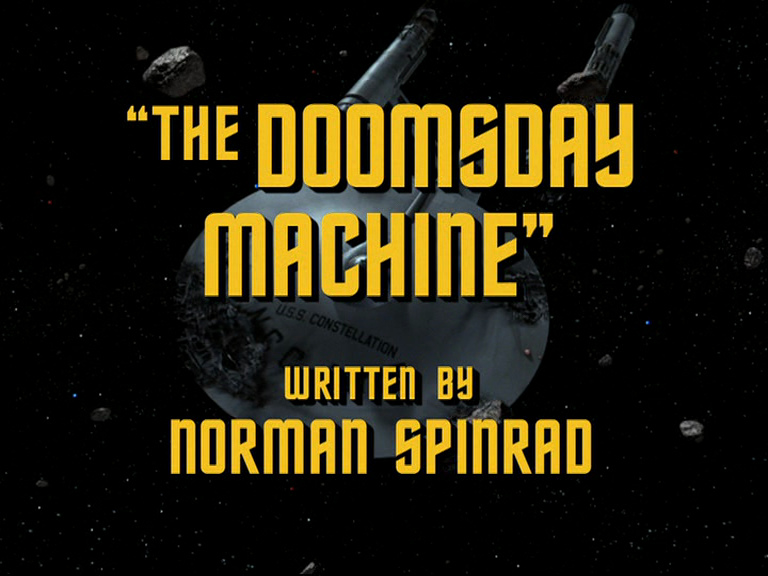
The Doomsday Machine

William Windom is brilliant as Commodore Matt Decker. It's probably the best performance by a guest star on a series not always notable for allowing guest stars to shine. Unless an actor is extremely good, or very lucky, they stand little chance of making an impression against Star Trek's regular cast and attendant science-fiction gubbins (winking lights, strange makeup, weird noises, bizarre creatures, etc). Pity poor Alfred Ryder credited as the guest star of The Man Trap when all the audience remembers is the salt vampire, or Robert Brown dropped at the last minute into a thankless role (technically two thankless roles) in The Alternative Factor and unable to make an impression against the special effects of that episode. There are actors who make Star Trek work for them. William Campbell, as Trelane in The Squire Of Gothos, and Ricardo Montalban, as Khan in Space Seed both take big central characters and make them their own. More impressively Mark Lenard, as the Romulan Commander with no name in Balance Of Terror, and Celia Lovsky as T'Pau in Amok Time both make very good impressions in considerably smaller roles than those given to Ricardo Montalban or William Campbell. Generally speaking though Star Trek tends to be a series which treats the guest star role as disposable. A slot which can be filled by simply giving the star something different to do (evil Kirk in The Enemy Within), or by a prop (Nomad in The Changeling), or a costume (the Gorn, Arena), or by not bothering with a guest star at all (Operation – Annihilate!).

William Windom is so good it comes as something of a disappointment to discover he thought the role, “seemed kind of silly, with the planet eater and spaceships. It's like doing a cartoon, so I acted accordingly!” As a fan, his blunt comment disappoints for two reasons. First because as a non-actor it's easy to assume an actor has to like the material to turn in a good performance (an assumption most actors would probably consider an insult to their professionalism). Secondly because The Doomsday Machine is great. It would be nice to think some of that greatness rubbed off on Windom and made him remember this job as different from the more run of the mill material. Still, it's a reasonable assessment from an actor with an amazingly long career, who seemed to regard television as the disposable portion of his work. The Doomsday Machine was one of ten jobs Windom had in 1967 (the others being parts in Run for Your Life, The Fugitive, Bob Hope Presents the Chrysler Theatre, Hour of the Gun, The Invaders, Custer, Gentle Ben, Dundee and the Culhane, and Judd for the Defense). Imagine how the job must have appeared from his perspective. Five days schlepping across Los Angeles to a soundstage at Desilu (a company past its prime), surrounded by the aforementioned blinking lights and actors in strange makeup, and being told to look scared at something the production team will add later.

There's a surprising similarity between Commodore Decker and Finney from Court Martial. Most obviously in both cases the production team dress the character in a gold coloured top, and give them stubble; apparently the ultimate sign in the 1960s of someone losing their mind. Both actors use the same performance style for their character; letting their voice crack, bulging their eyes, and making quick transitions between emotional states. The key difference is Windom's performance works while Richard Webb's seems melodramatic and over the top. Party this is down to the way each character is introduced to the audience. Court Martial spends a great deal of its running time telling us how everyone loves Finney; he's popular in Starfleet (certainly much more popular than Kirk judging by the welcome he gets at Starbase 11), and generally together enough to assemble (and fake evidence for) an elaborate revenge plot against Captain Kirk. When Finney is finally revealed as a ranting, barely in control madman there's a mismatch between what the audience has been told, and what they are shown, and Webb's performance seems wrong. By contrast The Doomsday Machine sets up two destroyed planetary systems, and a wrecked starship. After Matt Decker is introduced in a virtually catatonic state Windom's performance seems appropriate because his character has obviously gone through hell. Also, Windom is a better actor than Webb. That's not to run down Webb's performance too much because he's fine in Court Martial, but Windom is just astonishing.

KIRK: Matt, where's your crew?
DECKER: On the third planet.
KIRK: There is no third planet.
DECKER: Don't you think I know that? There was, but not anymore. They called me. They begged me for help, four hundred of them. I couldn't. I couldn't.

Windom brings those lines to life. His red-eyed, crumpled face delivery of “don't you think I know that,” is pure melodrama but it works perfectly and sets a doom-laden tone for the rest of the episode. It's no surprise to learn he used to self-deprecatingly refer to himself as Willie the Weeper.

It's the addition of Matt Decker to The Doomsday Machine which makes Norman Spinrad's script sing. His character defines the threat to the Enterprise, acting as a warning from the future of what Kirk could become if his luck ever runs out. Decker also doubles the threat to the Enterprise crew. There's the external threat from the planet killer, and the internal one from Decker who is obsessed with taking revenge against the machine which killed his crew. Decker's presence also makes Kirk more heroic. It's not accidental that Decker as a Commodore outranks both Spock and Kirk. If Decker was a mere Captain he would still be able to take charge of the Enterprise but there would be no drama in the scene where Kirk orders Spock to relieve Decker. It would simply be one Captain taking action against another, the scene only works because Kirk has to undercut the chain of command. The script also shows why Spock is a natural second in command. He knows Decker is wrong but he plays things by the book and follows regulations. He lacks Kirk's ability to make an intuitive leap and find another solution. Essentially Spock's plan is to keep confronting Decker with the facts until he listens to reason. “You tried to destroy it once before, Commodore. The result was a wrecked ship and a dead crew.” Spock doesn't understand emotion enough to realise that saying astonishingly brutal things like that don't help; especially not to someone still grieving over the deaths of 430 crew. The scenes where Decker assumes command of the Enterprise show what an asset Leonard Nimoy is to Star Trek. When Deforest Kelly yells, “do something,” Nimoy's stone-faced stare manages to project the impression that Spock's mind is going at a million miles an hour trying to find a way to relieve Decker of command; really Nimoy was probably wondering what to have for lunch.

The presence of Commodore Decker is also what separates the threat in The Doomsday Machine from the similar one posed by Nomad three episodes ago in The Changeling. Both are apparently unstoppable machines capable of wiping out planetary systems, and both pose a massive threat to the Enterprise. Apart from the difference in size, it's only Nomad's ability to talk which separates the two. The dividing line between good and average stories is very fine and it's easy to imagine transplanting elements from The Changeling into The Doomsday Machine. Nomad could easily have sterilized the Constellation crew, leaving Decker out for revenge and shocked by the threat posed by something so small. Or, Kirk could have beamed inside the planet killer and talked the controlling computer to death with illogic. Kirk is also dealing with a considerable ramping up of threat. Over the last year and a bit he's gone from dealing with a single salt vampire on the Enterprise, to planetary outbreaks of insanity, to machines capable of destroying entire planetary systems.

Marc Daniels, a solid workmanlike director, injects some flourishes into the bridge scenes. Most notably in a lovely tracking shot which starts on Sulu, follows a yellow shirted ensign round to Kirk who then walks in front of the bridge screen and around to Spock. Daniels must have been, understandably, proud of this shot as he repeats it with Kirk and Spock at the end of the episode. Film editor Donald R. Rode also does good work intercutting Kirk and McCoy searching the Constellation with Scotty and the damage control team examining engineering. He also manages to extend the final 30 second countdown to 90 seconds. Something which he makes tense, rather than silly, by cutting frantically between the Enterprise bridge, Scotty attempting to fix the transporter, the transporter room, exterior shots, and Kirk on the Constellation, “Gentlemen, I suggest you beam me aboard.”

Helping Donald R. Rode's cutting in the 30 second countdown is Sol Kaplan's astonishing score. As the planet killer closes on the Constellation, Kaplan gives us a pulsing rhythm which speeds up and increases the tension as the Constellation and the planet killer close on each other, and ends on cornets blaring as the planet killer is destroyed. Kaplan's music is what makes The Doomsday Machine such an outstanding Star Trek episode. It perfectly underscores big moments like Decker flying the shuttle into the planet killer's maw and small ones like the first sighting of the crippled Constellation. Just as important, Kaplan understands the value of silence. When the Enterprise is caught in the planet killer's tractor beam, and Spock threatens to relieve Decker on the grounds that his actions would amount to suicide, the whole scene plays out with no music, and instead the score is brought back on Sulu's line, “we're being pulled inside” to make the ending of act two more dramatic.

Kaplan also composes a theme for people using the transporter which leads to a great musical double-bluff as Kirk sets the timer running on Scotty's lashed up self-destruct system for the Constellation. In the build up to Kirk pressing the red button the music is playing the pulsing planet killer pursuit theme. As he presses the button a trumpet plays a little flurry which extends out into a single held note. The same note as the one which starts the already established transporter theme. As the film cuts to a shot of the transporter the music sounds as if it is making a transition between the theme for the planet killer and the one for the transporter and it tricks the audience into expecting to see Kirk beamed safely aboard. Instead the transporter gives out a puff of smoke, and the held note breaks up into a musical sting. Amusingly, Kaplan is the name of one of the unfortunate guards killed in The Apple (the 9th episode filmed, after The Doomsday Machine but shown the week before), he's the one zapped by lightning, maybe someone on the writing team was having a joke.

Enterprise crew deaths: None.
Running total: 34