Friday, March 9, 2012

The Enemy Within

The transporter was Star Trek's great innovation. A signature of the series created from the need to get the characters into the story as quickly, and cheaply, as possible and a simple but memorable visual effect. A straightforward jump cut -a shot of the empty set and the cast suddenly standing there-would have looked comical, like something out of I Dream of Jeannie or Rentaghost. A less abrupt cross fade would be fine, it's how the BBC made the TARDIS disappear in Doctor Who, but while it's cheap and easy, it's also a little dull. What makes the transporter effect work is the addition of another stage by Darrell Anderson, who designed and filmed effects for the Star Trek pilots and series. It's backlit aluminium powder filmed against a black cloth using an upside down camera so the grains seem to rise. It's visually interesting and has the advantage of not being obviously animated like the phaser beams and photon torpedoes which gives it a how-did-they-do-that factor for the watching audience at home.

Having added the transporter to the series it's inevitable writers would want to take the concept apart and see what happens when it goes wrong. Richard Matheson's script uses the transporter failure to examine the nature of good and evil as Captain Kirk is split in two; separating all his good qualities into one person and his bad qualities into another. Written down this reads more like a fairy tale than science-fiction; the sort of stunt the Snow Queen would pull. And yet while this script pushes Star Trek as far into fantasy as it has ever gone it never feels out of step with the rest of the series.

William Shatner is the focus of the episode and moment by moment the quality hangs on his performance. Most of the time he's very good but sometimes his acting choices -and those of the director- result in things being terribly overplayed. There's no better contrast than the two scenes on either side of the opening titles. Bad Kirk's first appearance is shot, and lit from below in close-up. Combined with Shatner's twitchy eye-rolling performance it looks like something from German expressionist cinema. It's comic not dramatic and the episode is almost fatally damaged before it even starts. On the other side of the titles, as the Captain's log narration talks about a duplicate being created, Shatner does little more than slowly walk off the transporter pad, roll his shoulders, and straighten up. The lighting is subtle so the shadows shift across his face as he walks and the effect is wonderfully creepy. Overall Shatner is better as good Kirk, possibly because he has fewer scenes by himself so there are less opportunities to emote like a silent movie villain, but also because he plays good Kirk with a tiredness, as if the energy that usually drives the Captain comes more from his bad half.

Fortunately Shatner keeps his performance restrained when bad Kirk hides in Yeoman Rand's cabin. Kirk's attempted sexual assault on Rand is all the more remarkable for being filmed at a time when NBC's Standards and Practices Department would send back script notes advising against characters kissing with open mouths. Unusually this scene is filmed with a hand-held camera making it
more claustrophobic and uncomfortable to watch. More uncomfortable still is the scene where good Kirk, Spock, and McCoy interrogate Rand in the wake of her assault. Rand is questioned by three men, one of whom is her Captain and supposed attacker, and while she stays seated the three men stand and tower over her. This scene is hard to watch not because of a failure in the writing, direction, or acting (Grace Lee Whitney is very good as the shocked and embarrassed Rand) but simply because of the way it presumably reflects wider social attitudes at the time regarding the acceptable treatment and interrogation of people who have been assaulted.

Richard Matheson has said the sub-plot of crew members stuck on a freezing planet, unable to beam up until the transporter is fixed, was added by the production team against his wishes. I don't want to disagree with the writer of I Am Legend but the script benefits from their presence. The trapped crew don't distract from Kirk's problem, they define it. When Kirk talks about the men trapped on the freezing planet he becomes almost hysterical, and at one point seems on the edge of tears. His bad side doesn't just contain his decision making abilities, it restrains his compassion and his empathy. Without that restraint the qualities that make him a good man overwhelm him and become weaknesses. The trapped crew members are also essential to keep the plot moving. With them trapped there is an obvious race against time to repair the transporter and rescue them before it is too late. Without them the race against time is to repair the transporter before Kirk loses the ability to command. Interesting as a metaphysical conceit but not so easy for the audience to care about.
  
Enterprise crew deaths: None, another good week for the crew. Some exposure, some frostbite, but the only death is the poor space dog who doesn't survive a trip through the transporter.
Running total: 17

"If we put a little hat on him, he'll look adorable."
Misc

It's tempting to pretend the real star of this story is Mr Sulu's space dog. A sad-eyed thing, dressed in orange fur, with a tail, horn, and space antennae. The poor dog has a mournful expression which suggests it knows no matter how many sausages it has been promised for good behaviour there just aren't that many treats in the universe to compensate for this humiliation.

Sunday, February 26, 2012

Sunday Plugging

2012 turns out to be the year of watching things from the beginning and blogging.

Over on Horsehair Nebula a Bond Watch is taking place. The CBS version of Casino Royale has already been reviewed and the films should be coming soon...

Meanwhile This Way Up is working through all 52 episodes of Blake's 7 at the rate of one a week. A nice round number but it does mean Christmas dinner could be spoiled by the garish nightmare that is Warlord.

Thursday, February 23, 2012

The Naked Time

There's an episode of Blake's 7 called Ultraworld where the spaceship Liberator is trapped by the Core, a living planet. Servants of the Core, the Ultras, want the technology of the Liberator and the crew will be added to Core's collection of brain prints. After Cally and Avon have their minds drained Tarrent and Dayna must prevent their crewmate’s bodies being fed to Core, restore the correct mind to the correct body, and then escape.

It's not difficult to imagine this as Star Trek. Substitute the Enterprise for the Liberator; Scotty and Yeoman Rand for Avon and Cally; Kirk and Uhura for Tarrant and Dayna (the Ultras want knowledge of “human bonding” added to Core's databank so there's even a “so tell me about this Earth thing called love” scene when they try to get Tarrant and Dayna tupping). Judged on its' own as a piece of television it's not bad. The story is exciting, there are some good jokes, some nice effects, and Cally nearly gets fed to a giant brain; an image guaranteed to grip the imagination of any seven year old watching. But it's poor Blake's 7 because it fails to engage with the characters, or use the elements which make Blake's 7 unique.

Likewise Star Trek has episodes which, while enjoyable, could easily belong to another series. In The Gamesters of Triskelion Kirk, Uhura and Chekov are kidnapped and forced to fight aliens for the entertainment of three multicoloured brains. Again not a bad story but not one to use as an example of Star Trek firing on all cylinders. Swap Kirk for Commander Koenig, Uhura for Doctor Helena Russell, and Chekov for Nick Tate and you've got a perfectly serviceable episode of Space 1999.

The ease with which you can visualise transferring an episode of one series to another isn't a foolproof way of spotting poor scripts -both of the examples above are at least good fun- but it is a starting point. If a writer is just going to squash established characters into his own plot, and fit the characters to his ideas rather than vice versa then even in the hands of a skilful writer an episode will struggle to be better than average, at most. And of course, generally speaking it's not going to be the skilful writers that cram Kirk, or Blake, or Commander Koenig, into their story, because they wouldn't be skilful writers if that was how they wrote scripts.

The Naked Time is the one glorious exception to this rule. It's the ultimate plug and play story. You have a concept, weird alien water causing space-drunkeness, and you fit the characters in around it. This could be an episode of any science-fiction series; Blake's 7, Doctor Who, Star Cops, Space 1999, Babylon 5, Star Trek: Voyager. Make the water demon blood and it's an episode of Buffy the Vampire Slayer. It doesn't matter because the emphasis stays firmly on the characters, and how they react, and what we learn about them. What do we learn about Kirk in The Gamesters of Triskelion? That he thinks it's bad to be kidnapped and forced to fight aliens for the entertainment of multicoloured brains. Well gosh! What do we learn about Kirk in The Naked Time? Loads.

We get to see him fret, and snap at Uhura when she is unable to switch off Lieutenant Riley's endless intercom performances of I'll Take You Home Again, Kathleen. He is a man struggling to remain composed even as his command falls apart in bizarre circumstances. Kirk, and Shatner's, best moment comes when he gets increasingly angry and hysterical before realising he too has also been infected by the alien water. We also get some insight into his character with a speech about how as Captain he is only allowed one love, the ship, but the impact of this scene is undercut by following too quickly on the heels of a similar speech from Spock about his mother. Leonard Nimoy also gets a very good scene where Spock has a private breakdown in the briefing room. In an unusual editing flourish the scene runs as an uninterrupted single shot for almost 90 seconds; a long time without a cut for Star Trek

If Spock is, metaphorically, the person who goes to a party and ends up sitting alone on the stairs at 3am crying then Sulu is the one who gets all hyperactive and overexcited. Sulu has the most memorable scene in The Naked Time. D'Artagnan in space, sword fighting down the Enterprise corridors. George Takei's enthusiasm and energy sell the scene and also provide cover for a nifty bit of character redirection. Up to this point Sulu has been Head of Astroscience (Where No Man Has Gone Before) and seen working in the botany section of the Life Science Department (The Man Trap). Here, suddenly, he's helmsman with this change of career covered by a single line from Lieutenant Riley “last week it was botany he was trying to get me interested in...” as if what we've seen Sulu doing previously is him flitting from hobby to hobby rather than another job. Someone on the production team has rightly realised it will be easier to get Sulu involved in plots if he is always on the bridge. Sulu's bout of space madness also leads to a brilliant joke in the next episode preview. Kirk's line,”question, could what happened down there to those people create any danger to this vessel or crew?” is followed by a jump cut to Sulu, half-naked and sweating, leaping forwards holding a sword. Kudos to Associate Producer Robert Justman and Assistant Film Editor Don Rode who were in charge of these previews.

The ending is the one part of the episode that disappoints. The build-up to the antimatter implosion necessary to break orbit is tense but the resolution, that the Enterprise has somehow also travelled back in time three days, feels like it has wandered in from another episode. It seems to be there to prime the audience to the idea of doing time travel stories but the audience has already accepted four episodes of other concepts without similar prompting. It's an unusual lack of faith in the audience from the production team.

Enterprise crew deaths: 1, Lieutenant Junior Grade Joe Tormolen.
Running total: 17


Misc:
The camera pushes forward as Scotty finishes cutting open the door to Engineering and as it does there is a nasty judder, and an audible thump. The camera's obviously rolled over something, or got caught, but the shot must have been deemed acceptable. It may have been the only take as it involves a pyrotechnic which would eat up time being reset. I guess the producers hoped it would be mistaken for turbulence from the collapsing planet or not spotted at all.

Saturday, February 4, 2012

Where No Man Has Gone Before

This is Star Trek's second pilot. Picked by NBC from three scripts (the other two being The Omega Glory, and Mudd's Women) and made more action oriented at their request. So while original pilot The Cage ends with then Enterprise Captain Christopher Pike accepting fantasy is sometimes preferable to reality Where No Man Has Gone Before ends with Kirk and new God Gary Mitchell having a fistfight.

If Charlie X is The Man Trap's brainy cousin Where No Man Has Gone Before is Charlie X's knuckle dragging older brother. Charlie X and Where No Man Has Gone Before tell different stories but both could have sprung from Gene Roddenberry's one line proposal for The Day Charlie Became God “The accidental occurrence of infinite power to do all things in the hands of a very finite man.”

Where No Man Has Gone Before may be less thoughtful than Charlie X but you can see how it persuaded NBC to buy the series. As an episode it's insanely ambitious. From the catalogue of expensive production techniques all that's missing is location filming. There are matt paintings, and planet exteriors, and interior sets, and shipboard action, and unique special effects sequences -including a really unusual optical zoom in the teaser as the camera pulls back from a star field to show Kirk and Spock watching it on a screen-, and new props (I don't think Kirk's phaser rifle was ever used again), and stunts, and fights, and special make-up. Also three guest cast members get killed off. Not just three nameless non-speaking extras but proper actors with lines. That's quite expensive. If I was a producer on a budget I'd remove the doomed Lee Kelso character and replace him with one of the featured cast; probably Scotty because Sulu is still head of Astrosciences in this episode. The Doctor can come in and say “Scotty's been choked unconscious, but he'll be okay.” and you've saved the cost of an actor. Penny pinching, but we're talking about an episode budgeted at $215,644 -against the standard first season budget of around $190,000 per episode- which ended up costing $354,974 (about $2,534,841 today). Incidentally, on the other side of the Atlantic the BBC was making Doctor Who and the four part story The Time Meddler was broadcast as Where No Man Has Gone Before was filmed. In 1965 100 minutes of Doctor Who cost £7157 or about £114,297 today.

So, what did Desilu Studios get for their money? The script for Where No Man Has Gone Before is entertaining but utterly routine. A standard story of absolute power corrupting absolutely. It has some nice moments. Kelso's death comes as a surprise because of a scene in the turbolift where Kirk and Mitchell mention him when he's not on screen. This doesn't often happen to one off characters who are not also the main guest star. It establishes the friendship between the three, makes Mitchell's later killing of Kelso more shocking, and ups the stakes in Kirk and Mitchell's fight. Which is why the producers didn't cut Kelso's character in the first place. Actually, if the producers did want to save money by cutting an actor they should have removed Yeoman Smith. It's a real nothing part which doesn't serve the plot and just makes Kirk and Mitchell both look unprofessional. Kirk can't remember her name and calls her Jones by mistake. Then Mitchell holds her hand as the Enterprise tries to break through the galactic energy barrier; the ship's at red alert, both hands on the steering wheel mister. Also, because Smith is standing slightly behind Mitchell he is forced to extend his arm back at a very awkward angle. It looks stupid and unnatural and is, presumably, at the instruction of the director because having her standing further forwards would mess up the framing of his shots. Apart from that moment the direction is quite stylish. Some interesting camera angles -an unusual overhead shot of Kirk and Spock entering a turbolift- and a great moment during the fade to commercial break between act one and two. Gary Mitchell's silver eyes linger on screen shining out from the black, I don't know if this is deliberate or just a happy accident of the fade to black process.

So what does happen to Gary Mitchell? The episode implies gaining the abilities of a god simply drives Mitchell mad with power but this has happened to other Star Trek characters without similar results. Commander Riker in Hide and Q is the most obvious example, but we've also seen Charlie Evans in the previous episode, who seemed to have comparable powers, and the Organians from Errand of Mercy. As Mitchell gains in power he becomes egotistical, cruel, and emotionally distanced from the crew. Maybe Mitchell is just unstable to begin with but if that's the case why does he say “Jim” in such a saddened and regretful way when his power is momentarily drained by trying to walk through a security force field? The Enemy Within shows us a transporter accident that splits Kirk into good and evil individuals. Maybe the energy from the galactic barrier performs a similar function, massively boosting the evil side of Mitchell's personality. For all his powers, Mitchell never displays any empathic ability like Counselor Troi from Star Trek: The Next Generation, and the one telepathic power which would seem to be rooted in the good side of a person's personality would be the ability to sense what others are feeling.

Enterprise crew deaths: 12. Nine unnamed plus Mitchell, Dehner, and Kelso.
Running total: 16

Sunday, January 22, 2012

Charlie X


If The Man Trap is Star Trek at its most exploitable then Charlie X feels like a deliberate attempt to go as far as possible in the opposite direction. A message from the production team to the audience; this new series can do more than just shape-shifting monsters. D.C. Fontana's script allows them to do this by taking a one sentence idea from Roddenbery's original proposal (“THE DAY CHARLIE BECAME GOD. The accidental occurrence of infinite power to do all things in the hands of a very finite man.” ) and turning it into a sweet, thoughtful piece.

Fontana's script comes across almost as a writing exercise. As if it was purpose written to push the boundaries of what an action series can do. Yes there's action but it's based on what characters say and do to each other. There are no phaser battles or punch-ups. Nobody says “fools, soon I'll crush you like the insects you are.” Charlie's not a monster. He's awkward, embarrassed, and wants to fit in. He also has the power to send you away if you upset him. He doesn't want to be taken to a planet to rule, but because he wants to be more human. The resolution is a teenage boy begging for help from people who want to offer it but know they cannot. Charlie X is the more thoughtful approach Star Trek: The Next Generation was groping for in it's first series when it wanted to differentiate itself from original Star Trek. Charlie X is also head and shoulders above any first series Next Generation episode.

As well as being  The Man Trap's brainy cousin Charlie X is also ideal for an audience still trying to get to grips with this new show. It's a character piece so everyone gets clearly defined motives and well written parts. Spock and McCoy support the Captain and get some banter which helps define their relationship. Kirk is at the centre of the story, which focuses on the relationship between Kirk and and Charlie, and is written as a father figure. Directly in the case of Charlie, but also in a more metaphorical way to the rest of the Enterprise crew. When Charlie gets obsessed with Yeoman Rand she takes the problem to Kirk and expects him to sort it out.

I've seen Rand's character criticised for not standing up for herself and not telling Charlie where to get off, particularly when he slaps her bottom, and that this is typical of Star Trek's poor treatment of female characters. This isn't really fair. Not in this case at least. Yes she could have told Charlie where to go, that she wasn't interested, and found him creepy and needy but she's being polite. She's well aware of Charlie's unique upbringing and is trying to make allowances. The pre-credits transporter room scene where Kirk asks Rand to take Charlie to his quarters is all about establishing how Rand feels sorry for Charlie and irritated by him in equal measure. When Charlie asks if Yeoman Rand is a girl Grace Lee Whitney makes the most of a nice opportunity for some comedy, looking crossly at the Captain, and then managing to reassemble her features into a facade of politeness before Charlie turns back to her. Rand taking her problem to Kirk is not girlie helplessness. It's a professional approaching a senior officer for help with an unusual situation.

Robert Walker Jr does a brilliant job of playing Charlie, getting through a lot of emotions in a short space of time. His real achievement is not making Charlie irredeemable. At the end of the episode he's killed at least 20 people and terrorised the Enterprise but he can still make you feel sorry for Charlie as he begs to stay among people. Other good moments include his throwaway delivery of lines that could easily be overplayed. “He had a mean look. I had to freeze him. I like happy looks” And a gag in the transporter room. After beaming across from the cargo vessel Antares Charlie approaches a door and jumps back in surprise when it swishes open. A clever way to clue the audience in on Charlie's unfamiliarity with the world he's entering and also, presumably, a hint that the crew of the Antares had to open their own doors.

Enterprise crew deaths: None this week. After Charlie's reign of terror the Thasians thoughtfully restore all the crew.
Running total: 4

Tuesday, January 10, 2012

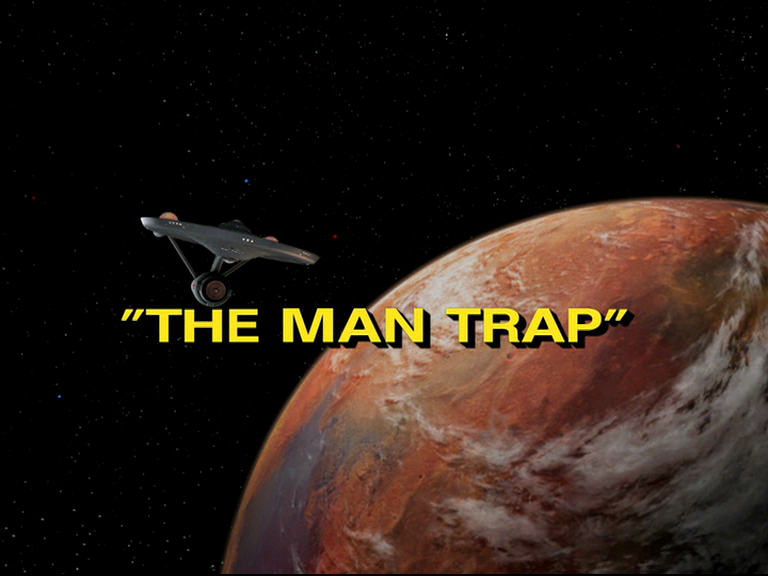
The Man Trap


How would this have looked in 1966? Impossibly weird or just another show set on a spaceship? It's easy to forget Star Trek did a lot of the heavy lifting for other television science fiction. When Roj Blake and his gang of freedom fighters find the Liberator in 1978 they can stand around discussing their new ship's teleport system knowing the viewer will accept it as one of those things from that show with Doctor Spock.

But what if you're a viewer in 1966? CBS has a repeat of My Three Sons and a Jerry Lewis film. ABC is showing The Tammy Grimes Show, followed by Bewitched. For some reason you don't fancy either of those so you switch to NBC. A voice-over tells you “Captain's log stardate 1513.1. Our position orbiting planet M113. On board the Enterprise Mr. Spock temporarily in command. On the planet, the ruins of an ancient and long dead civilisation. Ship's surgeon McCoy and myself are now beaming down to the planet's surface. Our mission...” And, in quick succession you see some sort of spaceship going round a planet. A weird guy in a blue top sitting in a room full of flashing lights looking at what might be a big window showing that planet again. And, 3 people appearing out of thin air in a sparkly glow. That's pretty much the first thirty seconds.

No attempt is made to ease the audience in gently. The closest thing to an explanation is Kirk's “space, the final frontier,” monologue. Even The Prisoner has an episode where Number 6 arrives in The Village and that's a series which takes pride in being wilfully obscure. Still, I'm not sure how exciting a purpose written first episode could be,” and this is the bridge... and this is Mr Spock, he's an alien from the planet Vulcan you know... and this is sick bay... and this is the transporter room....” With suspension of disbelief being such an important part of television science fiction maybe it's better to show the ship going about it's normal business. If this is all normal and routine to the crew maybe the audience will accept it even if they don't really get it at first.

So how did The Man Trap end up as the first broadcast episode? Herbert Solow (in the book Inside Star Trek) talks about meeting NBC in August to select the first episode from those that would be ready by September. The choices seem to have been The Man Trap, Charlie X, Where No Man Has Gone Before, The Naked Time, The Enemy Within, and Mudd's Women. The Man Trap and The Naked Time were the two serious candidates because they delivered on Kirk's promise of “strange new worlds” and The Man Trap was chosen. Associate Producer Robert H Justman suspected NBC viewed The Man Trap as “scarier and more exploitable” and pushed for The Naked Time but was overruled. Later he came to view The Man Trap as the better choice and I think he's right.

Look at what was available. Charlie X takes place entirely on the Enterprise and is a sweet, but slight, story about a teenage boy with psychic powers. Where No Man Has Gone Before was Star Trek's second attempt at a pilot, and is understandably a little rougher around the edges. The Naked Time is a great story but is about the crew acting strangely and so relies on the audience first getting to know the crew. It's also, and this is not a criticism, quite a funny episode which might raise false expectations about the rest of the series. The Enemy Within splits Kirk into good and evil versions; again not an idea with much traction until you know Kirk (also, do you want your first episode to be a transporter goes wrong story?). Finally, Mudd's Women is about space prostitutes.

The downside of choosing The Man Trap is it's a monster story. Not, like Arena or The Corbomite Manouver, a story which looks like a monster story to someone not paying attention. It's an honest to god monster stalking the ship killing the crew story. If you want people to take your new science fiction series seriously you probably don't want to start with one which makes it look like a monster of the week show. Especially not if your première is the day before the second series of Lost In Space starts. You can see why Robert Justman suspected NBC saw this as an exploitable episode. If you're not familiar with science fiction it probably most closely fits your expectations of the genre. Still, it's a good monster of the week story and manages to wrong-foot the audience slightly. As the last of its' species the salt vampire has some depth beyond the usual B-Movie “atomic fish beasts come to claim our Prom Queen”.

On the plus side, The Man Trap strikes a good balance between the characters. Kirk and Spock get to worry at the mystery of Nancy Crater while McCoy gets a lot of screen time from his relationship with Nancy and also when the shape shifting salt vampire doubles for him. Kirk and McCoy also get some good banter in sickbay. McCoy is explaining how crewman Darnell has had all the salt drained from his body and refers back to an earlier argument between himself and Kirk.

McCoy: Another error on my part
Kirk: (grins) I'm not counting them Bones, you in the mood for an apology?
McCoy: (smiles slightly) Forget it, I probably was mooning over [Nancy]
Kirk: (interrupts and turns suddenly businesslike) Perhaps you were

That wipes the smile off McCoy's face. It's a moment within the episode but it really sums up the complicated professional/personal relationship between the two. I also like Kirk's brusque “you bleed too much,” dismissal of Robert Crater when he pleads for clemency for the salt vampire.

Sulu, Yeoman Rand, and Uhura also get significant screen time. By the end of the episode we still haven't seen Scotty or had any real introduction to the abilities of the Enterprise; no warp drive, tractor beams, photon torpedos, or the Federation, but Spock does get to talk ominously about forcibly using truth serum on Robert Crater.

Enterprise crew deaths: 4. Crewmen Darnell, Sturgeon, Green and Barnhart.

Misc:

During the first sickbay scene there's something odd going on with the medical scanner in the background. At first it's blank but when the camera moves the red object in the picture above comes into view. It looks like someone left the cover off the medical scanner and we're seeing through the set and looking at some scaffolding.

UPDATE: Over on Gallifrey Base user Mr. Flibble told me the red object is the reflection of the medicine cabinet on the other side of sickbay. He's absolutely right. What confused me was the clarity of the object, there's not even the slightest distortion of the reflection and the way it glides in as the camera pans makes it look more like an object behind the set. Originally I wondered if the scanner screen might have been pulled out as a quick solution to the screen reflecting the camera crew, but that's obviously not the case.